
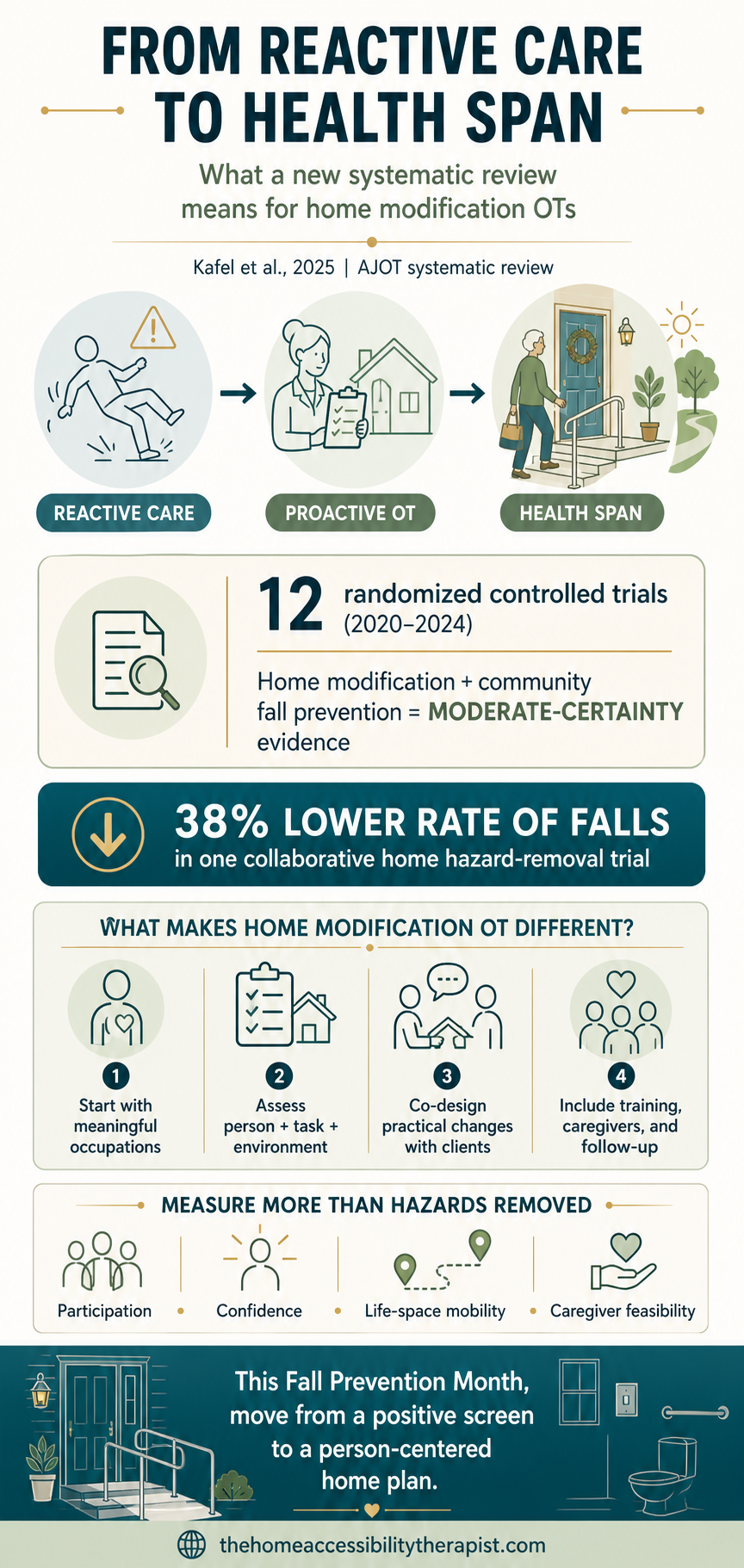

Fall prevention is often framed as a response to risk: a fall has occurred, mobility has changed, or a caregiver is struggling to keep someone safe at home. A new systematic review invites us to think more broadly. It positions occupational therapy as a proactive health-promotion profession—and it reinforces why home modification practice belongs squarely within that future.
For home modification occupational therapists, this is an important distinction.
We already know that environmental barriers can interfere with safety, participation, and independence. We see it in the older adult who stops using the shower because the transfer feels unsafe; the client who limits community participation because entering and exiting the home has become difficult; the caregiver who is physically straining during transfers; and the family that waits until after a fall, hospitalization, or crisis to consider changing the home.
But what if our work is not only about responding to these problems?
What if it is also about helping people preserve function, confidence, participation, and well-being before decline becomes entrenched?
A 2025 systematic review by Kafel and colleagues offers useful evidence for that broader view. The authors examined the effectiveness of occupational therapy interventions in adult health promotion and primary prevention. Their findings support what many home modification practitioners understand intuitively: when interventions are contextual, person-centered, occupation-based, and delivered by trained OT practitioners, they can contribute to meaningful health outcomes—including fall reduction, improved coping, physical performance, health-related quality of life, life-space mobility, and falls efficacy.
For therapists whose practice centers on aging in place, accessibility, home safety, and fall prevention, the implications are both clinical and strategic.
What the review examined
Kafel et al. searched PubMed, CINAHL, the Cochrane Library, ProQuest, and Wiley Online Library in February 2025. Using PRISMA 2020 methods, they identified 12 randomized controlled trials published between 2020 and 2024. The included studies evaluated occupational therapy–led or OT-aligned health-promotion and primary-prevention interventions across multiple populations and settings.
The intervention types were diverse:
- Home hazard assessment and environmental modification.
- Community-based fall-prevention education, skills training, and self-management.
- Workplace wellness and ergonomic interventions.
- Telerehabilitation, video-based exercise, and exergaming.
- Comprehensive environmental support addressing physical, social, and emotional factors.
- Digital self-management support.
Because the studies involved very different populations, interventions, durations, and outcomes, the authors did not combine results statistically. Instead, they used a narrative synthesis and rated certainty of evidence by intervention category using a U.S. Preventive Services Task Force approach. No category reached high certainty; however, home modification, workplace health-promotion, and community-based fall-prevention interventions each received moderate-certainty evidence ratings.
That nuance matters. This review does not establish that every occupational therapy health-promotion program will produce the same result. It does support a growing body of evidence that OT can play a meaningful preventive role when interventions are appropriately targeted, person-centered, and delivered with adequate expertise.
The finding most relevant to home modification
Three randomized trials in the review examined home-based environmental modifications for older adults at risk for falls or living with mobility limitations. Their results were not identical—which is exactly what makes the review clinically useful.
One trial of occupational therapist–led home hazard assessment and modification recommendations did not find a statistically significant difference in fall rates between groups. Another trial, however, used an adapted home hazard-removal program that incorporated education and collaborative decision-making with clients; it found a significant 38% reduction in fall rate compared with control. A third study combined environmental modifications with client and caregiver training and found significant improvements in life-space mobility and falls efficacy.
The takeaway is not that a checklist, a home visit, or a recommendation alone will reliably prevent falls.
The stronger message is this:
Home modification is most powerful when it is integrated into a collaborative, occupation-based intervention—not treated as a list of hazards or a catalog of products.
That conclusion fits the clinical reality of home modification practice. A client may agree that a loose rug is a hazard but still keep it because it is meaningful, aesthetically important, or part of a familiar routine. A family may install a grab bar but place it where it is least useful for the client’s actual transfer pattern. A recommendation may be technically sound but never implemented because the client cannot afford it, does not understand its purpose, does not see it as urgent, or experiences it as a threat to independence.
The environmental change matters. But how the recommendation is developed, prioritized, practiced, understood, and adopted also matters.
Beyond hazard removal
One of the most useful contributions of this review is that it challenges an overly narrow view of fall prevention.
The authors note that fall prevention may not improve quality of life if it is limited to physical risk management. Their synthesis points instead toward interventions that address participation, meaningful activity, environmental support, and the broader context of daily life.
For a home modification OT, this is familiar terrain.
Consider two ways to approach the same referral:
Approach one:
“Client has had two falls. Remove rugs, add grab bars, and improve lighting.”
Approach two:
“Client has had two falls while navigating between the bedroom and bathroom at night. Let us examine urgency, lighting access, footwear, visual contrast, transfer demands, furniture placement, the client’s use of their mobility device, medication timing, and the physical demands placed on their spouse.”
The second approach does not ignore hazards. It places hazards within the person’s occupational reality.
That is where occupational therapy adds value. The goal is not merely to reduce exposure to risk. The goal is to support safe, sustainable participation in what the person needs and wants to do:
- Shower independently.
- Reach the bathroom safely at night.
- Enter and leave the home with confidence.
- Carry groceries or manage deliveries.
- Use the kitchen and laundry areas.
- Continue gardening, hosting family, volunteering, or attending social activities.
- Reduce the physical burden on a spouse or family caregiver.
- Remain in a familiar home without giving up meaningful roles prematurely.
The review’s findings suggest that interventions rooted in occupational frameworks and delivered by trained OT practitioners were more effective than approaches that lacked that depth of professional expertise.
Timing is part of the intervention
Another important message is the value of earlier action.
Across several included studies, participants with lower baseline function appeared to benefit less from intervention. The authors interpret this pattern as a reminder that health promotion should be anticipatory—not delayed until decline has become pronounced.
This is especially relevant for therapists working in aging in place.
By the time a person is referred after repeated falls, hospitalization, caregiver burnout, or a major health change, the home may require extensive modification, the client may be fearful, and the family may be making decisions under pressure. In contrast, an earlier assessment may identify modest, manageable changes that preserve function and reduce risk before a crisis occurs.
This is not an argument for selling unnecessary modifications. It is an argument for helping people understand the relationship between changing abilities and environmental demands early enough to make informed, client-centered choices.
A proactive referral conversation
Instead of waiting for a fall, consider using questions such as:
- Has anything in the home become harder to do safely or independently?
- Are there rooms, stairs, or entrances the client has begun avoiding?
- Has the client started using furniture for balance?
- Has a caregiver begun providing more physical assistance?
- Is the client using a new mobility device without an evaluation of how it fits the home?
- Have vision, endurance, pain, balance, or medication routines changed?
- Could an assessment now help the client remain active and confident through the next season or health transition?
These questions reframe a home assessment as a health-promotion service, not simply a post-crisis response.
Practical applications for home modification therapists
The review’s findings can be translated into several concrete practice changes.
| Evidence-informed principle | Practical application in home modification practice |
|---|---|
| Personalization matters | Begin with the client’s valued occupations, routines, goals, concerns, and willingness to change—not a preselected product list. |
| Environment is one part of a larger system | Assess person, task, environment, caregiver context, health changes, routines, and supports together. |
| Collaboration supports implementation | Use shared decision-making to prioritize recommendations, discuss trade-offs, identify barriers, and create a realistic action plan. |
| Education should be tied to real tasks | Explain not only what to change, but why it matters in the client’s actual bathroom, entryway, nighttime route, stair routine, or kitchen activity. |
| Caregiver training can amplify impact | Include caregivers in transfer strategies, equipment use, pathway setup, emergency planning, and sustainable assistance routines—with client consent. |
| Timing matters | Offer preventive assessment pathways for clients experiencing early changes in function, confidence, mobility, or caregiver needs. |
| Participation is an outcome | Measure success beyond “hazards removed” or “falls avoided.” Ask whether the client can do more safely, confidently, independently, and consistently. |
1. Build recommendations around meaningful occupations
Use the home assessment to identify where the person’s goals and the environment are out of alignment.
For example, rather than asking only, “Are there stairs?” ask:
- What does the client need to do on each floor?
- How often do they carry items up or down?
- Can they use the rail while managing those items?
- Do they avoid stairs at certain times of day?
- What happens if they are tired, in pain, or using a mobility device?
- Is there a way to reorganize routines, storage, or the living setup so that essential occupations require less risk?
This expands the home-modification evaluation from structural features to occupational performance.
2. Move from recommendations to an implementation plan
The review’s mixed home-modification findings reinforce an important point: recommendations are not outcomes.
A clinically meaningful plan should clarify:
- Which recommendation is the highest priority and why.
- Who will complete it.
- What barriers may interfere with follow-through.
- Whether funding, landlord approval, installation support, or family coordination is needed.
- How the client will learn to use equipment or a modified environment.
- When the therapist will follow up.
- Whether the modification has improved safety, function, confidence, or caregiver burden.
For many clients, a staged plan is more realistic than a long list. Categorizing recommendations as address now, plan next, and monitor can reduce overwhelm and help clients act.
3. Make education active, not passive
The review included a community-based program in which education, skills training, and self-management strategies improved knowledge, strategy use, and fall-prevention behaviors among community-dwelling older adults.
For home-modification therapists, this supports moving beyond a written handout.
Instead of simply advising a client to use a shower chair, consider practicing:
- How to approach and enter the shower.
- Where to place hands and equipment.
- How to manage towels, soap, and clothing without unsafe reaching.
- How a caregiver can assist safely, if assistance is needed.
- How the new setup changes the client’s preferred bathing routine.
Likewise, do not only recommend lighting. Walk the nighttime path. Ask the client to demonstrate how they turn on the light, get out of bed, locate their mobility device, and navigate to the bathroom. The intervention becomes more relevant, more teachable, and more likely to be used.
4. Use caregiver inclusion intentionally
The review included evidence that pairing environmental modifications with client and caregiver training can improve mobility-related outcomes and falls efficacy.
Caregivers often know which activities are becoming difficult, but they may normalize unsafe assistance or hesitate to raise concerns. Include questions such as:
- Which tasks are physically demanding for you?
- When do you feel rushed or worried?
- What happens when you are not available?
- Does the current setup allow you to assist without lifting, twisting, or working in a confined space?
- What modification, equipment change, or routine adjustment would make assistance safer and more sustainable?
Caregiver needs should not override client autonomy. But ignoring caregiver safety and feasibility creates a plan that may fail quickly.
5. Measure participation, not just falls
Falls are important outcomes, but they are not the only outcomes that matter to clients or reflect the value of home modification OT.
The review highlights health-related quality of life, coping, physical performance, life-space mobility, falls efficacy, and participation as relevant outcomes.
In your own practice, consider tracking outcome questions such as:
- Can the client now complete the task they identified as important?
- Has the client resumed using a room, route, entrance, or community destination they had been avoiding?
- Does the client report greater confidence during a daily activity?
- Has caregiver assistance become less physically demanding?
- Has the client implemented the agreed-upon change?
- Is the new setup being used as intended?
- What remains difficult, and what needs to be adjusted?
These outcomes better reflect occupational therapy’s contribution to healthy aging and aging in place.
What this means for fall prevention
For Fall Prevention Month, this review gives home modification therapists a stronger evidence-based message:
Fall prevention is not only about preventing an injury. It is about protecting participation, confidence, roles, routines, and the ability to live well in one’s own home.
That message can be used in referral outreach, caregiver education, newsletters, community presentations, and conversations with clients.
For physicians and case managers, emphasize that a positive fall-risk screen should lead to more than generic safety advice. A home-modification OT can analyze how the person functions in the environment where daily life occurs.
For caregivers, emphasize that increased furniture-walking, avoidance of bathing, difficulty managing stairs, or greater reliance on physical help may be early signs that a change in the home—or in the routine—is needed.
For clients, emphasize that the goal is not to take away independence. The goal is to make valued daily activities more manageable and sustainable.
A practical call to action
This month, choose one client, referral source, or community audience and use the evidence to take one proactive step.
For your clinical practice
Identify one current client who has experienced a recent fall, near fall, increasing fear of falling, or a noticeable change in function. Revisit the case using these four questions:
- What occupation is becoming difficult, risky, or avoided?
- What has changed in the person, routine, caregiver situation, or environment?
- Which modification or adaptation would most directly support meaningful participation?
- What education, practice, follow-up, or collaboration is needed for the change to work in real life?
For referral development
Send one concise message to a physician, case manager, discharge planner, home-health agency, or community partner:
A positive fall-risk screen is the beginning—not the intervention. Home-based occupational therapy can identify how the person, daily routines, caregiver supports, and home environment interact, then develop practical modifications that support safety and participation.
For your Fall Prevention Month outreach
Create one piece of education that leads with participation rather than fear:
Has your home become harder to use?
If stairs, bathing, nighttime trips to the bathroom, entering the home, or everyday routines are becoming more difficult, a home-safety and accessibility assessment can help identify changes that support continued independence.
The evidence does not support a one-size-fits-all answer. It supports skilled, individualized occupational therapy that treats health promotion as more than a handout, a product, or a response to crisis.
That is the opportunity for home modification OTs: to help people make changes early enough—and thoughtfully enough—that home continues to be a place where life can be lived fully.
Reference
Kafel, T., Šuc, L., Skela-Savić, B., & Vidović, M. (2025). Effectiveness of occupational therapy interventions in health promotion and primary prevention for adults: A systematic review. American Journal of Occupational Therapy, 80, 8001205050. https://doi.org/10.5014/ajot.2025.051301
Author and AI-use disclosure
This article was developed by Sue Doyle, OTR/L, with limited assistance from generative artificial intelligence for literature organization and editorial drafting. The author reviewed the source article, provided the professional interpretation, completed substantive revisions, and approved the final version. Sue Doyle, OTR/L, is responsible for the accuracy, integrity, originality, and final published form of this content.
Leave a Reply