
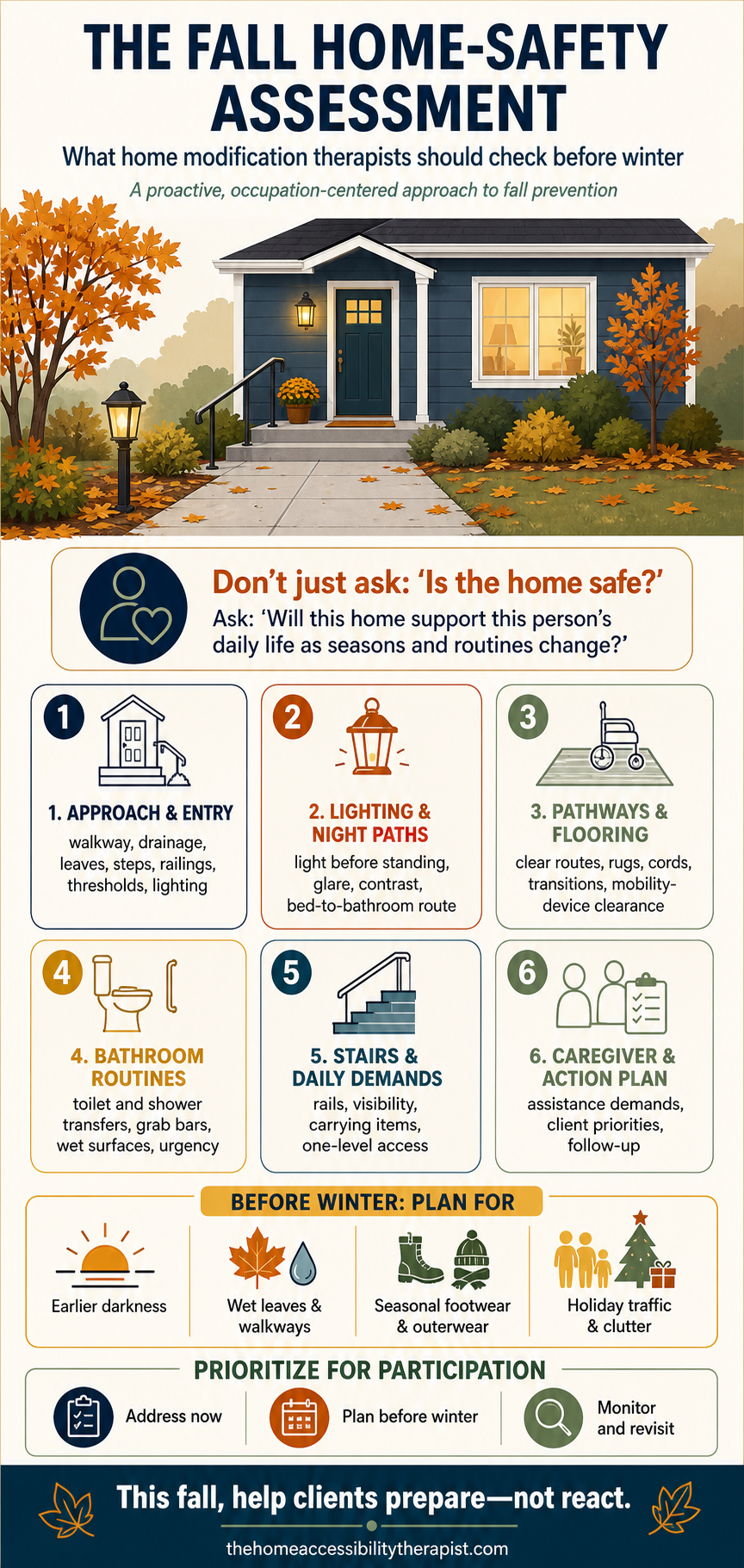

As daylight shortens, wet weather returns, and routines begin shifting indoors, fall is an ideal time for home modification therapists to help clients prepare—not react. A thoughtful seasonal assessment can identify environmental demands that may become more challenging in the months ahead and create a practical plan that supports safety, participation, and aging in place.
Fall is often described as a transition season. For home modification therapists, it is also an assessment season.
The home that supported a client well in July may present different challenges in October, November, and winter. Entryways become wet. Leaves cover uneven walkways. Outdoor lighting is used more often. Darkness arrives earlier. Boots, umbrellas, packages, and wet outerwear collect near the door. Clients may become less active outside. Holiday gatherings may increase clutter, traffic, transfers, and caregiving demands. In some regions, rain, ice, snow, or wind create additional barriers between the home and the community.
These changes do not automatically cause falls. But they can expose a mismatch between a person’s current abilities, the demands of daily occupations, and the home environment.
For home modification occupational therapists, the question is not simply, “Is this home safe?” A more useful question is:
Will this home continue to support this person’s daily life as seasonal conditions and routines change?
That distinction matters. A fall home-safety assessment is not a seasonal checklist of hazards. It is an opportunity to observe how clients enter and leave the home, manage clothing and equipment, move through familiar pathways in lower light, complete self-care routines, use mobility devices, manage fatigue, and respond when routines become less predictable.
The goal is not to make the home look institutional. It is to help clients preserve the occupations, roles, routines, and confidence that make aging in place possible.
Why assess before winter?
Falls are a significant concern for adults age 65 and older. More than one in four older adults falls each year, and falls are the leading cause of injury and injury-related death in this age group. Yet a fall rarely results from one isolated cause. It is more often the result of interacting factors: changes in strength, balance, vision, sensation, health status, medications, habits, footwear, task demands, environmental conditions, and available support.
The World Guidelines for Falls Prevention and Management for Older Adults emphasize multifactorial assessment and individualized intervention. This approach recognizes that effective fall prevention requires more than identifying a single hazard or handing someone a list of recommendations. It requires attention to the person’s health and function, the context in which falls occur, and the modifiable risks that matter most to that individual.
Home modifications are an important part of that work. Evidence reviews have found that environmental interventions designed to identify and address fall hazards in the home can reduce the rate of falls among community-dwelling older adults, particularly for people who are already at elevated risk.² A Cochrane review reported that home fall-hazard interventions probably reduce the rate of falls by 26% among community-dwelling older adults, with greater benefit in higher-risk groups.
But timing matters.
A client may manage a front step adequately during long, dry summer days yet struggle when it is dark at 4:30 p.m., wet leaves are present, and they are carrying groceries while wearing different footwear. A pathway to the bathroom may seem manageable until a nighttime urgency episode occurs in lower light. A shower-transfer routine that works during a period of stable function may become unsafe after illness, medication changes, pain, reduced endurance, or a decline in balance confidence.
The fall assessment allows therapists and clients to make adjustments while there is time to prioritize, plan, obtain equipment, arrange installation, involve family or caregivers, and practice new routines.
Start with seasonal occupations
A home assessment should begin with what the client needs and wants to do—not with a preset list of products.
Ask: What changes in this person’s life during fall and winter?
For some clients, the answer may involve:
- Leaving and entering the home in darker, wetter conditions.
- Managing wet shoes, boots, umbrellas, outerwear, packages, and mobility devices.
- Walking to the mailbox, parking area, garbage bins, garden, or community transportation.
- Carrying groceries, seasonal décor, laundry, or holiday items.
- Using stairs more often or differently as activity patterns shift indoors.
- Hosting visitors, staying with family, or managing increased household activity.
- Navigating nighttime toileting as darkness increases and routines change.
- Managing illness, fatigue, pain, depression, reduced activity, or seasonal deconditioning.
- Supporting a spouse, partner, or family member whose own mobility needs have changed.
These are occupational questions. They move the assessment beyond “Is there clutter?” toward “What does this environment require from the client when they are tired, rushed, carrying something, distracted, in pain, or managing a change in routine?”
A fall at the entry, for example, may involve surface traction and lighting. It may also involve the need to carry bags while using a cane, the absence of a place to set items down while unlocking the door, a threshold that is difficult to negotiate, wet footwear, reduced hand strength, impaired depth perception, or a rushing pattern created by bladder urgency or cold weather.
The therapist’s job is to understand the whole sequence.
Review the approach to the home
For many clients, the most important home-safety issue is not inside the home. It is getting into it.
The National Institute on Aging recommends checking outdoor steps and walkways for damage or unevenness, maintaining clear areas around porches and decks, using non-slip materials on outdoor stairs, ensuring adequate exterior lighting, and treating walkways with appropriate traction materials during winter conditions.
For a seasonal fall assessment, examine:
- The route from parking, public transportation, garage, driveway, or mailbox to the primary entrance.
- Surface condition, including cracks, uneven pavement, loose pavers, pooling water, moss, mud, leaves, snow, or ice risk.
- Drainage patterns around steps, landings, ramps, and exterior doors.
- Visibility of changes in level, curbs, thresholds, steps, and path edges.
- Exterior lighting quality, placement, glare, shadows, maintenance, and switch access.
- The presence, location, height, stability, and continuity of handrails.
- Whether steps and ramps are usable with the client’s mobility device, footwear, vision, balance, and carrying demands.
- The threshold and door-sill transition.
- Door hardware, opening force, storm doors, key access, and the ability to manage packages while entering.
- A stable surface or small table for setting down bags, mail, or a mobility aid while unlocking the door.
- A sheltered place to manage wet umbrellas, footwear, and outerwear without creating a slippery, cluttered interior bottleneck.
Do not assume that installing a rail resolves the problem. Observe how the client uses the route, if possible. Can they hold the rail while carrying an item? Do they have enough upper-extremity function and grip to use it? Is the rail located where balance support is actually needed? Does the path still work when it is dark, wet, or crowded?
For clients who use walkers, canes, wheelchairs, scooters, oxygen equipment, or other devices, include those devices in the observation. A clear path is not necessarily an accessible path. Surface texture, slope, turning space, drainage, doorway clearance, and device maneuverability all matter.
Assess lighting as a functional support
Lighting is often reduced to “add night-lights,” but a fall assessment should address lighting as a functional system.
The National Institute on Aging advises good lighting at the top and bottom of stairs and at both ends of long hallways, as well as easy access to light switches. For a home-modification OT, the assessment can go further.
Consider:
- Is light available before the client stands, steps, or turns?
- Can the client reach the switch from the bed, chair, doorway, or entry point?
- Are there dark zones along the route from bedroom to bathroom?
- Does the client experience glare from lamps, windows, shiny floors, or reflective surfaces?
- Can they distinguish changes in level, thresholds, steps, and floor-surface transitions?
- Are bulbs burned out, dim, mismatched in color temperature, or difficult to replace safely?
- Are outdoor entrances adequately illuminated during the client’s typical arrival time?
- Would motion-activated lighting, automatic controls, illuminated switches, task lighting, or better contrast support performance?
- Does the client use bifocals or multifocal lenses that may affect the ability to judge steps, curbs, and floor changes?
Remember that more light is not always better light. Glare, shadows, poor contrast, confusing reflections, and a sudden change from bright to dim lighting can all make navigation harder. The goal is not simply to increase brightness; it is to make the task and route easier to see and interpret.
The nighttime route deserves special attention. Ask clients to describe exactly what happens when they wake up to use the bathroom. Where is the light? What is the first thing they reach for? What do they wear on their feet? Do they use a mobility device? Is there urgency? Are there pets, cords, rugs, furniture edges, or floor transitions along the path?
A vague recommendation to “be careful at night” is not an intervention. A well-designed nighttime pathway can be.
Examine pathways and floor transitions
Pathways are not only circulation spaces. They are the routes through which daily life happens.
During the fall and winter months, indoor pathways may become more crowded with coats, boots, umbrellas, walkers, delivery packages, holiday décor, extra seating, pet supplies, or visiting family members. Seasonal changes can turn a previously clear route into a narrow, visually complex, or slippery space.
The National Institute on Aging recommends keeping pathways clear, securing carpets and rugs, and ensuring that cords and furniture do not create tripping hazards.³ These remain important starting points, but assessment should include functional observation whenever possible.
Review:
- The primary paths between bedroom, bathroom, kitchen, living spaces, entryways, and laundry areas.
- Flooring changes, thresholds, transitions, curled carpet edges, loose mats, or uneven surfaces.
- Clearance for walkers, wheelchairs, canes, and caregiver assistance.
- Furniture placement and the tendency to use furniture for balance.
- Storage patterns that encourage reaching, climbing, carrying, or walking while holding multiple items.
- Wet-floor risk at entrances, kitchens, bathrooms, and areas where footwear is removed.
- Seasonal clutter and whether the household has a plan for managing deliveries, holiday decorations, wet outerwear, or visiting children’s items.
- Visual contrast at changes in level and floor-surface transitions.
- Pets, pet beds, cords, and commonly used items that may migrate into pathways.
A client who “furniture walks” is giving important information. The behavior may reflect reduced balance confidence, fatigue, an inaccessible mobility device, insufficient support along a route, a layout that encourages unstable handholds, or reluctance to use a prescribed device in the home. The intervention may include environmental modification, mobility-device review, education, referral, behavior change, or several coordinated strategies.
The point is not to eliminate every object from the home. It is to create pathways that work safely for the individual and their actual daily routines.
Revisit bathroom safety and nighttime toileting
Bathrooms remain a high-priority area because they combine wet surfaces, confined space, transfers, turning, clothing management, urgency, fatigue, and privacy demands.
The National Institute on Aging recommends mounting grab bars near toilets and inside and outside tubs or showers, using non-slip surfaces in wet areas, and ensuring adequate lighting. However, a therapist-led assessment should move beyond the presence or absence of equipment.
Observe or discuss:
- How the client approaches, turns, and transfers onto and off the toilet.
- Whether toilet height, positioning, and available support match current abilities.
- Whether grab bars are appropriately located for the client’s actual transfer pattern and hand use.
- Shower or tub entry, stepping demands, balance requirements, and use of a bath seat, shower chair, tub transfer bench, or handheld showerhead.
- Bathing routines: standing tolerance, reaching, bending, shaving, washing feet, drying, and managing towels or clothing.
- Floor conditions, drainage, bath mats, and the likelihood of wet surfaces outside the shower.
- Whether the layout permits safe caregiver assistance when needed.
- Lighting, nighttime path access, and the client’s ability to use the bathroom without rushing.
- Urgency, continence concerns, constipation, diuretic timing, and other health issues that may influence nighttime safety.
A grab bar is not automatically safe because it is installed. Its value depends on location, secure installation, client use, transfer mechanics, and the relationship between the person, the fixture, and the task.
The fall season is also a good time to ask whether cold weather, heavier clothing, pain, arthritis flares, reduced activity, or illness change the client’s ability to manage toileting and bathing independently.
Consider stairs, transfers, and routine changes
Stairs are not just a structural feature. They are a repeated functional demand.
The National Institute on Aging recommends handrails on both sides of stairs, secure installation, good lighting, and attention to floor covering and visibility. In a home-modification assessment, consider the client’s full stair routine:
- How often are stairs used each day?
- Does the client need to carry laundry, meals, groceries, equipment, or seasonal items?
- Are both hands available for rails?
- Are steps visually distinct and adequately lit?
- Is there a landing or stable surface for rest or item placement?
- Does the client use a cane, walker, or other mobility device—and how is it managed on the stairs?
- Are there footwear, vision, pain, or endurance issues affecting performance?
- Does the client avoid a needed part of the home because stairs have become too difficult?
- Is a caregiver providing physical assistance, and is that assistance safe and sustainable?
- Does the home layout permit essential daily activities on one level if function changes?
Seasonal routines often make these questions more urgent. Clients may retrieve decorations from storage, carry heavier clothing, use basement laundry, host visitors, or make repeated trips to bring in food and supplies. A task that occurs infrequently may still be high risk if it requires carrying, reaching, climbing, or managing stairs without adequate support.
Include the caregiver and the care context
The home is shared by more than one person, even when only one person is identified as “the client.”
A fall-prevention assessment should include the caregiver’s role, abilities, physical capacity, time constraints, concerns, and willingness to assist. If a spouse is routinely steadying the client during shower transfers, helping them manage front steps, lifting a walker over thresholds, or carrying items while the client uses the rail, the caregiver’s safety is part of the assessment.
Ask:
- What tasks does the caregiver help with now?
- Which tasks feel physically difficult, rushed, or unsafe?
- What happens when the caregiver is unavailable?
- Has the amount of assistance increased?
- Is the home layout contributing to caregiver strain?
- Are recommendations realistic in the household’s financial, cultural, physical, and emotional context?
- Does the client agree that a change is needed, or do they see the recommendation as a threat to independence?
Client acceptance matters. A beautifully designed recommendation that conflicts with a client’s values, routines, aesthetics, identity, finances, or perceived priorities may never be implemented. Fall Prevention Month is a timely reason to begin these discussions, but it should not become a reason to pressure people into changes they do not understand or want.
Our role is to help clients make informed decisions and prioritize changes that protect what matters most to them.
Prioritize before recommending
Most homes contain more potential issues than a client can address at once. A useful fall assessment helps establish priorities.
Rather than presenting a long, overwhelming list, consider organizing recommendations into three categories:
Address now
These are issues with an immediate connection to the client’s current function, known falls or near falls, essential routines, or high-consequence risk.
Examples may include an unsafe nighttime path, a broken or absent handrail, an unstable shower transfer, a severely cluttered route needed for toileting, inadequate support at an entry, or a critical accessibility barrier after a recent health change.
Plan before winter
These are concerns likely to become more difficult when weather, darkness, seasonal routines, or health demands shift.
Examples may include exterior lighting improvements, drainage repairs, leaf and snow/ice management plans, accessible storage for seasonal items, weather-appropriate footwear strategies, an entryway drop zone, or equipment and modification planning that requires time for funding or installation.
Monitor and revisit
These are concerns that may not require immediate modification but warrant follow-up because of changing health, activity, caregiver availability, or environmental conditions.
Examples may include a client who is beginning to avoid stairs, a change in mobility-device use, reduced activity after illness, declining vision, increased caregiver assistance, or a pattern of furniture-walking that has not yet resulted in a fall.
This approach communicates that fall prevention is an ongoing process rather than a one-time inspection.
Build the fall-prevention team
Home modification is one part of a broader fall-prevention plan. Therapists should consider when collaboration or referral is needed for concerns related to balance and gait, medication management, vision, foot health, hearing, cardiovascular symptoms, continence, mood, pain, nutrition, cognition, or other health factors.
The U.S. Preventive Services Task Force recommends exercise interventions for community-dwelling adults 65 years and older who are at increased risk for falls. Depending on the individual, the broader plan may include physical therapy, primary-care follow-up, medication review, vision care, evidence-based balance and exercise programming, assistive-technology consultation, caregiver education, and community supports.
The home-modification OT brings a vital perspective to that team: How does the person actually function in the place where daily life occurs?
We see how a client gets out of bed, reaches the bathroom, enters the home, carries laundry, navigates a threshold, manages a shower transfer, or tries to continue a meaningful routine despite changing abilities. We can identify the environmental demands that may not be obvious in a clinic, office, or hospital setting. We can also help ensure that recommendations from the broader care team are realistic in the client’s home.
The value of a proactive assessment
Fall prevention is often discussed after a fall, an emergency department visit, a hospitalization, or a noticeable functional decline. Those moments matter, and intervention is essential. But the fall season gives therapists an opportunity to work earlier.
A proactive home-safety assessment can help clients and families:
- Recognize changes before they become a crisis.
- Prioritize modifications before weather and daylight conditions worsen.
- Prepare for more complex seasonal routines.
- Make decisions gradually rather than under pressure after an injury.
- Maintain confidence and participation at home and in the community.
- Reduce unnecessary caregiver strain.
- Build a plan that supports aging in place over time.
The most important question is not, “What hazards can we find?”
It is:
What changes will help this person move through the coming season with greater safety, confidence, and ability to do what matters?
That is the value of a fall home-safety assessment. It is not a checklist. It is clinical reasoning in service of everyday life.
References
Campani D, Caristia S, Amariglio A, et al; (2021). IPEST Working Group. Home and environmental hazards modification for fall prevention among the elderly. Public Health Nurs. (38)493–501. https://doi.org/10.1111/phn.12852
Clemson L, Stark S, Pighills AC, Fairhall NJ, Lamb SE, Ali J, Sherrington C. (2023). Environmental interventions for preventing falls in older people living in the community. Cochrane Database of Systematic Reviews Issue 3. Art. No.: CD013258. DOI: 10.1002/14651858.CD013258.pub2
Lektip, C., Chaovalit, S., Wattanapisit, A., Lapmanee, S., Nawarat, J., & Yaemrattanakul, W. (2023). Home hazard modification programs for reducing falls in older adults: a systematic review and meta-analysis. PeerJ, 11, e15699. https://doi.org/10.7717/peerj.15699
National Institute on Aging. (2022, September 12). Preventing falls at home: Room by room. https://www.nia.nih.gov/health/falls-and-falls-prevention/preventing-falls-home-room-room
US Preventive Services Task Force. Interventions to Prevent Falls in Community-Dwelling Older Adults: US Preventive Services Task Force Recommendation Statement. (2024). JAMA. 332(1):51–57. doi:10.1001/jama.2024.8481
Montero-Odasso, M., van der Velde, N., Martin, F.C., et al.. (2022). World guidelines for falls prevention and management for older adults: A global initiative. Age and Ageing, 51(9), afac205. https://doi.org/10.1093/ageing/afac205
Author and AI-use disclosure
This article was developed by Sue Doyle, PhD MSc(PP) BOccThy OTR/L, with limited assistance from generative artificial intelligence for literature exploration, content organization, and editorial drafting. The author selected and reviewed the cited literature, independently evaluated the accuracy and applicability of the content, provided the professional and clinical interpretation, and completed all substantive revisions. Sue Doyle, OTR/L, is the responsible author and accepts full responsibility for the article’s accuracy, integrity, originality, and final published form.
Leave a Reply