
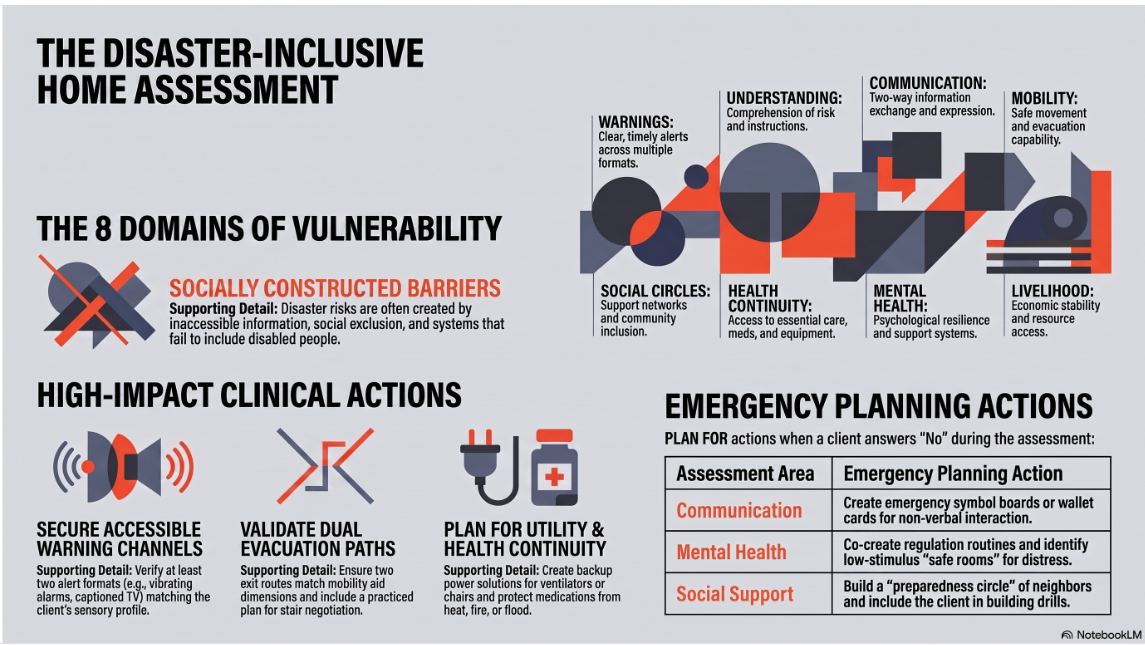
As home accessibility therapists, we spend a lot of time thinking about the everyday hazards that trip people up: the too‑narrow doorway, the slippery step, the dim hallway that hides obstacles. But increasingly, our work is also about the big events—the earthquake at three in the morning, the heat dome that will not lift, the smoke that creeps in around window frames. When we complete home assessments and plan modifications, we cannot afford to treat disasters and emergencies as a separate topic to “add on later.” They must be built in from the start (Nguyen-Trung et al., 2025).
A recent open‑access article by Nguyen‑Trung and colleagues (2025) offers a powerful reminder of why this matters. The authors look closely at how climate‑related disasters and extreme weather events impact people with different types of disabilities—mobility, visual, hearing, cognitive/intellectual, and multiple disabilities—within the very disaster‑prone context of Vietnam. Their findings speak directly to what we do in home accessibility practice, and they give us a clear map of the vulnerabilities we need to address in every home visit.

Disasters are not “equal opportunity” events
Nguyen‑Trung and colleagues (2025) combined a rapid evidence review of 33 studies with interviews and key informant conversations involving 78 participants, many of them people with disabilities themselves. Using thematic analysis, they identified eight socially constructed difficulties that people with disabilities face before, during, and after disasters:
- Barriers to accessing disaster risk information and warnings
- Difficulties in understanding emergencies
- Challenges in communicating needs
- Evacuation and mobility hurdles
- Decreased sense of belonging and isolation
- Increased risk of getting sick
- Increased risk of developing mental health and behavioural disorders
- Disrupted livelihood and loss of income (Nguyen-Trung et al., 2025).
What stands out is that these are not just “medical” problems. They are created and magnified by inaccessible environments, social exclusion, and systems that fail to include disabled people in planning. That’s exactly the territory where home accessibility therapists can make a difference (Nguyen-Trung et al., 2025).
1. Accessible warnings: can you even know there is an emergency?
One of the clearest themes in the article is the difficulty many participants had even knowing that a disaster was coming. Deaf participants often relied on family or neighbors to tell them about floods or storms, because official warnings were delivered via sound‑based alerts, TV broadcasts without adequate sign language, or small on‑screen interpreters scheduled late at night. People with visual impairments struggled with highly visual TV weather forecasts that lacked clear verbal description, and many in rural areas depended on village loudspeakers or family members to relay messages (Nguyen-Trung et al., 2025).
When we walk into a home for an assessment, we see the grab bars and thresholds. But do we ask, “How do you get emergency alerts?” We should. A disaster‑inclusive home assessment includes looking at:
- Whether the person’s usual alert channels (text, phone, TV, apps, loudspeaker, neighbor knocks) match their sensory and cognitive abilities (Nguyen-Trung et al., 2025).
- Whether there are at least two accessible pathways for warnings—for example, captioned local news plus a vibrating/visual alarm for someone who is Deaf, or loudspeaker plus clear verbal description for someone who is blind (Nguyen-Trung et al., 2025).
It is a small shift in our interviews, but for the person who would otherwise sleep through a flood warning, it is a life‑saving one.
2. Understanding emergencies: what does “danger” look like?
Access to information is only part of the picture. For people with cognitive or intellectual disabilities, the article highlights that the main challenge in disasters is making sense of what is happening and deciding what to do. In interviews, parents described children who relied entirely on adult guidance to evacuate, with no ability to judge danger or make independent decisions (Nguyen-Trung et al., 2025).
In practice, this means that when we work with clients with cognitive or intellectual disabilities, we must bring disaster scenarios into our routine planning. The same tools we use for daily living—visual schedules, social stories, simple step cards on the fridge—can be adapted to create “earthquake routines,” “flood days,” or “heat wave plans.” Instead of assuming emergency instructions will be understood in the moment, we help families embed these scenarios into familiar routines and rehearse them (Nguyen-Trung et al., 2025).
3. Communicating needs: who speaks for you when you can’t?
Nguyen‑Trung et al. also report that people with hearing and cognitive disabilities often struggle to communicate their needs in emergencies, especially when they do not know sign language or rely on family interpreters. Some participants described relying entirely on spouses or parents to explain what they needed; others were too shy or fearful to use body language with strangers in a crisis (Nguyen-Trung et al., 2025).
From a home accessibility perspective, this points to a simple but often overlooked step: helping each person develop a way to communicate their needs if their usual speech or devices are not available. This might be:
- A wallet‑sized card with key information and needs written in clear language.
- A laminated symbol or phrase board kept with the emergency kit.
- Teaching family members a few agreed‑upon signs or phrases that can be used quickly with responders (Nguyen-Trung et al., 2025).
During assessments, we can ask: “If your communication device broke, or the power went out, how would you explain what you need?” Then we design supports around the answers.
4. Evacuation and mobility: the doorway is not the only problem
Unsurprisingly, evacuation and mobility hurdles were prominent across mobility and visual disabilities. Participants described difficulties navigating stairs, narrow spaces, and flooded areas; some families lacked basic means such as boats to leave their homes. For people with multiple disabilities, evacuation was even more complex, especially when shelters were too crowded or inaccessible for families to stay together (Nguyen-Trung et al., 2025).
We already think about movement when we redesign a home, but disaster scenarios expand the frame. A disaster‑inclusive assessment asks:
- Can the person safely and realistically use at least two exit routes from the home, given their mobility aids and endurance?
- Is there a plan for multi‑story evacuation—who assists on stairs, what equipment is used, how is this practiced?
- In flood‑prone or wildfire‑prone areas, who is responsible for transport, and is the vehicle truly accessible in an emergency?
We can link these questions directly to our modification recommendations: path clearance, ramp installation, stair strategies, and identification of a “safe transfer zone” near exits.
5. Isolation and belonging: who is in your preparedness circle?
The article shows that disasters often disrupt social relations, reducing participation in community activities and leaving people at home instead of in training or meetings. Some participants with mobility or visual disabilities reported staying home during floods and storms, limiting contact with friends and neighbors. Interestingly, deaf participants in urban areas sometimes maintained online connections and did not report social abandonment, reminding us that vulnerability is not uniform (Nguyen-Trung et al., 2025).
In our practice, we can respond by explicitly exploring social support as part of disaster planning. We might ask:
- “If something happened, who would check on you?”
- “Are you included when your building does fire drills or your community runs emergency trainings?”
Where the answers are thin, we help families create a “preparedness circle”—neighbors, friends, faith communities, or local disability organizations—and encourage inclusion in events and drills. Social belonging becomes a safety feature, not just a nice‑to‑have.
6. Getting sick: health, hygiene and the invisible impacts
Nguyen‑Trung and colleagues (2025) found that disasters and extreme weather events increased health risks, especially for people with mobility disabilities who lost access to power, clean water, or hygienic conditions. Participants described evacuations to homes without electricity or clean water, aches and sleep difficulties, and heightened vulnerability to infection after floodwaters receded. People with visual and intellectual disabilities also reported worsening health in extreme heat or changing weather (Nguyen-Trung et al., 2025).
A home assessment can incorporate this by reviewing:
- How medications, assistive devices, and health‑critical supplies are stored and protected from flood, fire, heat, and power loss.
- Whether there is a backup plan for power‑dependent equipment, including batteries, backup locations, and utility priority lists.
- How hygiene needs will be met if the person must evacuate to a shelter or friend’s home, particularly for women and people with mobility impairments.
These conversations can feel personal, but they are central to preserving health in crises.
7. Mental health and behaviour: planning for emotional storms
The article devotes attention to mental health and behavioural impacts, especially among people with intellectual disabilities and those with multiple impairments. Families described episodes of aggression, destruction, and intense distress during heat waves and heavy rains, sometimes needing to restrain a family member for safety. A participant with visual disabilities spoke of feeling like “dead weight” in extreme weather, highlighting the psychological burden (Nguyen-Trung et al., 2025).
As therapists, we are familiar with sensory profiles and behavior support plans. Disaster preparedness is simply another context where those skills apply. We can:
- Identify triggers that are likely during disasters (heat, noise, crowds, confinement).
- Co‑create calming spaces and routines that can function during emergencies: a low‑stimulus room, sensory tools, predictable steps.
- Integrate disaster scenarios into existing behavior plans, so caregivers are not improvising under stress.
By doing this, we help families anticipate emotional storms as well as environmental ones.
8. Livelihood and recovery: protecting roles and work
Finally, Nguyen‑Trung et al. show that disasters disrupt the livelihoods of people with mobility, visual, and hearing disabilities who work in roles like masseurs, barbers, tailors, and shopkeepers. Floods and storms damaged furniture and tools, forced closures during power outages and extreme heat, and reduced income to “a couple of million VND a month,” in one barber’s words (Nguyen-Trung et al., 2025).
Many of our clients work from home, run micro‑businesses, or have key roles that rely on accessible space and equipment. In our assessments, we can ask:
- “What in this home is essential for your work, volunteering, or daily roles?”
- “What would it mean if you couldn’t use this space or equipment for a week?”
Then we design modifications and plans that protect those elements: elevating equipment, adding surge protection, planning alternate workspaces, and linking clients to community recovery resources where appropriate (Nguyen-Trung et al., 2025).
Bringing it together: a disaster‑inclusive home assessment
The eight themes identified by Nguyen‑Trung and colleagues are not abstract research findings. They are a practical checklist for us:
- Can you receive warnings?
- Can you understand what they mean?
- Can you communicate your needs?
- Can you move to safety?
- Are you connected to others?
- Can you stay healthy without your usual utilities?
- Is there a plan for your emotional and behavioural responses?
- Will your work and roles survive the disruption? (Nguyen-Trung et al., 2025)
At The Home Accessibility Therapist, our Disaster Preparedness Course is designed to walk clients and families through each of these questions in depth, with concrete tools and practice. When we step into a home for an assessment, we carry that same framework with us. We don’t wait for a “disaster specialist” to arrive later. We start where we always start—with the home, the person, and the realities of their daily life—and we stretch our lens to include the days when everything changes.
Because in a disaster, the home may become the shelter, the clinic, the workplace, and the refuge all at once. Our job is to make sure it’s ready. Learn more about how to prepare your clients and your own families for disasters with our online course ” Disaster Preparedness, repsonse, & recovery: A role for OT.” https://www.thehomeaccessibilitytherapist.com/Disastercourse
References:
Nguyen-Trung, K., Thuy, T. T. T., Anh, N. P., Cong-Lem, N., Huyen, D. T., Diu, L. T., Giang, N. H., & Simon, M. (2025). Vulnerabilities of people with different types of disabilities in disasters: a rapid evidence review and qualitative research. Disasters, 49(3), e12686. https://doi.org/10.1111/disa.12686
Leave a Reply