
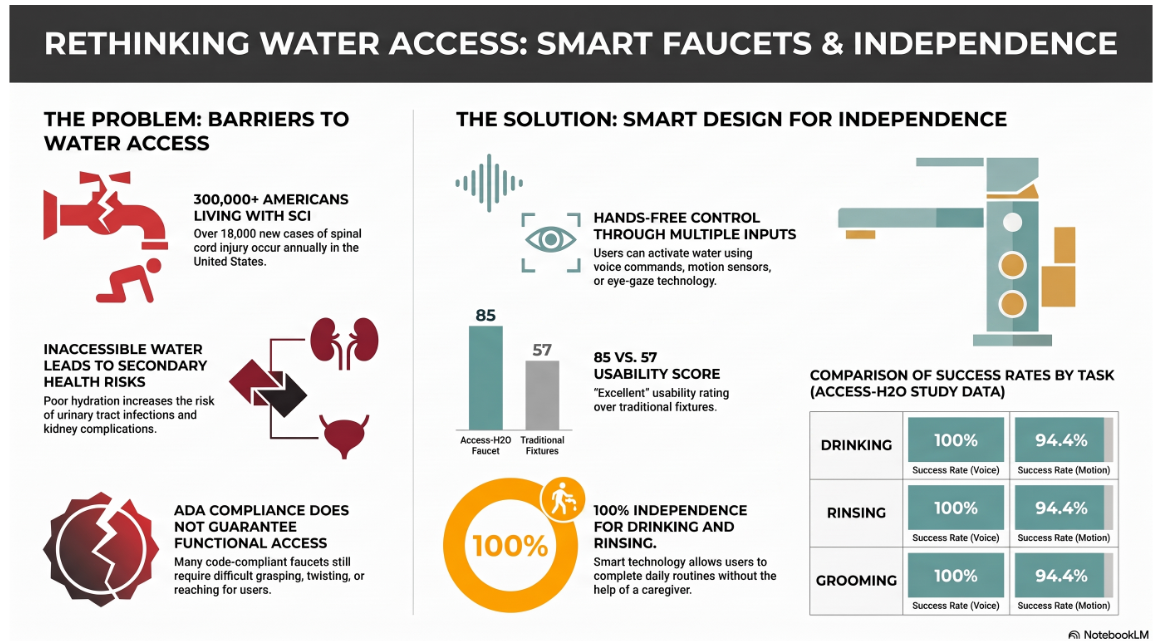

When people think about home accessibility, they usually picture ramps, showers, grab bars, and stair lifts. Those features matter, but another daily activity deserves much more attention: accessing water independently at the sink. A recent peer-reviewed study on the Access-H2O smart faucet offers a strong starting point for that conversation by showing how hands-free faucet design may improve independence for people living with cervical spinal cord injury (SCI) and, by extension, may inform better home design for a much broader range of mobility and dexterity impairments (Jeng, Koperna, & Waddell, 2025).
Why water access matters
Water access is tied to much more than handwashing. At the sink, people need water for drinking, rinsing after brushing teeth, washing the face, and other routine self-care tasks. For individuals living with SCI, especially cervical SCI, those activities can become difficult or impossible when a faucet requires grasp, twisting, sustained reach, trunk stability, and precise control of water temperature and flow (Jeng, Koperna, & Waddell, 2025).
The study article notes that SCI affects more than 300,000 individuals in the United States, with about 18,000 new cases annually, and emphasizes that access to water is directly linked to independence and quality of life (Jeng, Koperna, & Waddell, 2025; World Health Organization, 2024). The authors also highlight a practical health consequence: when getting water is hard, inadequate hydration can follow, raising the risk of problems such as constipation, urinary tract issues, bladder complications, and kidney concerns (Jeng, Koperna, & Waddell, 2025).
This is one reason sink access deserves more deliberate attention in home accessibility practice. A home can appear accessible on paper while still leaving a person dependent on others for basic daily routines if faucet controls, water trajectory, or sink approach do not match that person’s functional abilities (Jeng, Koperna, & Waddell, 2025).
The study’s contribution
The article, “Increasing Water Access for Individuals Living with Spinal Cord Injury Using an Innovative Smart Faucet,” was published in Assistive Technology Outcomes and Benefits, a peer-reviewed ATIA journal, and evaluated the Access-H2O faucet as an assistive technology solution for sink-based activities of daily living (Jeng, Koperna, & Waddell, 2025).The researchers recruited 18 participants living with SCI at levels C2 to C6 and 10 control participants, then conducted interviews and feasibility testing in an outpatient rehabilitation clinic (Jeng, Koperna, & Waddell, 2025).
The faucet was designed with three distinct modes: fountain mode for drinking, washing mode for a more traditional downward flow, and grooming mode for face rinsing (Jeng, Koperna, & Waddell, 2025). It also supported three hands-free access methods: motion control, voice control through Alexa or Google Assistant, and eye-gaze control through Tobii eye-tracking technology (Jeng, Koperna, & Waddell, 2025).
That combination is clinically important because the problem is not simply “touching the faucet.” Many people can reach a sink but cannot grip, twist, stabilize, or position themselves well enough to use standard fixtures effectively. The Access-H2O design addressed both activation and water delivery, allowing users to select water output that better matched the task at hand (Jeng, Koperna, & Waddell, 2025).
What the results showed
The study reported strong feasibility outcomes. Using voice control, participants achieved a 100% success rate for drinking, rinsing, and grooming (Jeng, Koperna, & Waddell, 2025). With eye-gaze control, they achieved 100% success for drinking and rinsing and 88.9% for grooming (Jeng, Koperna, & Waddell, 2025). With motion control, they achieved a 94.4% success rate across the three activities (Jeng, Koperna, & Waddell, 2025).
The usability findings were also notable. Participants rated the Access-H2O faucet with an average System Usability Scale (SUS) score of 85, compared with an average SUS score of 57 for traditional faucets (Jeng, Koperna, & Waddell, 2025). Using the interpretation cited in the study, scores above 85 are considered excellent, which supports the idea that the faucet was not only usable in theory but also acceptable to the intended user group (Jeng, Koperna, & Waddell, 2025).
The most compelling findings may be the independence outcomes. When using the Access-H2O faucet, participants demonstrated 100% independence for drinking and rinsing and 91.3% independence for grooming, which represented a major improvement over their reported experience with standard bathroom faucets (Jeng, Koperna, & Waddell, 2025). In practical terms, that means tasks that often required assistance could, in many cases, be completed independently (Jeng, Koperna, & Waddell, 2025).
The article also included spontaneous participant feedback that helps bring the data to life. Participants described the faucet as increasing independence, feeling sanitary, and making it easier to wash the face without getting into the shower (Jeng, Koperna, & Waddell, 2025). For therapists and families, that kind of response matters because it reflects real-world value, not just technical performance.
Looking beyond SCI
Although the study focused on people living with cervical SCI, the implications are broader. The same barriers that interfered with faucet use in the study are common among people with arthritis, stroke, multiple sclerosis, muscular dystrophy, ALS, Parkinson’s disease, upper extremity weakness, chronic pain, and age-related frailty (Jeng, Koperna, & Waddell, 2025).
A person with arthritis may have the range of motion to approach the sink but not the grip strength to manage a knob. A person after stroke may be able to complete a task one-handed but still struggle with faucet control if the design demands bilateral coordination. A wheelchair user may be able to reach the sink but not position the trunk and head well enough to use water that falls too far back in the basin. A person with progressive neuromuscular disease may fatigue before completing the task, especially if multiple steps are required (Jeng, Koperna, & Waddell, 2025).
This broader framing is why the article is so useful for a home accessibility blog. It gives a research-based anchor in SCI while supporting a larger point: independent water access should be treated as a meaningful accessibility goal for many people with mobility and dexterity impairments, not just as a convenience feature (Jeng, Koperna, & Waddell, 2025).
What smart faucet features matter most
Not every client needs a high-tech research prototype, but the study helps clarify which features actually matter. The most important lesson is that “smart” should never mean “complicated for its own sake.” The goal is not gadget appeal. The goal is a better functional match between the person, the task, and the environment (Jeng, Koperna, & Waddell, 2025).
Several features stand out:
- Hands-free activation can reduce or eliminate the need for grasp, twist, and sustained pressure.
- Multiple input methods matter because users have different movement profiles and different days of function.
- Temperature control is essential for both safety and confidence, especially for users with sensory impairment or reduced hand function.
- Water angle and trajectory are just as important as activation because users must be able to bring the water to the mouth, face, or hands without unsafe positioning.
- Clear feedback helps users know when a mode has activated or changed, which reduces uncertainty and frustration.
The study also points to a valuable clinical insight: mainstream touchless faucets may solve only part of the problem. Many commercial models turn water on and off, but they still produce a standard downward stream that requires the user to bend or reach into the sink in ways that may not be possible (Jeng, Koperna, & Waddell, 2025). The Access-H2O faucet’s distinct drinking, washing, and grooming modes show why task-specific water delivery can matter as much as sensor-based activation (Jeng, Koperna, & Waddell, 2025).
What therapists should assess
For occupational therapists, physical therapists, and other accessibility professionals, the article is a useful reminder to assess the sink as a functional workstation, not just a fixture. Questions worth asking include:
- Can the person reach the faucet controls from their actual seated or standing position?
- Can they activate water without pain, fatigue, unsafe compensations, or caregiver help?
- Can they control temperature safely and reliably?
- Does the water stream reach the body where it needs to for drinking, oral care, or face washing?
- Can they turn the water off again without distress or delay?
- (Jeng, Koperna, & Waddell, 2025).
The article also noted that even faucets considered compliant with the Americans with Disabilities Act still posed major barriers for some participants, including difficulty reaching knobs or levers, adjusting temperature, regulating flow, and accessing water effectively for activities of daily living (Jeng, Koperna, & Waddell, 2025). That is an important distinction for blog readers: accessible code features and functional accessibility are not always the same thing (Jeng, Koperna, & Waddell, 2025).
Applying the idea in real homes
Most households are not going to install this exact prototype tomorrow, but the principles are highly transferable. In practice, improving water access may involve a combination of mainstream products and environmental modifications.
A more accessible sink setup may include a single-lever or touchless faucet, anti-scald temperature control, sufficient knee clearance, sink placement that minimizes forward reach, and a spout position that better serves a seated user. In some cases, voice control may be appropriate, especially when the user already relies on smart home technology. In other cases, a simpler touchless or low-force solution may be more reliable and less cognitively demanding.
The study’s design also supports a broader lesson about personalization. Because functional limitations vary so much across SCI and other disabling conditions, the best solution is often not the most advanced one but the one that best matches the person’s movement profile, sensory needs, cognition, goals, and budget.
Strengths and limitations
One reason this article is worth discussing publicly is that it balances innovation with realism. The strengths are clear: it studied a neglected aspect of daily living, focused on user function rather than novelty alone, and reported practical outcomes related to success, time, usability, and independence.
The limitations matter too. The sample size was small, testing occurred in an outpatient rehabilitation clinic rather than participants’ homes, and the paper did not include a full cost analysis.The authors also identified areas for improvement, including stronger Alexa integration, better auditory feedback, a larger and clearer digital display, and refinement of design features before commercialization.
The eye-gaze feature was especially instructive. It worked for many users and may benefit people with very limited mobility, but the study raised concerns about privacy and HIPAA compliance in a bathroom setting and noted that eye-gaze integration significantly increased cost. That kind of honest reporting strengthens the article because it helps readers distinguish between promising innovation and broad real-world adoption.
Why this topic belongs on a home accessibility blog
This is a strong topic for a blog because it sits at the intersection of rehabilitation, home modification, universal design, and assistive technology. It starts with a focused, evidence-based SCI study and expands naturally into a broader discussion about how sink design can either support or limit autonomy at home.
It also speaks to an audience beyond therapists. Clients, caregivers, remodelers, designers, and builders can all understand the practical impact of being able to get a drink of water, rinse after brushing teeth, or wash the face without assistance. That makes the article especially useful for educational content that bridges research and real-world home design.
More broadly, the study helps reframe a subtle but powerful question in accessibility practice: not just whether someone can get into the bathroom, but whether they can actually use water once they are there. When the answer is no, independence is still incomplete. When the answer becomes yes, even through a relatively small design change, the result can be meaningful in daily life. In a follow‑up post, I’ll dive into how therapists can systematically evaluate sink access and decide which faucet features best match clients’ needs.
References:
Jeng, H. A., Koperna, L. J., & Waddell, S. (2025). Increasing water access for individuals living with spinal cord injury using an innovative smart faucet. Assistive Technology Outcomes and Benefits, 19, 33–46. Retrieved from: https://www.atia.org/wp-content/uploads/2025/06/ATOB-V19_Final.pdf
World Health Organization. (2024). Spinal cord injury. Retrieved from: https://www.who.int/news-room/fact-sheets/detail/spinal-cord-injury
Leave a Reply