
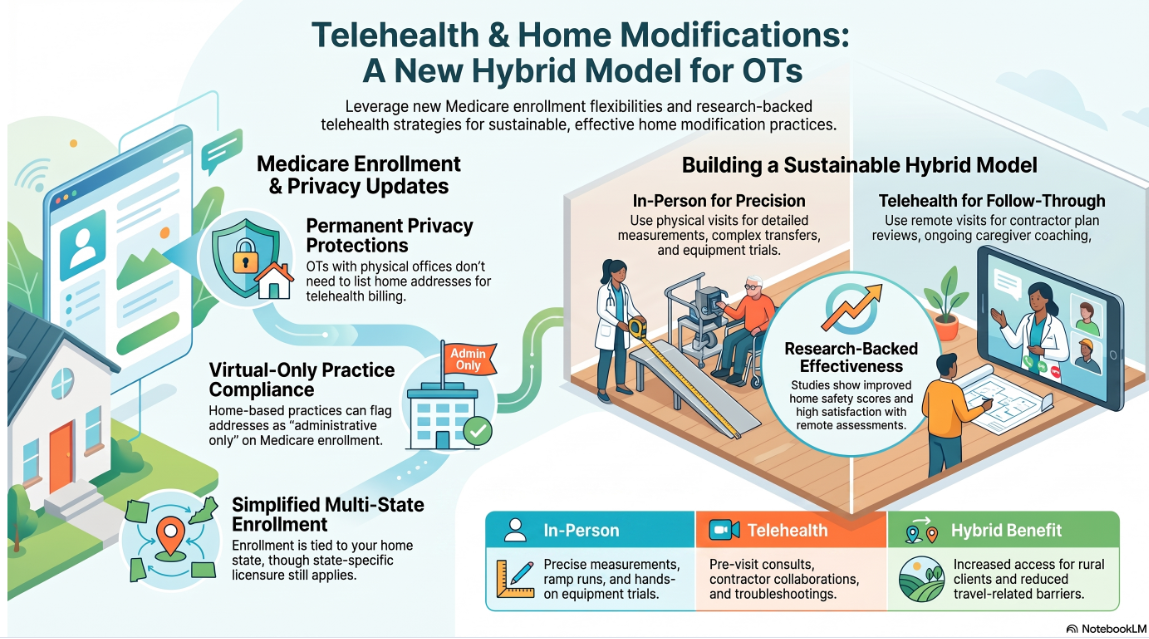
Telehealth is no longer an emergency workaround—it is becoming a permanent part of rehabilitation service delivery. For occupational therapy practitioners who specialize in home modifications, this is particularly important. Your work lives at the intersection of people, function, and the built environment, and telehealth gives you powerful new ways to assess homes, coach caregivers, and follow through on recommendations.
At the same time, Medicare has clarified how clinicians can enroll and bill when providing telehealth, including from home. The recent “Understanding Telehealth Enrollment” fact sheet from the Centers for Medicare & Medicaid Services (CMS) explains how practitioners can report practice locations, including home‑based telehealth, under Medicare Part B. When combined with growing evidence that telehealth home‑safety and home‑modification interventions are feasible and effective, this creates a strong foundation for OT home‑mod practices to use telehealth confidently and strategically (McBride et al., 2023; Breeden, 2016; Renda & Lape, 2018; CMS, 2026; AOTA,2018)
This article will:
- Summarize the key Medicare telehealth enrollment updates that affect OT home‑mod specialists.
- Review research on telehealth home accessibility and safety assessments by OTs.
- Explore practical implications for how you design and market your home‑modification services under Part B.
1. Medicare’s Telehealth Enrollment Update: What Changed?
The CMS “Understanding Telehealth Enrollment” document clarifies how practitioners should report practice locations when they furnish telehealth services, including from home (CMS,2026).
There are three main points OT home‑mod practitioners need to understand:
A. Providing telehealth from home when you have a physical practice site
If you provide telehealth services from your home and you also have a separate physical practice location (for example, a clinic office, co‑working suite, or shared professional space), CMS states that you:
- Do not need to list your home address as a practice location on your Medicare enrollment.
- May continue to enroll and bill using your existing practice location, as though the telehealth services were provided in person at that location (CMS, 2026).
This is a permanent flexibility, and it addresses a long‑standing concern for many solo and mobile OTs: the fear that they would need to share their home address publicly in order to provide telehealth (CMS, 2026).
B. Virtual‑only practices and home addresses
If you operate a virtual‑only practice and your home is your only physical practice location, CMS requires that you list your home address as the practice location in PECOS and on your enrollment. However:
- You can designate the home address as a business office used for administrative/telehealth purposes only, which CMS indicates can keep it from appearing on certain public‑facing tools (CMS,2026).
- You still enroll and bill as a standard Part B provider, even if all of your services are conducted via telehealth or in the patient’s home (CMS, 2026).
For home‑mod specialists who have chosen to keep overhead low by working from home and traveling into clients’ homes, this clarifies that it is possible to be virtual‑first and compliant.
C. Where enrollment and licensure fit together
CMS also clarifies that practitioners do not need to enroll in every state where beneficiaries live; Medicare administrative contractors verify enrollment only in the state where the practitioner is located. At the same time, CMS explicitly notes that practitioners are responsible for complying with state licensure laws in the state where the patient is located (CMS,2026).
For OT home‑mod practices that are considering cross‑state telehealth, this means:
- Medicare Part B enrollment is tied to your home/practice state.
- You must still meet each state’s OT licensure and telehealth requirements if you plan to see clients located there (AOTA, 2018; CMS, 2026).
2. Evidence: Telehealth Works for OT Home Safety and Home Modifications
Parallel to these policy changes, the research base for OT‑delivered telehealth home assessments and interventions has grown.
A. Feasibility and effectiveness of telehealth home modification OT
A pretest–posttest study on telehealth OT home‑modification interventions used participants’ own smartphones, tablets, or computers to deliver remote assessments and recommendations (Renda & Lape, 2018). The authors found:
- Improvements in home safety scores and in participants’ perceived performance of daily activities after the telehealth intervention.
- High satisfaction with telehealth, with participants noting ease of use and reduced burden for themselves and their caregivers.
This study essentially shows that core elements of OT home‑modification work—assessing risks, identifying barriers, and co‑creating solutions—can be delivered effectively through telehealth when supported by consumer technology.
B. Telehealth home safety education and coaching
A multi‑case study of older adults (Breeden, 2016) receiving home safety education via telehealth found that:
- Telehealth sessions, supported by photographs of home hazards, allowed the OT to provide meaningful, individualized education about home safety.
- Participants reported that the telehealth format facilitated reflection on their environments and supported behavior change.
While this study focused on wellness and education, it suggests that telehealth is a viable platform for home‑safety coaching, a core part of what home‑modification OTs provide.
C. Structured telehealth home assessment protocols
More recently, researchers have developed and validated structured protocols specifically for telehealth home assessments. The Protocol for Administering Telehealth (PATH) Home Safety Assessment (McBride et al., 2023), for example, provides:
- A standardized, valid approach for synchronous telehealth home assessments.
- Guidance on how OTs can direct clients or caregivers to show key parts of the home environment via video.
Other work is underway to develop digital home‑safety tools and telehealth‑specific assessment adaptations for community‑dwelling adults at risk of falls (George et al., 2025).
D. Broader telehealth OT literature
Position papers and reviews from AOTA and others emphasize that telehealth can support OT outcomes such as occupational performance, participation in daily living, fall prevention, and home environmental safety (AOTA, 2018; Van Pelt, 2025). Benefits identified for older adults include increased access to care, better alignment of therapy with real‑life routines in the home, and reduced barriers related to travel, time, and cost.
Taken together, this literature supports what many home‑modification OTs discovered during the pandemic: telehealth is not a second‑best option; in many cases, it enhances the ability to see how people actually live and function in their spaces.

3. What This Means for OT Home‑Modification Practices
With both the CMS telehealth enrollment clarity and a solid evidence base behind you, how should you adapt your home‑modification practice if you bill under Medicare Part B?
A. Build a hybrid model: In‑person for measurement, telehealth for follow‑through
The research suggests a hybrid model plays to the strengths of both formats.
In‑person visits are ideal for:
- Detailed measurement of spaces (door widths, turning radii, ramp runs, bathroom layouts).
- Hands‑on trials of equipment such as transfer devices, shower chairs, and temporary ramps.
- Complex postural or transfer assessments where camera angles are limiting.
Telehealth visits are well suited to:
- Pre‑visit consults to clarify needs, goals, and priorities before a full home evaluation.
- Follow‑up sessions to review contractor plans, measure for grab bar placement with caregiver assistance, or troubleshoot problems after installation (McBride et al., 2023; Breeden, 2016; Renda & Lape, 2018).
- Ongoing caregiver coaching and adherence support, which research shows is critical for successful implementation of home‑modification recommendations (Gitlin et al,2001; Renda & Lape, 2018).
Telehealth can make it easier to schedule shorter, more frequent touchpoints, which may enhance uptake of recommendations and reduce caregiver burden over time.
B. Protect your privacy while expanding your telehealth capacity
The CMS enrollment update gives you options:
- If you have a physical practice address (even a small office you rarely use), you can:
- List that practice location in PECOS.
- Provide telehealth from your home without listing your home address on your enrollment (CMS, 2026).
- If your home is your only practice site:
For many home‑mod OTs who previously hesitated to offer telehealth because of home‑address concerns, this policy removes a significant barrier.
C. Clarify your documentation and billing processes
Telehealth does not change the fundamental requirements for Medicare Part B outpatient therapy: you still need a valid plan of care, appropriate codes, and documentation that supports medical necessity. Consider:
- Using established self‑care/home‑management, therapeutic activities, or neuromuscular re‑education codes when telehealth visits focus on training, problem‑solving, and functional performance in the home.
- Clearly documenting that telehealth was used, why it was appropriate (e.g., to evaluate home safety in real time, to minimize caregiver burden, to address mobility limitations), and what objective changes were observed.
- Linking your home‑modification recommendations to research‑supported outcomes (fall risk reduction, improved participation, reduced caregiver burden), especially when writing letters of medical necessity for equipment or modifications.
D. Re‑think access, geography, and partnerships
Because CMS does not require enrollment in each beneficiary’s state, but leaves licensure to state law, you may be able to thoughtfully extend your reach:
- Within your state, you can serve rural or hard‑to‑reach communities via telehealth for parts of your process, reducing travel time for you and access barriers for them (AOTA, 2018; CMS, 2026).
- If you hold multiple state licenses (or are part of a compact, when applicable), you can offer telehealth home‑modification consultation across a wider region, as long as you follow each state’s laws.
Telehealth also creates new opportunities to collaborate with contractors and DME suppliers: joint video visits where you, the client, and the contractor review home plans together can prevent costly errors and mismatches.
4. Positioning and Communicating Your Telehealth Home‑Mod Services
Finally, think about how you describe these services to clients and referral sources. Some ideas you can adapt:
- “We provide outpatient occupational therapy for home safety and accessibility in your home and via secure telehealth, following current Medicare Part B and telehealth enrollment rules.”
- “Telehealth visits allow us to check in on your home modifications, coach caregivers, and work with your contractor or DME vendor—without you having to schedule additional in‑person visits.”
- “Our telehealth home‑modification services are informed by current research showing that remote OT home assessments can improve home safety, daily performance, and caregiver satisfaction.” (van Pelt, 2025; McBride et al, 2023; Breeden, 2016; Renda & Lape, 2018).
On your website or in your newsletter, you might dedicate a short section to “How telehealth supports home modifications,” outlining:
- What a telehealth home‑safety or follow‑up session looks like.
- What technology is needed (smartphone, tablet, or computer with video).
- How it integrates with in‑person visits for measuring and hands‑on trials.
Telehealth is not replacing the need for you to stand in a bathroom and check clearances or to roll a power wheelchair through a tight hallway. But the combination of clear Medicare enrollment rules and growing evidence of telehealth effectiveness means that OT home‑modification specialists can design flexible, hybrid service models that better match clients’ needs, support caregivers, and make your practice more sustainable.
From here, what part of this could you see yourself implementing first—adding telehealth follow‑ups to existing in‑person evals, or formalizing a hybrid process from the start of each case?
References:
American Occupational Therapy Association. (2018). Telehealth in occupational therapy. American Journal of
Occupational Therapy, 72(Suppl. 2), 7212410059. https://doi.org/10.5014/ajot.2018.72S219
Breeden, L.E. (2016). Occupational therapy home safety intervention via telehealth. International Journal of Telerehabilitation.8(1) DOI: https://doi.org/10.5195/ijt.2016.6183
Centers for Medicare & Medicaid Services. (2026). Understanding telehealth enrollment [Fact sheet]. CMS. https://www.cms.gov/files/document/understanding-telehealth-enrollment.pdf
Clemson, L., Mackenzie, L., Ballinger, C., Close, J. C., & Cumming, R. G. (2008). Environmental interventions to prevent falls in community-dwelling older people: a meta-analysis of randomized trials. Journal of aging and health, 20(8), 954–971. https://doi.org/10.1177/0898264308324672
George, J., Brandis, S., Fields, S., & Leung, M. (2025). Exploring home safety risk assessment tools for telehealth use in occupational therapy. Australian Occupational Therapy Journal, 72(S1), 79-80. https://doi.org/10.1111/1440-1630.70024
Gitlin, L. N., Corcoran, M., Winter, L., Boyce, A., & Hauck, W. W. (2001). A randomized, controlled trial of a home environmental intervention: effect on efficacy and upset in caregivers and on daily function of persons with dementia. The Gerontologist, 41(1), 4–14. https://doi.org/10.1093/geront/41.1.4
Mann, W. C., Ottenbacher, K. J., Fraas, L., Tomita, M., & Granger, C. V. (1999). Effectiveness of assistive technology and environmental interventions in maintaining independence and reducing home care costs for the frail elderly. A randomized controlled trial. Archives of family medicine, 8(3), 210–217. https://doi.org/10.1001/archfami.8.3.210
McBride, C., Story, S., & Cason, J. (2023). Development and Validation of the Protocol for Administering Telehealth Home (PATH) Assessments. International journal of telerehabilitation, 15(1), e6545. https://doi.org/10.5195/ijt.2023.6545
Petersson, I., Lilja, M., Hammel, J., & Kottorp, A. (2008). Impact of home modification services on ability in everyday life for people ageing with disabilities. Journal of Rehabilitation Medicine, 40(4), 253–260. https://doi.org/10.2340/16501977-0160
Renda, M., & Lape, J. E. (2018). Feasibility and Effectiveness of Telehealth Occupational Therapy Home Modification Interventions. International journal of telerehabilitation, 10(1), 3–14. https://doi.org/10.5195/ijt.2018.6244
Stark, S., Keglovits, M., Arbesman, M., & Lieberman, D. (2017). Effect of home modification interventions on the participation of community-dwelling adults with health conditions: A systematic review. American Journal of Occupational Therapy, 71, 7102290010. https://doi.org/10.5014/ajot.2017.018887
Van Pelt, J. (2025) Occupational therapy and telehealth: An emerging model of care and delivery for older adults. Today’s Geriatric Medicine. 15(2)14. Retrieved from: https://www.todaysgeriatricmedicine.com/archive/MA22p14.shtml
Leave a Reply