
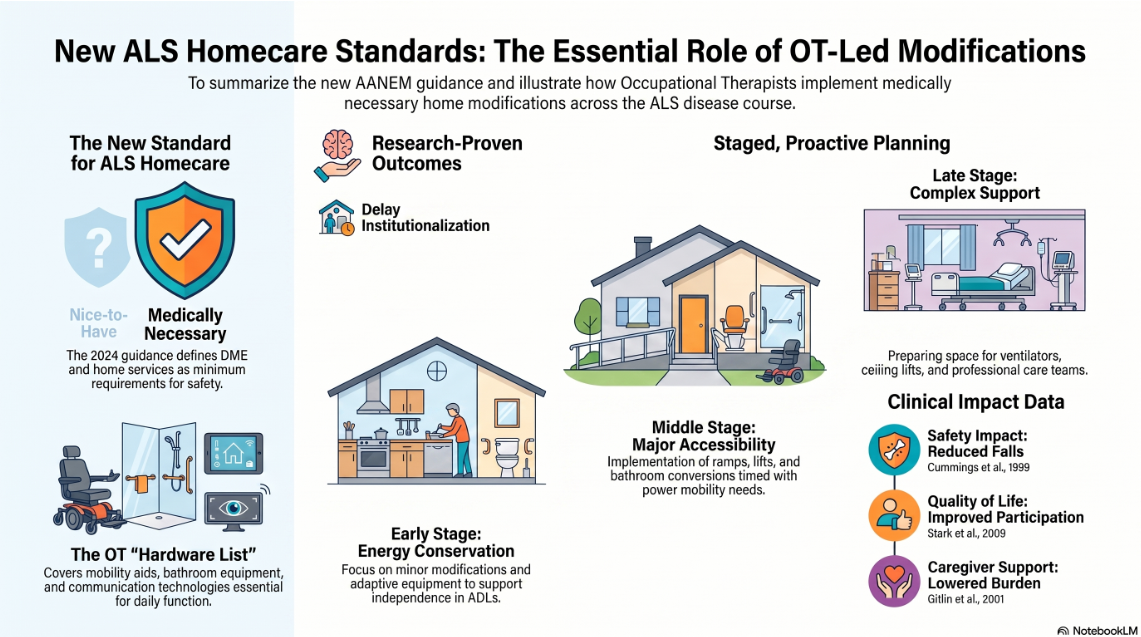
Most people living with amyotrophic lateral sclerosis (ALS) want to remain at home for as long as possible, even as weakness, fatigue, and respiratory changes make daily activities increasingly difficult. The new ALS Home Health and Durable Medical Equipment Medical Standard Guidance from the American Association of Neuromuscular and Electrodiagnostic Medicine (AANEM) is a major step forward in defining what “minimum standard of home care” should look like across the ALS disease course. It outlines stage‑responsive recommendations for home health services and durable medical equipment (DME), with clear attention to safety, participation, and caregiver support in the home environment (AANEM, 2026).
For occupational therapy (OT) practitioners—especially those specializing in home modifications—this guidance is both a validation and a call to action. It explicitly names the kinds of services and equipment that can and should be considered medically necessary, and it creates a strong framework for clinically grounded, funded home-modification work. At the same time, a growing body of research shows that OT‑led home evaluations and modifications improve occupational performance, reduce falls, and lower caregiver burden (Gitlin et al., 2001; Mann et al., 1999; Stark et al., 2009; Stark et al., 2017; Aplin et al., 2013; Cummings et al., 1999).
In this article, the focus is on three questions:
- What does the new ALS homecare guidance actually recommend?
- How can OTs with advanced home‑modification skills operationalize these recommendations?
- How can OT practitioners—both in home health and in Part B private practice—position and market their services to support people living with ALS?
What the ALS Home Health and DME Guidance Recommends
The ALS Home Health and DME Medical Standard Guidance was created to address a gap: existing ALS guidelines have largely focused on clinic‑based care and medications, with limited direction on what is medically necessary in the home (AANEM, 2026). The new document provides stage‑responsive guidance across early, middle, and late ALS, covering:
- Home health services such as skilled nursing, home health aides, occupational therapy, physical therapy, speech‑language pathology, respiratory therapy, nutrition, and social work.mda+1
- Durable medical equipment and supplies, including mobility aids, lifts, beds, bathroom equipment, communication devices, and respiratory technology.
A core emphasis is that these are not “nice‑to‑have” items; they represent minimum standards to support safety, function, and quality of life at home (AANEM, 2026). The guideline recommends comprehensive assessment of functional abilities, caregiver capacity, and environmental barriers, and it explicitly encourages anticipatory planning so that equipment and services are in place before crisis points.
For OTs, this language is crucial. It positions home‑based functional assessment and home modifications as part of medically necessary care, not peripheral add‑ons.
Home Health Services, DME, and the Home Environment
From an OT home‑modification perspective, several domains in the guideline are especially important.
Mobility and Home Accessibility
The guidance describes medically indicated mobility equipment such as manual and power wheelchairs, seating systems, and lift devices, as well as home accessibility solutions like ramps and lifts (AANEM, 2026). The expectation is that, as ALS progresses, individuals will need properly fitted power mobility and appropriate home access to enter and move within the home.
Bed, Bathroom, and ADL Equipment
Hospital beds, specialty mattresses, positioning devices, shower/commode chairs, and adaptive clothing are highlighted as needed to support safe transfers, positioning, bathing, toileting, and dressing (AANEM, 2026). These are precisely the tasks that OTs routinely evaluate and address through both equipment and environmental modification.
Communication, Technology, and Daily Routines
The guideline also calls for access to communication devices and environmental control technologies that allow people with ALS to use phones, tablets, and other electronics, maintain social connection, and control aspects of their environment (AANEM, 2026). Integrating these technologies into the home layout and daily routines is often an OT‑led process.
Taken together, the guidance essentially lays out a “hardware list” for living with ALS at home. OT‑led home modifications are how that hardware gets translated into safe, usable, meaningful spaces.
Evidence for OT-Led Home Modifications
The ALS guidance arrives against a strong backdrop of research demonstrating the value of OT home evaluations and modifications.
Home evaluations by occupational therapists have been shown to:
- Reduce caregiver burden (Gitlin et al., 2001).
- Delay institutionalization (Mann et al., 1999).
- Reduce falls in community‑dwelling adults (Cummings et al., 1999; Cockayne et al, 2018; Renda & Lape, 2018).
- Improve self‑perception of performance and satisfaction with daily activities (Petersson et al., 2008; Stark et al., 2017).
- Increase acceptance and follow‑through with home modifications (Renda & Lape, 2018).
A systematic review of home modification interventions found that higher‑intensity, comprehensive interventions—often OT‑led—are particularly effective at improving occupational performance and participation, with emerging evidence for OT’s specific contribution (Stark et al., 2017). A community‑based program review concluded that involving OT practitioners in home-modification programs leads to better adherence to recommendations, fewer falls, and better fit between the home and the individual (Chase et al., 2012; Currin et al., 2012; Gitlin et al., 2006; Leland et al., 2012).
In ALS specifically, practice materials and clinical resources emphasize that OTs play a central role in helping individuals adapt daily tasks, maintain valued activities, and modify the home as function declines (ALS Network, 2023). Typical OT involvement includes early‑stage strategies for fine‑motor tasks, progressive adaptation of bathing and dressing, and recommendations for grab bars, ramps, and kitchen/bath modifications as mobility changes (ALS Network, 2023).
The new ALS homecare guidance therefore aligns closely with the existing evidence: timely, OT‑guided home modification improves safety, function, and caregiver experience, and should be viewed as a standard component of ALS homecare.

The Role of OTs with Advanced Home-Modification Skills
Many occupational therapists can and do address safety and equipment in the home. However, the ALS guidance creates a particular niche for clinicians with advanced home‑modification skills—those who can integrate complex equipment, architectural changes, and disease progression into a coherent home plan.
Translating Standards into Individualized Home Plans
The guideline defines what services and equipment are medically necessary; it does not, and cannot, prescribe how to adapt a unique home with its specific layout, construction limits, and family dynamics. OTs with home‑mod expertise:
- Conduct detailed, in‑home assessments of occupational performance, environmental barriers, and caregiver routines (Doyle, 2017).
- Analyze circulation paths, transfer zones, and clearances in relation to power wheelchairs, lifts, and other ALS‑related DME (Rhodes, 2019).
- Collaborate with the person and family to set goals that honor both safety and personal priorities (e.g., accessing a favorite outdoor space, staying in a particular bedroom) (ALSNetwork, 2023).
A systematic review notes that OT‑delivered home modification interventions are most effective when they are comprehensive and individualized, rather than generic hazard checklists (Stark et al., 2017). This level of individualization is exactly what the ALS guidance invites.
Staged, Proactive Planning Across ALS Progression
The ALS homecare standard emphasizes stage‑responsive care and anticipatory planning (AANEM, 2024). OT home‑mod specialists operationalize this by:
- Early stage: recommending minor modifications and adaptive equipment to conserve energy and support independence with ADLs and work/leisure activities (ALSnetwork, 2023).
- Middle stage: planning major access changes (ramps vs. lifts, bathroom conversions, door widening) timed to the introduction of power mobility and increased transfer needs (Rhodes, 2019; AANEM, 2024).
- Late stage: preparing for complex equipment (ventilators, cough assist devices, ceiling lifts), caregiver safety, and adequate space for teams and technology (Cockayne et al., 2018).
Research on home modifications suggests that proactive interventions—implemented before crises—are more effective at preventing falls, reducing burden, and supporting aging in place (Stark et al., 2017; Gitlin et al., 2006). The ALS guidance gives OTs a clear backbone for structuring that proactive, staged approach (Goldhammer et al., 2022).
Documentation and Justification Using the ALS Guidance
Clinically, one of the most powerful aspects of the guidance for OTs is its framing of home health and DME recommendations as medically necessary and minimum standards (AANEM, 2024). OT practitioners can leverage this language when:
- Writing evaluations and letters of medical necessity for ramps, lifts, bathroom modifications, and caregiver training (Archie, 2026).
- Supporting appeals when funders initially deny or limit coverage for key accessibility features.
Because payers frequently require evidence that proposed modifications are essential for safety and basic function, referencing a national ALS standard—combined with OT clinical reasoning and relevant research—can significantly strengthen the case for coverage.
The Part B Private Practice Opportunity: Outpatient Care in the Home
The ALS homecare guidance is written largely with home health (Part A) in mind, but its principles apply equally well to outpatient OT delivered in the home under Medicare Part B or commercial plans. Many people with ALS either do not qualify for home health, choose not to receive it, or receive only short, episodic services. Yet their home‑based needs continue to evolve (AANEM, 2024; Krupa, 2025).
Mobile or community‑based OT practices that bill Part B for outpatient services in the home can:
- Provide ongoing, guideline‑aligned functional assessments and home‑modification recommendations beyond the time‑limited home health episode.cms+1
- Focus specifically on complex home access, DME integration, and caregiver training—areas that may not be fully addressed in brief home health visits. (Rhodes, 2019).
- Offer periodic “check‑ins” at predictable transition points (e.g., first fall, introduction of power mobility, addition of respiratory equipment) (AANEM, 2026).
- CMS guidance and rehabilitation billing resources confirm that medically necessary OT services—including evaluation, self‑care/home management, and neuromuscular re‑education—may be billed under Part B as outpatient therapy delivered in the home, provided that other home health rules are respected (CMS, 2024; SpryPT, 2025).
For OTs in private practice, positioning as “outpatient OT in the home specializing in ALS and neuromuscular home modifications” aligns well with both the ALS guidance and existing reimbursement frameworks.
Marketing OT Home-Modification Services in the Context of ALS
Who to Market To
Key referral partners and audiences include:
- ALS multidisciplinary clinics (neurologists, nurse coordinators, social workers, in‑clinic PT/OT) who are tasked with aligning care with current ALS standards and are looking for community partners to implement home‑based recommendations (ALS, 2023).
- Home health agencies that want to ensure their ALS patients receive comprehensive, guideline‑aligned home evaluations and environmental modifications, but may not have dedicated home‑mod experts on staff (Rhodes, 2019; AANEM, 2026).
- DME suppliers and accessibility contractors who see home barriers daily but lack clinical expertise in occupational performance and disease progression; co‑managing cases with an OT often improves fit and client satisfaction (Goldhammer, 2022; AOTA, n.d.).
- Case managers and payers looking for clear, evidence‑based justification when authorizing home modifications or nonstandard DME for ALS and other neuromuscular conditions (Krupa, 2022; Centers for Medicare and Medicaid Services, 2019).
You can also speak directly to families in your public‑facing content, explaining that they can ask for an OT home evaluation that explicitly aligns with the ALS homecare standard.
How to Position Your Services
Some message frames that connect the ALS standard and OT home mods:
- “We translate the ALS Home Health and DME Medical Standard Guidance into customized home plans—so the equipment your neurologist orders actually fits your home, your routines, and your goals (AANEM,2026).”
- “Our OT home evaluations and recommendations cite current ALS homecare standards and home‑modification research, supporting medical necessity and funding for ramps, lifts, bathroom access, and caregiver training.” (Renda & lape, 2018; AANEM, 2026; Goldhammer et al., 2022).
- “As outpatient OTs in private practice, we provide ongoing, guideline‑aligned visits in your home even when traditional home health is not in place.” (Krupa, 2025; Centers for Medicare and Medicaid Services, 2019).
From a marketing strategy perspective, aging‑in‑place and home‑modification services benefit from clear online messaging, local SEO, and educational content that answers common questions families are already Googling (Maritato, 2021). Videos or short blog posts on topics like “Ramp or lift?”, “When should we remodel the bathroom?”, or “How do we make space for a power chair and ventilator?” can draw in both OTs and lay readers while subtly reinforcing your alignment with the ALS standard.
Bringing It All Together
The ALS Home Health and DME Medical Standard Guidance marks a meaningful shift: it explicitly recognizes that home health services and home‑based equipment are central, medically necessary components of ALS care—not peripheral extras (AANEM, 2024). For occupational therapists, particularly those with advanced skills in home modifications, the guideline:
- Validates the centrality of functional, environmental assessment in ALS homecare.
- Provides strong language around medical necessity and minimum standards to support documentation and funding.
- Opens the door for both home health and Part B outpatient, home‑based OT models to deliver staged, proactive home‑modification services over the disease course.
At the same time, a robust evidence base shows that OT‑led home modifications reduce falls, improve occupational performance, and lessen caregiver burden, adding weight to the guideline’s recommendations (Gitlin et al., 2001; Mann et al., 1999; Stark et al., 2017; Aplin et al., 2013; Cummings et al., 1999).
For OTs in home‑mod practice, this is an opportunity to step confidently into a specialized role: as interpreters of ALS standards in real homes, as designers of staged home‑access plans, and as advocates who can speak the language of both families and payers. For clinicians and families, partnering with such OTs can make the difference between having equipment in the home and actually having a home that works.
References:
American Association of Neuromuscular & Electrodiagnostic Medicine. AANEM (2026). The ALS Home Health and Durable Medical Equipment Medical Standard Expert Consensus Guideline. Muscle & nerve, 10.1002/mus.70290. Advance online publication. https://doi.org/10.1002/mus.70290
AOTA, (n.d.) Productive aging: Home modifications & key community partnerships. Retrieved from: https://www.aota.org/practice/practice-settings/home-modifications-key-community-partnerships
Aplin, T., de Jonge, D., & Gustafsson, L. (2013). Understanding the dimensions of home that impact on home modification decision making. Australian occupational therapy journal, 60(2), 101–109. https://doi.org/10.1111/1440-1630.12022
Archie, B. (2026). The OT’s guide to home modifications that acutally get funded. OTConnected. Retrieved from: https://otconnected.com/blog/the-ot-s-guide-to-home-modifications-that-actually-get-funded
Centers for Medicare & Medicaid Services. (2024). Outpatient rehabilitation therapy services: Complying with documentation requirements (MLN Booklet). https://medicareadvocacy.org/mobile-outpatient-therapy/
Chase, C. A., Mann, K., Wasek, S., & Arbesman, M. (2012). Systematic review of the effect of home modification and fall prevention programs on falls and the performance of community-dwelling older adults. The American journal of occupational therapy : official publication of the American Occupational Therapy Association, 66(3), 284–291. https://doi.org/10.5014/ajot.2012.005017
Cockayne, S., Pighills, A., Adamson, J., Fairhurst, C., Drummond, A., Hewitt, C., Rodgers, S., Ronaldson, S. J., Lamb, S. E., Crossland, S., Boyes, S., Gilbody, S., Relton, C., Torgerson, D. J., & OTIS study (2018). Can occupational therapist-led home environmental assessment prevent falls in older people? A modified cohort randomised controlled trial protocol. BMJ open, 8(9), e022488. https://doi.org/10.1136/bmjopen-2018-022488
Cumming, R. G., Thomas, M., Szonyi, G., Salkeld, G., O’Neill, E., Westbury, C., & Frampton, G. (1999). Home visits by an occupational therapist for assessment and modification of environmental hazards: a randomized trial of falls prevention. Journal of the American Geriatrics Society, 47(12), 1397–1402. https://doi.org/10.1111/j.1532-5415.1999.tb01556.x
Currin, M. L., Comans, T. A., Heathcote, K., & Haines, T. P. (2012). Staying safe at home. Home environmental audit recommendations and uptake in an older population at high risk of falling. Australasian Journal on Ageing, 31(2), 90 – 95. https://doi.org/10.1111/j.1741-6612.2011.00545.x
Doyle, S. (2017) Home safety: The unique role of occupational therapy. Clark County, WA. Community Planning Symposium. Retrieved from: https://clark.wa.gov/sites/default/files/fileuploads/community-planning/2017/05/cccoa_home_safety_presentation.pdffilename_utf-8cccoa_home_safety_presentation.pdf
Gitlin, L. N., Corcoran, M., Winter, L., Boyce, A., & Hauck, W. W. (2001). A randomized, controlled trial of a home environmental intervention: effect on efficacy and upset in caregivers and on daily function of persons with dementia. The Gerontologist, 41(1), 4–14. https://doi.org/10.1093/geront/41.1.4
Gitlin, L. N., Hauck, W. W., Winter, L., Dennis, M. P., & Schulz, R. (2006). Effect of an in-home occupational and physical therapy intervention on reducing mortality in functionally vulnerable older people: preliminary findings. Journal of the American Geriatrics Society, 54(6), 950–955. https://doi.org/10.1111/j.1532-5415.2006.00733.x
Goldhammer, T., Scott, S., Waugh-QuAWBerh, E., & Wickel, C. (2022, January 5) Safe at Home: A community -based approach to home modifcation implementation. OT Practice. American Occupational Therapy Association. https://www.aota.org/publications/ot-practice/ot-practice-issues/2022/safe-at-home
Krupa, E. (2025). Is mobile outpatien therapy an alterantive to home health care? Center for medicare Advocacy. Retrieved from: https://medicareadvocacy.org/mobile-outpatient-therapy/
Leland, N. E., Elliott, S. J., O’Malley, L., & Murphy, S. L. (2012). Occupational therapy in fall prevention: current evidence and future directions. The American journal of occupational therapy : official publication of the American Occupational Therapy Association, 66(2), 149–160. https://doi.org/10.5014/ajot.2012.002733
Mann, W. C., Ottenbacher, K. J., Fraas, L., Tomita, M., & Granger, C. V. (1999). Effectiveness of assistive technology and environmental interventions in maintaining independence and reducing home care costs for the frail elderly. A randomized controlled trial. Archives of family medicine, 8(3), 210–217. https://doi.org/10.1001/archfami.8.3.210
Maritato, A. (2021, March 17). Marketing home modifications in 2021 | Occupational therapy | Physical therapy [Video]. YouTube. https://www.youtube.com/watch?v=EO51mo5GDBY youtube
Petersson, I., Lilja, M., Hammel, J., & Kottorp, A. (2008). Impact of home modification services on ability in everyday life for people ageing with disabilities. Journal of rehabilitation medicine, 40(4), 253–260. https://doi.org/10.2340/16501977-0160
Logan, P. A., Coupland, C. A., Gladman, J. R., Sahota, O., Stoner-Hobbs, V., Robertson, K., Tomlinson, V., Ward, M., Sach, T., & Avery, A. J. (2010). Community falls prevention for people who call an emergency ambulance after a fall: randomised controlled trial. BMJ (Clinical research ed.), 340, c2102. https://doi.org/10.1136/bmj.c2102
Renda, M., & Lape, J. E. (2018). Feasibility and Effectiveness of Telehealth Occupational Therapy Home Modification Interventions. International journal of telerehabilitation, 10(1), 3–14. https://doi.org/10.5195/ijt.2018.6244
Rhodes, M. (2019). Durable medical equipment, adaptive equipment, and home modifications: Decreasing barriers in the home health setting. University of Indianapolis. https://uindy.hykucommons.org/downloads/f73a02cc-4134-42e2-b280-20e5e2fa9137?locale=en
SpryPT. (2025). 7 essential OT billing codes that boost reimbursement. https://www.sprypt.com/blog/ot-billing-codes-reimbursement-rates
Stan Cassidy Center for Rehabilitation (N.D.) ALS: A quick guide for occupational therapists (OTs). Retrieved from: https://horizonnb.ca/wp-content/uploads/2024/06/ALS_OT_Guide_EN.pdf
Stark, S., Keglovits, M., Arbesman, M., & Lieberman, D. (2017). Effect of Home Modification Interventions on the Participation of Community-Dwelling Adults With Health Conditions: A Systematic Review. The American journal of occupational therapy : official publication of the American Occupational Therapy Association, 71(2), 7102290010p1–7102290010p11. https://doi.org/10.5014/ajot.2017.018887
Stark, S., Landsbaum, A., Palmer, J. L., Somerville, E. K., & Morris, J. C. (2009). Client-centred home modifications improve daily activity performance of older adults. Canadian journal of occupational therapy. Revue canadienne d’ergotherapie, 76 Spec No(Spec No), 235–245. https://doi.org/10.1177/000841740907600s09
The ALS Association. (2023, May 5). A focus on quality of life: The occupational therapist role in ALS multidisciplinary care. https://alsnetwork.org/a-focus-on-quality-of-life-the-occupational-therapist-role-in-als-multidisciplinary-care/
The ALS Association. (2021). Home modification for safety and accessibility in ALS [PDF]. https://www.als.org/sites/default/files/2021-10/Oct%20Home%20Modification%20For%20Safety%20and%20Accessibility.pdf
Leave a Reply