
In home occupational therapy services are a cornerstone of safe discharge and aging in place. They combine environmental assessment, equipment prescription, and home modifications to support safety, independence, and caregiver capacity after hospitalization (McBride et al, 2023; Clemson et al., 2008; Health Quallity Ontario, 2013). Historically, these services have been delivered almost entirely in person, making them time‑ and resource‑intensive (Lannin et al., 2007; Renda & Lape, 2018).
A new feature article in the Australian Occupational Therapy Journal, “Telehealth versus in‑person delivery of an occupational therapy home visiting service: A cost analysis” (Savira et al., 2025), offers something we haven’t had before: a detailed look at how telehealth OT home visits compare to traditional in‑person visits in terms of health‑system costs and adverse events. It complements earlier work showing that telehealth OT home‑modification and home‑safety interventions are clinically feasible and effective (Renda & Lape, 2018; Breeden, 2016; McBride et al., 2023; Savira et al., 2025).
For OTs specializing in home modifications, this study adds a critical missing piece: economic value. It also surfaces important nuances—telehealth is not equally suitable for all conditions, and careful patient selection and hybrid models are key.
What the Study Did
Savira and colleagues (2025) conducted a retrospective cost‑consequence analysis using data from 537 adults recently discharged from two hospitals in Western Australia who received OT home visiting services between 2020 and 2022.
All patients received a home visiting service that included:
- Environmental assessment
- Provision of equipment
- Recommendations for home modifications and strategies
The team compared two groups:
- Telehealth group: 271 patients, including 56 who received “hybrid” care (telehealth plus some in‑person visits).
- In‑person group: 266 patients who received the traditional in‑home OT visit.
They examined health‑system costs from the hospital perspective, including:
- OT service delivery
- Subsequent emergency department encounters
- Inpatient admissions
- Outpatient visits
- Patient‑related travel and other cost categories (e.g., salaries, leases, depreciation).
They also stratified costs by adverse events occurring after discharge: falls, delirium, and pressure injuries.
This cost analysis builds directly on a prior cohort study from the same group, which showed that telehealth OT home visits significantly reduced therapy time (median 40 vs. 160 minutes) without increasing falls or pressure injuries overall, though about 20% of telehealth patients needed hybrid care (Lommerzheim et al., 2025).
Key Findings
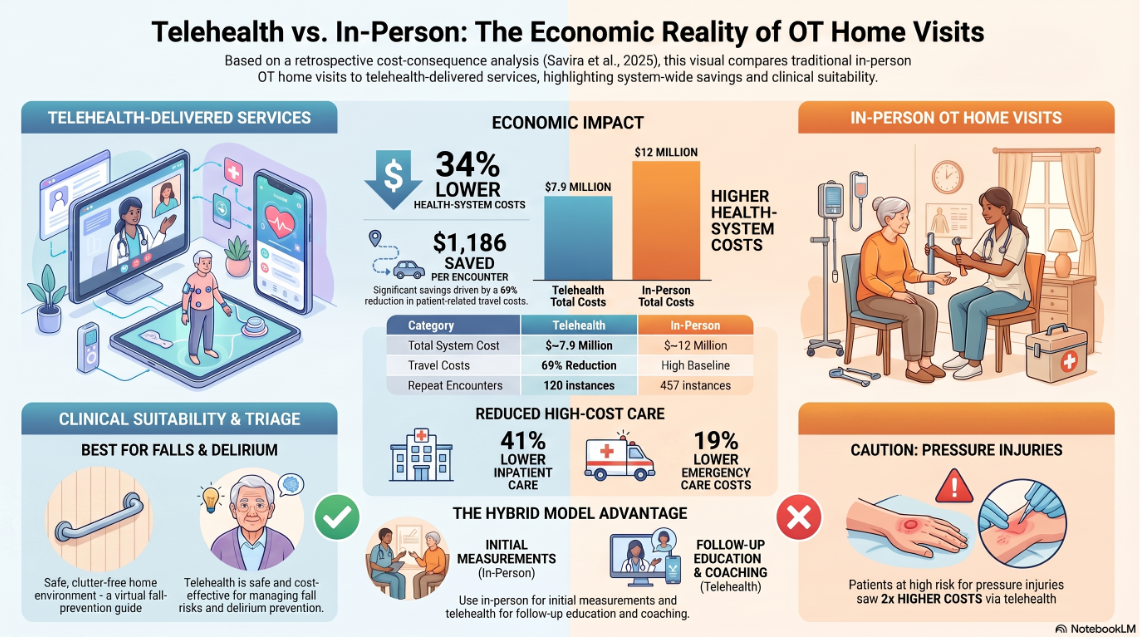
1. Overall costs: Telehealth saved 34% compared to in‑person
Across all encounters (emergency, inpatient, outpatient, and unlinked), telehealth incurred 34% lower costs for the health system than in‑person care.
- Total costs:
- In‑person: about $12 million
- Telehealth: about $7.9 million
- Difference: ≈ $4 million saved.
- Per‑encounter savings: about $1,186 saved per telehealth encounter.
Most of the savings came from:
- 41% reduction in inpatient care costs (fewer hospital admissions and inpatient days).
- 19% reduction in emergency care costs.
- A striking 69% reduction in costs related to travel to patients, saving about $1.9 million.
These findings echo earlier telehealth OT work showing improved efficiency and reduced travel burdens, but Savira et al. (2025) quantify these savings at a systems level.
2. Adverse events: savings for falls and delirium, not for pressure injuries
When the team looked at costs associated with specific adverse events, the picture became more nuanced.
- Falls
- Telehealth group had fewer fall‑related encounters and significantly lower costs.
- Telehealth yielded about $318,000 in savings for fall events, with cost reductions across medical, travel, and other cost categories.
- Delirium
- Telehealth also showed cost savings for delirium events, with approximately 30% lower costs than in‑person care.
- Pressure injuries
- Here, the telehealth group had higher total costs, more repeat inpatient and emergency encounters, and costs more than twice those of the in‑person group across all cost categories.
- The authors interpret this as suggesting some pressure injuries may not have been identified or managed early enough via telehealth, leading to more reactive, high‑cost care.
In short: telehealth OT home visits appear safe and cost‑saving for fall and delirium risks, but may not be appropriate as a stand‑alone modality for patients at high risk of pressure injuries.
3. Repeat encounters: fewer and cheaper under telehealth
Repeat encounters (emergency, inpatient, outpatient, and unlinked) represented about 8% of all encounters (577/7,200).
- Telehealth group: 120 repeat encounters costing about $691,000.
- In‑person group: 457 repeat encounters costing about $1.04 million.
Telehealth was associated with a 34% reduction in costs from repeat encounters overall.
This reinforces findings from earlier OT home‑modification and telehealth studies that timely environmental interventions and education can reduce repeat hospital use, especially for falls (Renda & Lape, 2018)
How This Connects to Other Telehealth and Home‑Mod Evidence
The Savira et al. (2025) cost analysis fits into, and extends, a broader evidence base:
- Telehealth OT home‑modification interventions have already been shown to be feasible and effective, improving home safety and perceived performance in daily activities (Renda & Lape, 2018).
- Telehealth home‑safety education using photographs has supported meaningful reflection and behavior change in older adults (Breeden, 2016).
- The PATH‑HSA and other telehealth home assessment protocols provide structured methods for OTs to conduct valid, synchronous home assessments via video (McBride et al., 2023).
- Home‑modification interventions, when comprehensive and OT‑led, improve occupational performance and reduce falls and caregiver burden (Stark et al., 2017; Renda & Lape, 2018).
Savira et al. add economic data and nuance about condition‑specific suitability, which is especially important for OTs advocating for funding and designing hybrid service models.

Clear Action Steps for OT Home‑Mod Practitioners
For therapists who specialize in home modifications and bill under Medicare Part B or other payers, this article points to several concrete actions.
1. Embrace telehealth for suitable patients and conditions
Use telehealth for:
- Patients where falls and delirium are key concerns and where environmental and educational interventions can be delivered effectively via video (Savira et al., 2025).
- Follow‑up visits to review home modifications, adjust strategies, and coach caregivers, building on initial in‑person assessments (Savira et al., 2025).
Be cautious about telehealth‑only models for:
- Patients at high risk of pressure injuries, especially those with limited mobility, low sensory input, or complex skin issues. Savira et al.’s data suggest these patients may need earlier and more frequent in‑person assessment and intervention.
2. Build hybrid models—not “telehealth vs. in‑person,” but “telehealth and in‑person”
Savira et al. note that about 20% of telehealth patients in the prior cohort required hybrid care (telehealth plus in‑person visits). That’s a realistic pattern for home‑mod practices:
- Use in‑person visits for initial environmental measurement, hands‑on equipment trials, and complex positioning/pressure assessment.
- Use telehealth visits for education, problem‑solving, follow‑through, and coordination with caregivers, contractors, and DME suppliers.
This hybrid approach aligns with telehealth efficiency (less travel, fewer inpatient/emergency encounters) while respecting the need for hands‑on assessment in certain high‑risk scenarios.
3. Leverage cost‑effectiveness data when advocating for telehealth home‑mod services
When writing business cases, program proposals, or advocacy letters:
- Cite the 34% cost reduction, $4 million total savings, and $1,186 per‑encounter savings associated with telehealth OT home visits in Savira et al.
- Emphasize reduced inpatient and emergency encounters and travel costs as key drivers—these are compelling to managers, payers, and health‑system leaders.
- Link these findings to existing evidence that OT home visits reduce falls and hospital length of stay (Renda & Lape, 2018; Clemson et al., 2008)
For OT home‑mod practitioners in private practice, this evidence can support building telehealth into your service menu as a cost‑conscious, evidence‑informed option.
4. Tighten your triage and screening processes
Savira et al. highlight that telehealth may not be appropriate for all conditions—pressure injuries being a clear warning sign. To act on this:
- Develop screening criteria for telehealth vs. in‑person vs. hybrid care, including:
- Risk profile (falls, delirium, pressure injuries).
- Mobility status and ability to reposition.
- Caregiver presence and capacity.
- Tech access and comfort.
- Use initial telehealth or phone consults to decide whether a full in‑person home visit, telehealth visit, or hybrid approach is best.
This improves safety and helps ensure telehealth is “directed to the right patients,” as the authors emphasize.
5. Connect the research to current Medicare telehealth rules and your enrollment
Finally, tie this cost‑effectiveness story to the Medicare telehealth enrollment guidance (CMS. 2026):
- CMS’s “Understanding Telehealth Enrollment” fact sheet clarifies how you can provide telehealth from home while listing a separate practice location, protecting your privacy and simplifying your practice model.
- With OT telehealth codes and flexibilities continuing under Medicare, you can legitimately bill Part B for telehealth home‑mod follow‑ups and education where clinically appropriate.
Together, the policy environment and Savira et al.’s cost‑analysis create a strong case for OT home‑mod practitioners to integrate telehealth as a standard part of their toolkit, rather than as an occasional add‑on.
Limitations and How to Read This Study Carefully
As a Research Spotlight, it’s important to acknowledge limitations:
- Retrospective cohort design: The study uses existing data from 2020–2022, which limits control over confounding variables and differences between the telehealth and in‑person groups.
- Context‑specific: Findings come from two hospitals in Western Australia, with particular funding models, service structures, and telehealth infrastructure. Results may differ elsewhere.
- Condition‑specific insights: The caution around pressure injuries is based on cost patterns and repeat encounters; it does not provide detailed clinical protocols for when exactly telehealth is safe vs. unsafe.
- Cost perspective: The analysis focuses on health‑system costs, not patient out‑of‑pocket costs, caregiver time, or long‑term quality‑of‑life outcomes.
Even with these limitations, the study is a valuable piece of the telehealth OT puzzle, adding economic and condition‑specific nuance to the more outcome‑focused literature.
Thinking about your own practice: when you imagine using telehealth for home modifications, which patient groups or scenarios feel like the best fit to start with?
References:
Breeden L. E. (2016). Occupational Therapy Home Safety Intervention via Telehealth. International journal of telerehabilitation, 8(1), 29–40. https://doi.org/10.5195/ijt.2016.6183
Centers for Medicare and Medicaid Services (CMS) (2026) Understanding Telehealth Enrollment Retrieved from: https://www.cms.gov/files/document/understanding-telehealth-enrollment.pdf
Clemson, L., Mackenzie, L., Ballinger, C., Close, J. C., & Cumming, R. G. (2008). Environmental interventions to prevent falls in community-dwelling older people: a meta-analysis of randomized trials. Journal of aging and health, 20(8), 954–971. https://doi.org/10.1177/0898264308324672
Gitlin, L. N., Corcoran, M., Winter, L., Boyce, A., & Hauck, W. W. (2001). A randomized, controlled trial of a home environmental intervention: Effect on efficacy and upset in caregivers and on daily function of persons with dementia. The Gerontologist, 41(1), 4–14. https://doi.org/10.1093/geront/41.1.4
Green, J., & Lambert, R. (2017). Systematic review of economic evaluations of occupational therapy interventions. British Journal of Occupational Therapy, 80(9), 581–592. doi:10.1177/0308022616650898
Health Quality Ontario (2013). In-home care for optimizing chronic disease management in the community: an evidence-based analysis. Ontario health technology assessment series, 13(5), 1–65.
Lannin, N. A., Clemson, L., McCluskey, A., Lin, C. W., Cameron, I. D., & Barras, S. (2007). Feasibility and results of a randomised pilot-study of pre-discharge occupational therapy home visits. BMC health services research, 7, 42. https://doi.org/10.1186/1472-6963-7-42
Lommerzheim, R., Savira, F., Lewis, G., Taylor, G., Hari, K., Pereira, S., Heinemann, T., Barry, L., Grant, R., Parsons, D., Robinson, S., & Harper, K. (2025). Does telehealth delivery of an occupational therapy home visiting service provide a non-inferior alternative to in-person delivery of the same service? A matched cohort study. Australian Occupational Therapy Journal, 72(2), e70013. https://doi.org/10.1111/1440-1630.70013
McBride, C., Story, S., & Cason, J. (2023). Development and Validation of the Protocol for Administering Telehealth Home (PATH) Assessments. International journal of telerehabilitation, 15(1), e6545. https://doi.org/10.5195/ijt.2023.6545
Mann, W. C., Ottenbacher, K. J., Fraas, L., Tomita, M., & Granger, C. V. (1999). Effectiveness of assistive technology and environmental interventions in maintaining independence and reducing home care costs for the frail elderly: A randomized controlled trial. Archives of Family Medicine, 8(3), 210–217. DOI:10.1001/archfami.8.3.210
Renda, M., & Lape, J. E. (2018). Feasibility and Effectiveness of Telehealth Occupational Therapy Home Modification Interventions. International journal of telerehabilitation, 10(1), 3–14. https://doi.org/10.5195/ijt.2018.6244
Savira, F., Robinson, S., Grant, R., Heinemann, T., Barry, L., Lommerzheim, R., & Harper, K. (2025). Telehealth versus in-person delivery of an occupational therapy home visiting service: A cost analysis. Australian Occupational Therapy Journal, 72, e70036. https://doi.org/10.1111/1440-1630.70036
Snoswell, C. L., Taylor, M. L., Comans, T. A., Smith, A. C., Gray, L. C., & Caffery, L. J. (2020). Determining if Telehealth Can Reduce Health System Costs: Scoping Review. Journal of medical Internet research, 22(10), e17298. https://doi.org/10.2196/17298
Stark, S., Keglovits, M., Arbesman, M., & Lieberman, D. (2017). Effect of Home Modification Interventions on the Participation of Community-Dwelling Adults With Health Conditions: A Systematic Review. The American journal of occupational therapy : official publication of the American Occupational Therapy Association, 71(2), 7102290010p1–7102290010p11. https://doi.org/10.5014/ajot.2017.018887
World Federation of Occupational Therapists. (2021). WFOT position statement on telehealth. Retrieved from: https://wfot.org/resources/occupational-therapy-and-telehealth
Leave a Reply