
Ask most clinicians what they think when they hear “hoarding disorder,” and the responses tend to cluster around the same themes: clutter, safety risk, resistance, and difficulty. The mental image is a home filled floor to ceiling with accumulated objects — a problem to be solved, removed, or cleared.
But what happens when you bring an occupational therapy lens to that same clinical picture? Something shifts fundamentally.
Because occupational therapy asks a different question. Not “what needs to be removed?” but “what is the occupation here, and what does it mean to this person?”
That reframe is the core of what makes OT uniquely powerful in treating hoarding disorder — and it is what the evidence increasingly supports as the most clinically effective approach.
What Do We Mean by “Hoarding as Occupation”?
Occupation, as occupational therapists understand it, is not simply what people do. It is how people make meaning, structure identity, and engage with the world (American Occupational Therapy Association, 2020). Collecting, acquiring, organizing, arranging, categorizing, and preserving are all occupations. They are purposeful activities that people engage in to meet psychological, emotional, and functional needs.
For many individuals with hoarding disorder, acquiring and keeping objects is not irrational behavior when understood in context. Objects may represent safety against future scarcity, connections to people or periods of life that are no longer present, identity, competence, or possibility. The act of saving — even something that appears to have no value from the outside — may be fulfilling a legitimate psychological need that the person currently has no other means of meeting (Bratiotis et al., 2021).
This is not a rationalization of hoarding behavior or its consequences. It is a clinical observation that changes the entire treatment orientation. When we understand what the occupation is doing for the person, we can design interventions that address that underlying need more adaptively.
When Allyson Evelyn-Gustave, OTR/L, ECHM — a CAPABLE Clinician Training Specialist with over 39 years of OT experience — completed Occupational Therapy for Persons with Hoarding Disorder, she described this reframe as genuinely transformative:
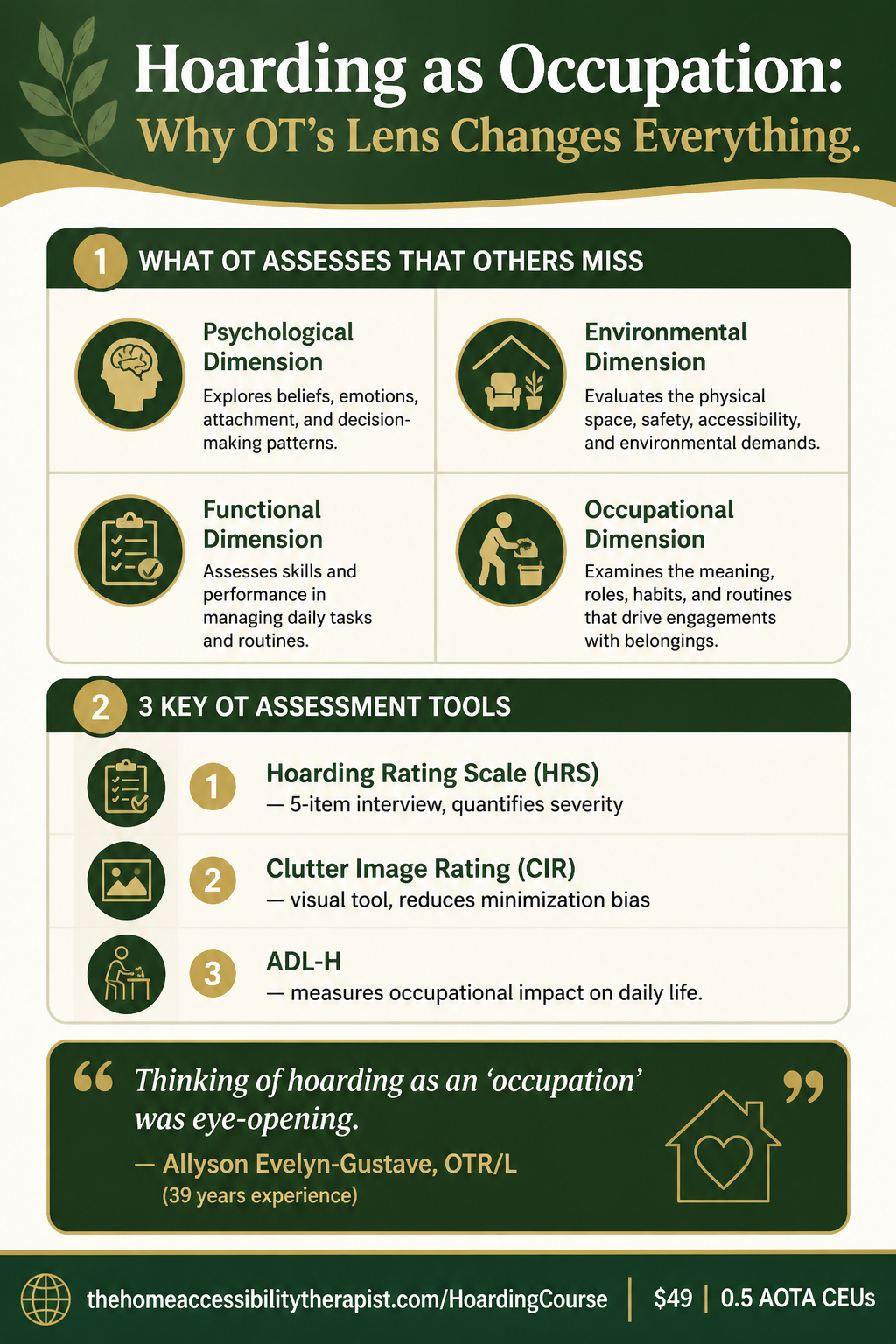
“Thinking of hoarding as an ‘occupation’ was eye-opening! The course was exceptional and moved beyond surface-level behaviors to explore the emotional and cognitive patterns that are often the underlying issues with hoarding. The training enhanced my clinical toolkit, but also strengthened my confidence in supporting individuals with hoarding behaviors in a way that is both person-centered and evidence-informed.”
That is the shift the occupational lens creates.
What Other Disciplines Miss — and What OT Uniquely Provides
Hoarding disorder presents at a clinical intersection that challenges virtually every discipline that encounters it. Mental health professionals may address the cognitive and emotional dimensions but typically lack training in environmental and functional assessment. Social workers bring essential housing and community resource expertise but may not be trained in the occupational impact of clutter on daily function. Family members and concerned others often bring frustration, pressure, and conflict rather than clinical structure.
Hoarding disorder affects an estimated 2.3%–6% of the adult population globally, with onset typically in adolescence that progressively worsens through adulthood (Bratiotis et al., 2021; Iervolino et al., 2009). It is associated with significant medical risk: hoarding-related fires spread beyond their source at six times the rate of non-hoarding-related fires (Bratiotis et al., 2021). Despite its prevalence and severity, it remains among the most undertreated clinical presentations in any discipline.
OTs hold a clinical framework that accommodates all dimensions of hoarding simultaneously:
- The psychological dimension: Emotional attachments to objects, cognitive distortions around saving and discarding, difficulties with decision-making, categorization, and attention — all neuropsychologically grounded features of the disorder (Bratiotis et al., 2021)
- The environmental dimension: Clutter severity across rooms, fire and fall hazards, blocked egress, structural and sanitation concerns
- The functional dimension: Which activities of daily life are compromised — can the client prepare a meal, sleep in the bed, use the bathroom, exit the home quickly?
- The occupational dimension: What roles, routines, and sources of meaning matter to this person, and how is hoarding behavior serving or undermining those roles?
No other discipline is routinely trained to hold and assess all four of these dimensions concurrently. That clinical breadth is OT’s competitive advantage in hoarding treatment.
Evidence-Based OT Assessment: Three Key Tools
Because hoarding is multidimensional, assessment must be too. Three validated tools are particularly well-suited to OT practice and are covered in depth in the hoarding course (The Home Accessibility Therapist LLC, 2024):
Hoarding Rating Scale (HRS): A brief five-item semi-structured interview that quantifies clutter, difficulty discarding, excessive acquisition, distress, and impairment on a 0–8 scale. A score of 14 or above indicates a probable clinical hoarding problem. The interview version has been shown to differentiate hoarding from non-hoarding participants and correlates strongly with other established measures of hoarding severity (Tolin et al., 2010; International OCD Foundation, 2024).
Clutter Image Rating (CIR): A visual assessment in which clients select standardized photographs that best represent the level of clutter in their kitchen, living room, and bedroom. Each room is rated on a 1–9 scale, with scores of 4 or above indicating clinically significant clutter. Because individuals with hoarding disorder commonly minimize the severity of their environment, a visual anchoring tool reduces this bias and produces a more clinically accurate baseline (Frost et al., 2008; International OCD Foundation, 2024).
Activities of Daily Living — Hoarding (ADL-H): A 15-item self-report scale — developed and validated by Frost, Hristova, Steketee, and Tolin (2013) — that directly measures the impact of clutter on specific daily occupations: cooking, using the refrigerator, bathing, sleeping in the bed, exiting the home quickly, and finding important documents, among others. Items are scored on a 1–5 scale; mean scores of 2.2 or above are typical of clinical hoarding populations. The ADL-H demonstrates strong internal consistency (α = .91–.92), good test-retest reliability (r = .79), and solid convergent and discriminant validity (Frost et al., 2013). It is the most occupationally direct of the three tools — and in an OT evaluation, it provides the direct link between assessment findings and treatment goals.

Why the Occupational Reframe Leads to Better Outcomes
The occupational reframe is not just philosophically elegant. It has direct clinical implications for treatment engagement and outcomes.
When clients experience their relationship with their possessions as understood rather than judged, therapeutic alliance strengthens — and alliance is one of the most robust predictors of treatment outcomes across all mental health interventions. When goals are framed around what the client wants to do rather than what they are expected to discard, ambivalence decreases. When the treating clinician understands what occupational need the hoarding behavior is meeting, interventions can be designed that address the same need through an adaptive, functional lens (Bratiotis et al., 2021; International OCD Foundation, Hoarding Center, 2024).
This is motivational interviewing in its truest OT application. Motivational interviewing — a core component of CBT-based hoarding treatment — uses reflective listening, exploration of ambivalence, and collaborative goal-setting to help clients identify and articulate their own reasons for change (International OCD Foundation, Hoarding Center, 2024). In an OT context, that process is grounded not just in behavior change theory but in occupational science: understanding that change must be connected to what matters to this person’s identity, roles, and daily life.
Build Your Practice in This Area
Occupational Therapy for Persons with Hoarding Disorder from The Home Accessibility Therapist LLC is an AOTA-approved course that covers the assessment tools, intervention frameworks — including motivational interviewing, CBT-informed strategies, environmental modification, and harm reduction — maintenance protocols, and interdisciplinary collaboration skills covered in this blog, and much more.
It is 0.5 AOTA-approved CEUs, self-paced, $49, and designed specifically for OT practitioners. Whether you are beginning to work with clients who hoard or seeking to deepen an existing practice area, this course will expand your clinical lens and your confidence.
👉 Enroll today: www.thehomeaccessibilitytherapist.com/HoardingCourse
References
American Occupational Therapy Association. (2020). Occupational therapy practice framework: Domain and process (4th ed.). American Journal of Occupational Therapy, 74(Supplement 2), 7412410010. https://doi.org/10.5014/ajot.2020.74S2001
Bratiotis, C., Muroff, J., & Lin, N. X. Y. (2021). Hoarding disorder: Development in conceptualization, intervention, and evaluation. Focus: The Journal of Lifelong Learning in Psychiatry, 19(4), 392–404. https://doi.org/10.1176/appi.focus.20210016
Frost, R. O., Steketee, G., Tolin, D., & Renaud, S. (2008). Development and validation of the Clutter Image Rating. Journal of Psychopathology and Behavioral Assessment, 30(3), 193–203. https://doi.org/10.1007/s10862-007-9068-7
Frost, R. O., Hristova, V., Steketee, G., & Tolin, D. F. (2013). Activities of daily living scale in hoarding disorder. Journal of Obsessive-Compulsive and Related Disorders, 2(2), 85–90. https://doi.org/10.1016/j.jocrd.2012.12.004
Iervolino, A. C., Perroud, N., Fullana, M. A., Guipponi, M., Cherkas, L., Collier, D. A., & Mataix-Cols, D. (2009). Prevalence and heritability of compulsive hoarding: A twin study. American Journal of Psychiatry, 166(10), 1156–1161. https://doi.org/10.1176/appi.ajp.2009.08121789
International OCD Foundation, Hoarding Center. (2024). Clinical assessment. https://hoarding.iocdf.org/professionals/clinical-assessment/
The Home Accessibility Therapist LLC. (2024). Occupational therapy for persons with hoarding disorder [Online course]. https://www.thehomeaccessibilitytherapist.com/HoardingCourse
Tolin, D. F., Frost, R. O., & Steketee, G. (2010). A brief interview for assessing compulsive hoarding: The Hoarding Rating Scale-Interview. Psychiatry Research, 178(1), 147–152. https://doi.org/10.1016/j.psychres.2009.05.001
Leave a Reply