
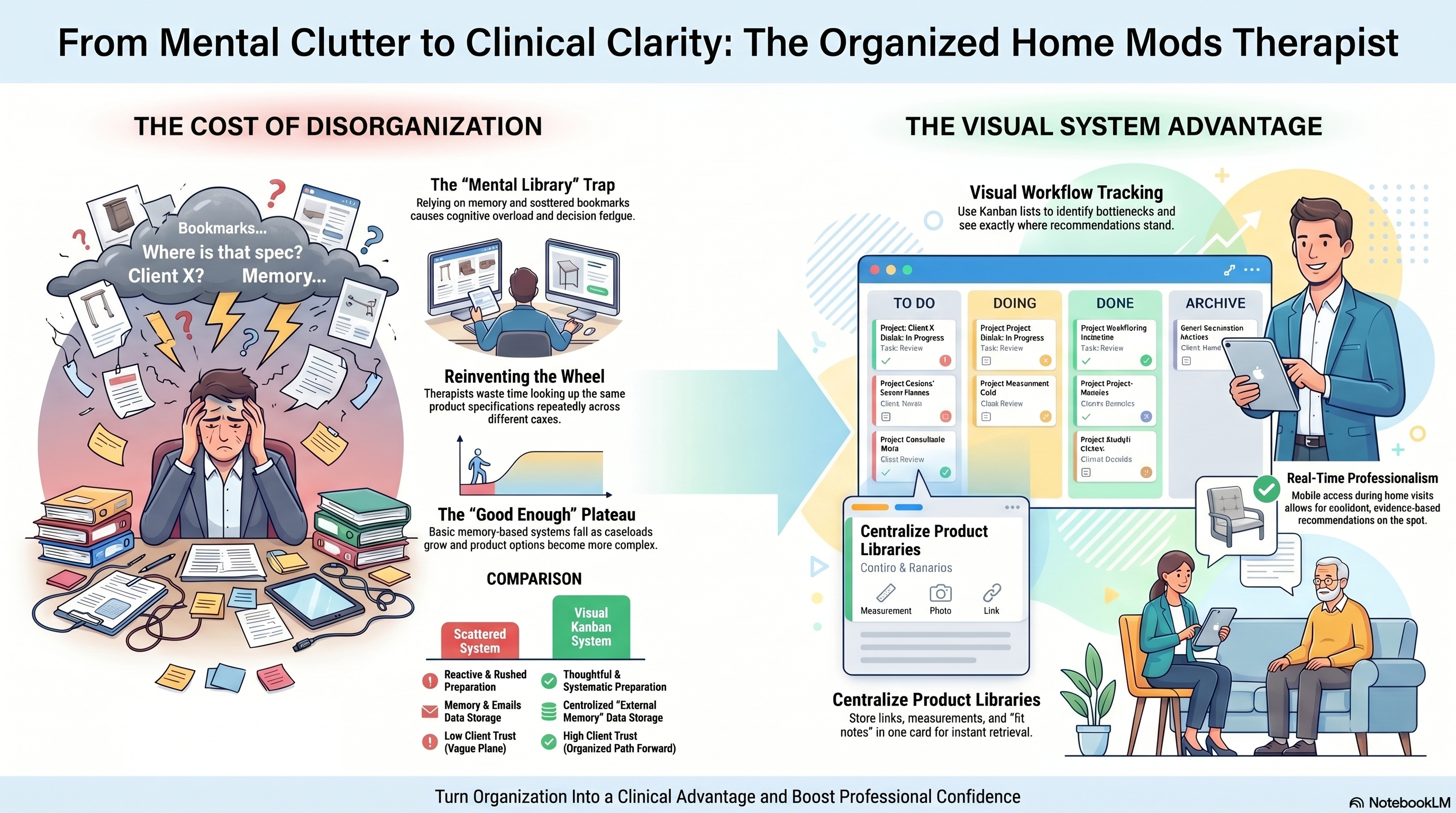
If you work in home modifications, you already know the hard part is not just identifying problems. The hard part is moving from “I know there’s a solution for this” to “I can quickly recommend the right solution, explain why it fits, and follow through with confidence.” A visual system like a Trello board or other Kanban-style setup can help because it organizes information into cards and lists, allows items to move through stages, and makes details easy to retrieve when work is in progress.
Many therapists carry a huge mental library of ideas: bath benches, transfer benches, handheld showers, grab bar layouts, raised toilet options, non-slip products, lighting changes, storage tweaks, shower chairs, tub rails, and communication tips for contractors. The problem is that when all of that information lives partly in memory, partly in email, partly in browser bookmarks, and partly in scattered notes, it becomes harder to use efficiently and consistently. External systems designed to capture and organize information function like an “external memory,” making information easier to recall and apply when needed.
That matters because every extra minute spent searching for an old link, trying to remember which bench fit a narrow tub, or rewriting the same recommendation from scratch is time and mental energy that could be spent on clinical reasoning and client care. Visual workflow systems are designed to improve efficiency by making work visible, showing where items are in the process, and reducing bottlenecks that slow progress.
Organization is not just a personal productivity issue. It directly affects the quality of recommendations, the consistency of documentation, and the confidence clients and families feel when they work with a therapist. When recommendations are easy to retrieve, clearly organized, and tied to real problems, the therapist looks prepared, thoughtful, and professional rather than reactive or rushed.
Why “good enough” organization stops working
In the beginning, many clinicians can get by with a few favorite products, handwritten notes, and a decent memory. That system often works when caseloads are small or recommendations are relatively repetitive. But as home modification practice grows, so does the number of products, diagnoses, bathroom layouts, funding situations, and family preferences a therapist has to juggle.
A recommendation is rarely just “get a bath bench.” It is usually more specific than that. It might be: “Choose a narrow bath bench with adjustable height because the tub opening is tight, the client fatigues easily, and the caregiver needs a setup that is quick to clean and simple to explain.” To make that kind of recommendation efficiently, the therapist needs not only product knowledge, but also a reliable way to store measurements, product links, pros and cons, fit notes, and clinical use cases.
Without a system, three common problems show up. First, therapists spend time reinventing the wheel by looking up the same categories of products over and over. Second, recommendations can become inconsistent because they depend too heavily on memory in the moment. Third, follow-through suffers because great ideas get buried in notebooks, tabs, or inboxes instead of moving toward action.
This is where organization becomes a clinical advantage, not just an administrative preference. A structured recommendation system makes it easier to compare options, explain choices, and revisit previous ideas when a client’s needs change. That kind of structure supports better judgment because the therapist is not trying to carry every detail mentally.

Why an organized system makes therapists more efficient
Efficiency in home modifications is not about rushing through visits. It is about reducing wasted effort so that more time goes toward problem-solving, education, and relationship-building. Kanban-style boards are specifically built to visualize work, organize tasks and information, and improve flow by showing what is waiting, what is active, and what is complete.
Think about how often small inefficiencies stack up in daily practice. Searching an email for a product link here, opening five tabs to compare benches there, trying to remember which recommendation worked well for a client with similar transfer needs, or flipping through notes to locate measurements from a past visit. Each task may take only a few minutes, but together they create friction that slows decisions and contributes to cognitive overload. External systems reduce that burden by storing ideas and notes in one place for easy recall.
A Trello-style board can act as a working recommendation library and a live case-management tool at the same time. Cards can hold product names, measurements, vendor links, photos, notes, checklists, due dates, and comments, while lists can be used to represent stages of progress or categories of information. That means one card for “bath bench options” can hold the exact details needed later instead of forcing the therapist to start over every time.
Efficiency also improves when the therapist can see the whole workflow. A board can make it obvious which recommendations are still under consideration, which need measurements or contractor input, which have been approved, and which are complete. Visual workflow tools are designed to expose bottlenecks in real time, which helps users identify where work is getting stuck.
Just as important, Trello can be accessed on mobile devices, which makes it practical during home visits when the therapist is with the client and needs to retrieve or record information on the spot. That matters because many of the best recommendations happen in the context of the actual space, not later at a desk when details are easier to forget.
Why better organization leads to better recommendations
Being organized does not just help a therapist work faster. It helps the therapist work better. When options are captured in a consistent way, it becomes easier to match the recommendation to the client instead of defaulting to whatever product comes to mind first.
For example, a strong recommendation system might track product category, size range, transfer style, cleaning considerations, cost level, installation needs, ideal user profile, and common cautions. A bath bench card might include notes such as: “Best for clients who can step into tub but need seated bathing,” “check tub edge clearance,” “watch for fit in narrow bathrooms,” and “good option when fatigue is a major factor.” Cards are meant to store exactly this kind of detailed task or idea information, including descriptions and supporting material.
That structure improves clinical reasoning in two ways. First, it helps the therapist compare relevant options quickly. Second, it helps the therapist explain the reasoning behind the final choice in a more precise and confident way. Rather than saying, “Let’s try some kind of shower seat,” the therapist can say, “A standard bath bench fits your layout better than a transfer bench because you are already stepping into the tub safely, but fatigue and standing tolerance make seated bathing the safer option.” A well-organized system supports clear, accessible retrieval of details needed for that level of explanation.
A more organized library also improves continuity. The same product knowledge, measurement notes, and rationale can be reused and refined over time instead of disappearing after one case. That makes each client encounter build the practice’s knowledge base rather than starting from zero.
Why organization makes therapists look more professional
Clients and families may not care whether a therapist uses Trello, a spreadsheet, a database, or a paper binder. What they do notice is whether the therapist appears clear, prepared, and systematic. A professional image is built when recommendations feel thoughtful rather than improvised.
Consider the difference between these two experiences. In one, the therapist says, “I think there’s a bench that might work; I’ll have to look it up later.” In the other, the therapist opens a phone or tablet, pulls up a category of bench options, reviews a few fit notes, and says, “Here are the two models I usually compare in bathrooms like this. Let’s measure the opening and narrow it down now.” The second interaction communicates preparation, clarity, and confidence. Mobile access to a board supports that kind of in-visit retrieval.
Professionalism also grows when documentation becomes cleaner. If the therapist already has organized records of product options, measurements, rationale, and next steps, those details are easier to turn into concise recommendations and defensible notes. Cards can hold supporting details, while lists can reflect progress from idea to implementation, which mirrors the logic many clinicians need in documentation.
There is also a subtle but important trust effect. When clients see that recommendations are tracked, updated, and followed through, they are more likely to believe that the process is real and manageable. A visual workflow turns a vague “someday” plan into an organized path forward.

What a Trello-style system could look like
A Trello-style system does not need to be complicated to be useful. Trello boards organize work into lists and cards, and cards can be customized with descriptions, checklists, due dates, and other details. For home modification therapists, that structure can be adapted in a few different ways.
One option is a recommendation library board. Lists might include categories such as Bathing, Toileting, Transfers, Lighting, Flooring, Storage, Entry Access, and Caregiver Supports. Each card represents one product or solution, such as “standard bath bench,” “transfer bench,” “vertical grab bar at tub entry,” or “motion-sensor night light.” The card can hold photos, links, ideal use cases, measurements, cautions, and notes from past experience.
A second option is a client planning board. Lists might include Pain Points, Ideas & Options, Recommended Plan, In Progress, Waiting on Family/Contractor, and Completed. This creates a visual workflow where cards move from discussion to decision to implementation, which matches how Kanban boards are intended to show progress through a process.
A third option is a hybrid system. One board stores reusable recommendations, and a second board tracks active client decisions. This separates the long-term knowledge library from the short-term workflow, while still keeping both in an easy-to-access visual format.
Templates can make this even faster. Trello supports card templates, which means a therapist can create a standard card layout for equipment recommendations or client problem statements and reuse it over and over. That reduces repetitive writing and helps keep information consistent across cases.
Trello is one option, not the only option
Trello is a strong choice because it is visual, flexible, and mobile-friendly, but the larger idea is bigger than one app. The real goal is to create a “trusted external system” for recommendations and workflow rather than depending on memory alone.
Other useful options include:
- A spreadsheet for sortable product comparisons, especially if cost, dimensions, and vendors matter most.
- A note app for quickly capturing photos, voice notes, and field observations when the main need is fast documentation.
- A cloud folder system with standardized product sheets, printable recommendations, and common education handouts.
- A simple paper binder or laminated field guide for therapists who prefer an offline option during visits.
The best system is usually the one that people will actually use consistently. Productivity guidance on note-taking systems repeatedly emphasizes choosing a method that fits work habits and supports regular capture and retrieval rather than chasing the “perfect” tool.
A simple way to get started
The easiest way to build a more organized practice is not to catalog everything at once. Start with one high-frequency problem area, such as bathroom equipment. Build a small library of your most common recommendations: bath benches, transfer benches, handheld showers, grab bars, raised toilets, non-slip solutions, and lighting aids. Add measurements, ideal use cases, client fit notes, and links.
Next, decide on a few workflow stages. For example: “Ideas,” “Need measurements,” “Recommended,” “Waiting on decision,” and “Implemented.” Kanban systems work best when stages are clear enough to show where each item currently stands.
Then, during the next home visit, use the system in real time. Pull up a relevant card, confirm measurements, add a note about the client’s transfer pattern, and move the recommendation to the next stage. This is where the organization system stops being theoretical and starts saving time in practice. Mobile access makes that in-visit use especially practical.
Over time, the board becomes more than a collection of products. It becomes part of the therapist’s clinical infrastructure: a recommendation library, a documentation aid, a follow-up tracker, and a visible sign of professionalism all in one.
Closing thought
Home modification therapists do not need more random product links. They need a reliable system for turning observations into organized, defensible recommendations that can move from idea to action. Visual boards like Trello are effective for this because they store detailed information in cards, organize it into meaningful lists, and support workflow tracking across stages.
When recommendations are organized, therapists waste less time searching, give clearer advice, document more consistently, and present themselves with greater confidence. That does not just make the work feel easier. It makes the service better for clients, caregivers, and referral partners too.
Leave a Reply