
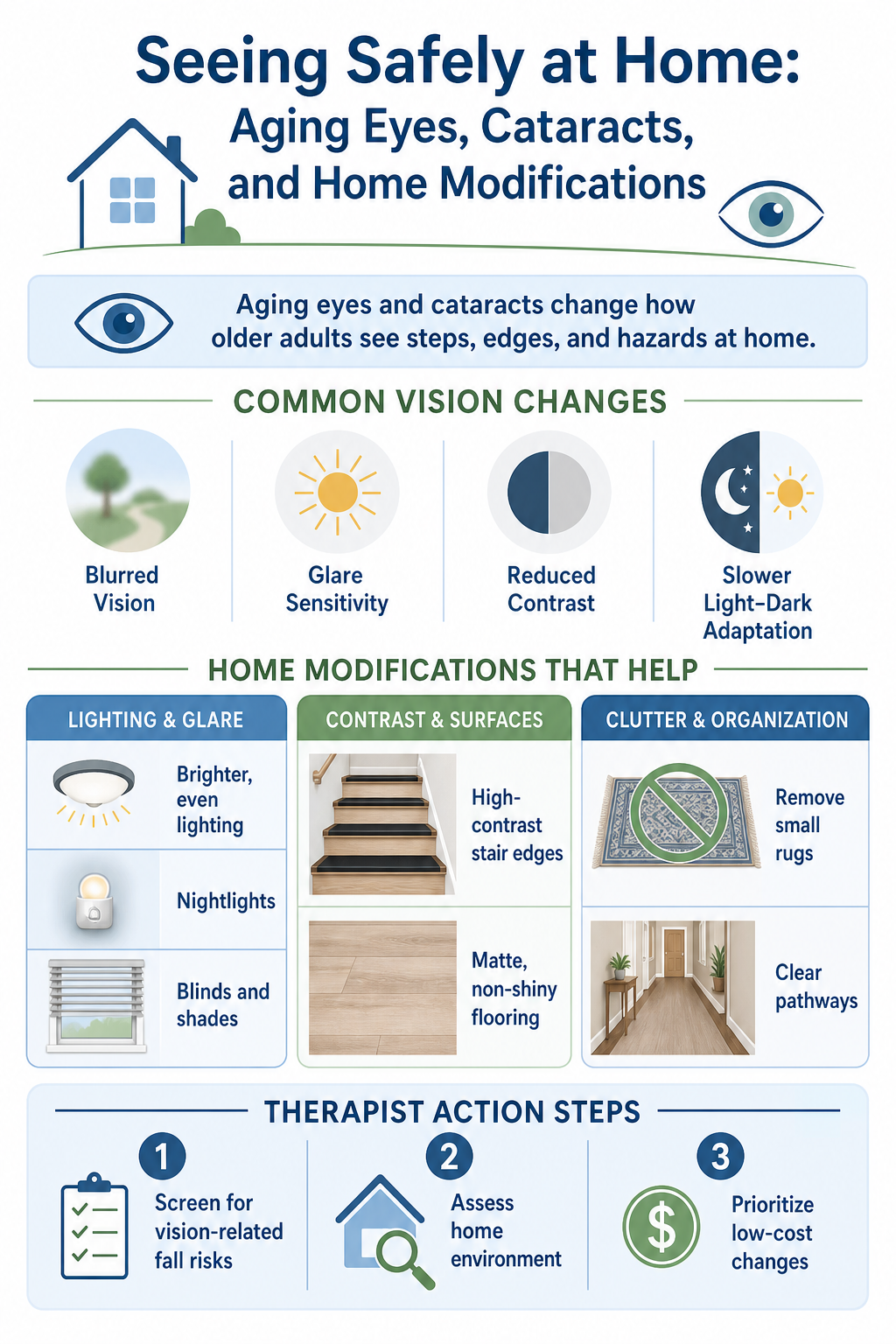
Vision changes are so common with aging that many people treat them as an inconvenience rather than a meaningful home safety issue. The problem is that blurred vision, glare sensitivity, poorer contrast sensitivity, and slower adjustment to changes in lighting can quietly reshape how a person moves through the home, completes daily tasks, and responds to everyday hazards (Cleveland Clinic, 2023; Hayden Vision, 2024; Saftari & Kwon, 2018). For older adults, those changes are tied to a higher risk of falls, especially when the home environment adds poor lighting, clutter, reflective surfaces, and hard-to-see edges (Steinman et al., 2009; CDC, 2024; Zhu et al., 2024).
Cataracts deserve special attention because they are one of the most common age-related causes of visual decline. They cloud the natural lens of the eye and can make vision seem foggy or dim, reduce color clarity, increase sensitivity to glare, and make night vision harder (Cleveland Clinic, 2023; Hayden Vision, 2024; Thomas H, 2024). In practical terms, that can mean trouble seeing stair edges, reading appliance controls, identifying medications, or feeling confident moving from a bright room into a darker hallway (Hayden Vision, 2024; Thomas H, 2024). For occupational therapists, this creates a clear opportunity: the home itself can be modified to reduce risk and support participation while the person is aging with visual change, waiting for surgery, or adapting after treatment (Cha, 2025; Stark et al., 2017).
Why aging vision matters at home
Typical age-related vision change is not limited to needing reading glasses. Older adults often need more light to see clearly, have more difficulty adapting from light to dark settings, and show reduced contrast sensitivity, meaning they may struggle to distinguish an object from the background around it (Hayden Vision, 2024; Thomas H, 2024; Saftari & Kwon, 2018). Those changes affect mobility because safe walking depends on seeing depth, edges, obstacles, and surface changes accurately (CDC, 2024; Jin et al., 2024; Saftari & Kwon, 2018).
Cataracts can intensify those age-related challenges. Common symptoms include blurred vision, faded colors, halos around lights, poorer night vision, and increased glare from sunlight, headlights, or glossy indoor surfaces (Cleveland Clinic, 2023; Thomas H, 2024). A person may still describe their eyesight as “good enough,” yet begin avoiding stairs, limiting outings after dusk, or reaching less confidently for items in the kitchen and bathroom (Hayden Vision, 2024; Pepose Vision Institute, 2025). That is often how function declines at home: not through one dramatic event, but through a series of small visual mismatches between the person and the environment.
Research supports taking those changes seriously. A review of aging vision and falls found that declines in visual function impair gait and balance control and increase fall risk in older adults (Saftari & Kwon, 2018). More recent research has shown that contrast sensitivity impairment is consistently associated with recent and recurrent falls, which is especially relevant because contrast problems are common in aging eyes and cataracts (Jin et al., 2024). The CDC also notes that vision impairment increases the risk of falls among older adults, reinforcing that this is a public health issue, not merely a comfort issue (CDC, 2024).
What the research says about falls and the home environment
The relationship between vision loss and falls is shaped not only by the body, but also by the home. Research examining older adults has found that home hazards play a central role in the relationship between poor vision and falling, suggesting that environmental risk is not secondary; it is part of the pathway that turns visual impairment into injury (Xu et al., 2026). Earlier work also found that vision, home modification status, and physical function interact in meaningful ways when fall risk is examined in community-dwelling older adults (Steinman et al., 2009).
This matters because home modifications are one of the few risk factors therapists can often change quickly. A recent systematic review of home modifications for aging in place reported that most included studies found benefits related to fall prevention, functional independence, and cost savings (Cha, 2025). Reviews focused on home modification interventions also report strong evidence for interventions that include occupational therapists, particularly when changes are tailored to the person and their performance limitations (Stark et al., 2017). Even though not every study shows a dramatic short-term effect, the larger pattern supports targeted environmental change as part of a fall-prevention strategy (Cha, 2025; Stark et al., 2017; E J-Y et al., 2020).
The low-vision evidence is nuanced, and that nuance is useful. A Cochrane review on home improvements and related strategies for older people with low vision concluded that home changes may make little difference to falls after six months but may slightly reduce risk after one year, with the certainty of evidence rated low (E J-Y et al. 2020). This does not mean modifications are unhelpful. It suggests that outcomes depend on the type of modification, the individual’s habits and health status, and whether the intervention is part of a broader plan that includes education, mobility strategies, and follow-through over time (Stark et al., 2017; Steinman et al., 2009; E J-Y et al., 2020).
Cataracts and fall risk
Cataracts are often discussed primarily in terms of surgery, but from a home safety perspective the period before surgery matters greatly. During that time, people may be dealing with reduced clarity, glare disability, faded contrast, and hesitation in dim or visually busy areas of the home (Cleveland Clinic, 2023; Thomas H, 2024). Those changes can contribute to falls directly by making obstacles and level changes harder to detect, and indirectly by reducing confidence and changing gait speed or movement strategies (Jin et al., 2024; Saftari & Kwon, 2018).
The research on cataracts and falls is not perfectly uniform, but it still provides useful direction. A 2024 study reported fewer falls in older adults who had undergone cataract surgery than in those with cataracts, although surgery was not a statistically significant protective factor after regression modeling (Reza Heidarzadeh et al., 2024). A prospective cohort study in Ghana concluded that cataract surgery significantly reduced fall prevalence among older adults (Kyei et al., 2024). In contrast, another study found that older adults with cataracts did not show a clear association between cataract-related vision impairment and balance disorders on selected tests (Nodehi Moghadamet et al., 2015). Taken together, these findings suggest that cataracts are one important piece of fall risk, but not the only one; medication burden, gait speed, general health, and the home environment all influence whether visual decline leads to injury (Nodehi Moghadamet al., 2015; Reza Heidarzadeh et al., 2024).
For therapists, that is actually helpful news. It means the best response is rarely “wait for surgery.” Instead, the home can be adapted right away while medical treatment proceeds on its own timeline (Thomas H, 2024; ReFocus Eye Doctors, n.d.).
Lighting: the most important first step
If there is one theme that appears across clinical guidance for aging vision and low vision, it is lighting. Older eyes typically need more illumination for the same task, but they also become more sensitive to glare, so the goal is not simply “brighter.” The goal is even, sufficient, controllable light (Hayden Vision, 2024; Deafblind Information Australia, 2022).
At home, this often starts with increasing ambient lighting in hallways, stairways, entrances, bathrooms, and kitchens (Deafblind Information Australia, 2022; Iowa City Hospice, 2023; Crater Community Hospice, 2024). Additional fixtures, brighter compatible bulbs, under-cabinet lighting, and task lamps at reading or work areas can make surfaces and objects easier to identify (Deafblind Information Australia, 2022; Iowa City Hospice, 2023). Nightlights in bedrooms, hallways, and bathrooms are especially valuable because low-light navigation is often one of the first places age-related visual decline becomes functionally obvious (Iowa City Hospice, 2023; Serious Illness Care, 2024).
Just as important is glare control. Sunlight through windows, polished floors, glossy countertops, and bare bulbs can create visual scatter that is especially troublesome for people with cataracts (Cleveland Clinic, 2023; Hayden Vision, 2024; Deafblind Information Australia, 2022). Guidance for people with low vision recommends blinds or shades that allow better control of natural light, diffusers on fixtures, and avoiding high-gloss paints and shiny finishes that reflect light harshly (Deafblind Information Australia, 2022; Iowa City Hospice, 2023; Crater Community Hospice, 2024). In practice, therapists can often improve function substantially by changing both the amount and quality of light in the home.
Contrast, edges, and visual clarity
Contrast sensitivity is one of the most functionally important parts of vision in the home, and recent evidence shows that contrast sensitivity impairment is consistently associated with recent and recurrent falls in older adults (Zhu et al., 2024). When contrast is poor, it becomes harder to tell where one surface ends and another begins. A white toilet against a white wall, a beige step on a beige staircase, or a glass shower door with no visible markings can all create uncertainty (Deafblind Information Australia, 2022; Iowa City Hospice, 2023).
Home modifications that strengthen contrast are often inexpensive and highly practical. Contrasting tape on stair edges, shelf edges, and the bottom of cupboard doors can improve visual detection of boundaries (Deafblind Information Australia, 2022; Iowa City Hospice, 2023). Grab bars that stand out from the wall rather than blending into tile make it easier to orient quickly during transfers (Crater Community Hospice, 2024). Switch plates, door handles, and appliance controls are also easier to use when they are visually distinct from surrounding surfaces (Deafblind Information Australia, 2022; Iowa City Hospice, 2023).
Color choice matters too, but not in a decorative sense alone. High-contrast combinations help the person “read” the environment more easily, while busy patterns can create visual confusion (Deafblind Information Australia, 2022; Iowa City Hospice, 2023). Solid flooring is usually better than heavily patterned rugs or carpets, and matte finishes are preferable to reflective surfaces that add glare (Deafblind Information Australia, 2022). In kitchens and bathrooms, contrasting linens, mats, toilet seats, and countertop work areas can all support safer and more efficient task performance (Crater Community Hospice, 2024; Iowa City Hospice, 2023).
Clutter, organization, and task performance
Many falls do not happen because the person cannot see anything at all; they happen because visual processing is strained by unnecessary complexity. Cluttered pathways, decorative furniture placed into walking routes, loose cords, and small movable rugs create hazards that become harder to detect as vision declines (Thomas H, 2024; Hayden Vision, 2024). For someone with cataracts, a dim room plus poor contrast plus floor clutter can be enough to transform a familiar route into a fall risk.
Decluttering, however, should not be understood as simply “getting rid of things.” Good environmental design also involves organization and consistency. Clear storage systems, labeled containers, and predictable placement of frequently used items reduce the amount of visual scanning needed for daily tasks (Deafblind Information Australia, 2022; Iowa City Hospice, 2023; Crater Community Hospice, 2024). In kitchens, this may include assigning one well-lit prep area, using contrasting mats under important objects, and ensuring appliance markings are easy to read (Iowa City Hospice, 2023; Crater Community Hospice, 2024). In bathrooms, it may mean grouping supplies into one visible caddy and marking hot and cold controls so they can be identified quickly (Crater Community Hospice, 2024).

Assistive strategies and interdisciplinary care
Home modification works best when paired with broader low-vision strategies. Updated eyeglass prescriptions, magnifiers, large-print labels, enlarged digital settings, and nonvisual cues such as tactile markers on controls can all extend functional independence (Hayden Vision, 2024; JEVS Human Services, 2024; Deafblind Information Australia, 2022). Referral to low-vision rehabilitation or ophthalmology is also important when a person reports increasing glare, blurred vision, reduced reading tolerance, or growing avoidance of everyday tasks (Cleveland Clinic, 2023; Thomas H, 2024; ReFocus Eye Doctors, n.d.).
Therapists can play a valuable bridging role here. A home visit may reveal that the problem is not only visual acuity, but the interaction among cataracts, medication load, gait speed, fear of falling, and environmental demands (Reza Heidarzadeh et al., 2024; Jin et al., 2024). That broader view supports better recommendations: changing the home, coaching the client and family, and referring medically when the pattern suggests cataract progression or another eye condition.
What this means for practice
The research does not support a one-size-fits-all checklist. It supports individualized assessment with special attention to lighting, glare, contrast, clutter, flooring, and task setup (Cha, 2025; Stark et al., 2017; E J-Y et al., 2020). It also suggests that therapists should pay close attention to contrast sensitivity and environmental hazards, not just whether a client says they can “see okay” (Xu et al., 2026; Jin et al., 2024; Saftari & Kwon, 2018).
For a therapist-facing practice, this area is a strong fit for home accessibility work because the recommended changes are often practical, visible, and immediately relevant to daily life. A comprehensive home evaluation for aging vision or cataracts can include stair safety, bathroom transfers, kitchen access, medication management, night mobility, and outdoor entry lighting, all tied back to participation goals the client actually values (CDC, 2024; Deafblind Information Australia, 2022; Crater Community Hospice, 2024; Iowa City Hospice, 2023). That is where environmental modification becomes most effective: not as generic safety advice, but as a targeted clinical intervention.
Aging eyes change how home is experienced. Cataracts can intensify that shift, but the research shows that the home environment remains modifiable. When therapists address lighting, contrast, glare, clutter, and everyday task setup, they can reduce risk and help older adults continue to move through home with more confidence, safety, and independence (Cha, 2025; CDC, 2024; Jin et al., 2024; E J-Y et al., 2020).
References
Centers for Disease Control and Prevention. (2024, May 15). About vision impairment and falls among older adults. U.S. Department of Health and Human Services. https://www.cdc.gov/vision-health/prevention/older-adult-falls.html
Cha S. M. (2025). A Systematic Review of Home Modifications for Aging in Place in Older Adults. Healthcare (Basel, Switzerland), 13(7), 752. https://doi.org/10.3390/healthcare13070752
Cleveland Clinic. (2023, August 14). Cataracts: Signs, symptoms & treatment options. https://my.clevelandclinic.org/health/diseases/8589-cataracts-age-related
Crater Community Hospice. (2024, December 3). Home modifications for vision loss. https://seriousillness.org/richmond/handout/home-modifications-for-vision-loss/
Deafblind Information Australia. (2022, October 16). Adapting the environment. https://www.deafblindinformation.org.au/living-with-deafblindness/adapting-the-environment/
E J-Y, Li T, McInally L, Thomson K, Shahani U, Gray L, Howe TE, Skelton DA. Environmental and behavioural interventions for reducing physical activity limitation and preventing falls in older people with visual impairment. Cochrane Database of Systematic Reviews 2020, Issue 9. Art. No.: CD009233. DOI: 10.1002/14651858.CD009233.pub3.
Hayden Vision. (2024, February 5). What you need to know about age-related vision changes. https://www.haydenvision.com/cataracts-and-aging-what-you-need-to-know-about-age-related-vision-changes/
Iowa City Hospice. (2023, February 13). Home modifications for vision loss. https://iowacityhospice.org/home-modifications-for-vision-loss/
Jin, H., Zhou, Y., Stagg, B. C., & Ehrlich, J. R. (2024). Association between vision impairment and increased prevalence of falls in older US adults. Journal of the American Geriatrics Society, 72(5), 1373–1383. https://doi.org/10.1111/jgs.18879
Kyei, S., et al. (2024). Cataract blindness related falls among older adults: A prospective cohort study in Ghana. Energy and Environment Research. https://journal.hep.com.cn/eer/EN/PDF/10.1002/eer3.23
Nodehi Moghadam, A., Goudarzian, M., Azadi, F., Hosseini, S. M., Mosallanezhad, Z., Karimi, N., Larne, Y., Habibi, M., & Yaghmaei, P. (2015). Falls and postural control in older adults with cataracts. Medical journal of the Islamic Republic of Iran, 29, 311.
Pepose Vision Institute. (2025, October 2). 7 ways cataracts affect your daily life. https://peposevision.com/7-ways-cataracts-affect-your-daily-life/
ReFocus Eye Doctors. (n.d.). Can my vision change after cataract surgery? https://fairfield.refocuseyedoctors.com/article/can-your-eyes-get-worse-after-cataract-surgery/
Reza Heidarzadeh, H., Derakhshan, A., Hossein Ghavami Shahri, S., Reza Ansari Astaneh, M., Bakhtiari, E., Shokouhi Rad, S., & Abrishami, M. (2024). Visual and Demographic Risk Factors for Falls and the Impact of Cataract Surgery in Elderly Patients. Journal of ophthalmic & vision research, 19(3), 306–312. https://doi.org/10.18502/jovr.v19i3.13536
Saftari, L. N., & Kwon, O. S. (2018). Ageing vision and falls: a review. Journal of physiological anthropology, 37(1), 11. https://doi.org/10.1186/s40101-018-0170-1
Steinman, B. A., Pynoos, J., & Nguyen, A. Q. (2009). Fall risk in older adults: roles of self-rated vision, home modifications, and limb function. Journal of aging and health, 21(5), 655–676. https://doi.org/10.1177/0898264309338295
Stark, S., Keglovits, M., Arbesman, M., & Lieberman, D. (2017). Effect of Home Modification Interventions on the Participation of Community-Dwelling Adults With Health Conditions: A Systematic Review. The American journal of occupational therapy : official publication of the American Occupational Therapy Association, 71(2), 7102290010p1–7102290010p11. https://doi.org/10.5014/ajot.2017.018887
Thomas H (2024, June 12). Cataracts: Essential information for aging adults and caregivers on symptoms and treatment. JEVS Human Services. https://www.jevshumanservices.org/cataracts-essential-information-for-aging-adults-and-caregivers-on-symptoms-and-treatment/
Xu, S., Clarke, P., Sun, M. J., & Ehrlich, J. R. (2026). The Role of Home Hazards in the Association Between Visual Function and Falls in Older Adults. JAMA ophthalmology, 144(2), 121–128. https://doi.org/10.1001/jamaophthalmol.2025.5057
Leave a Reply