
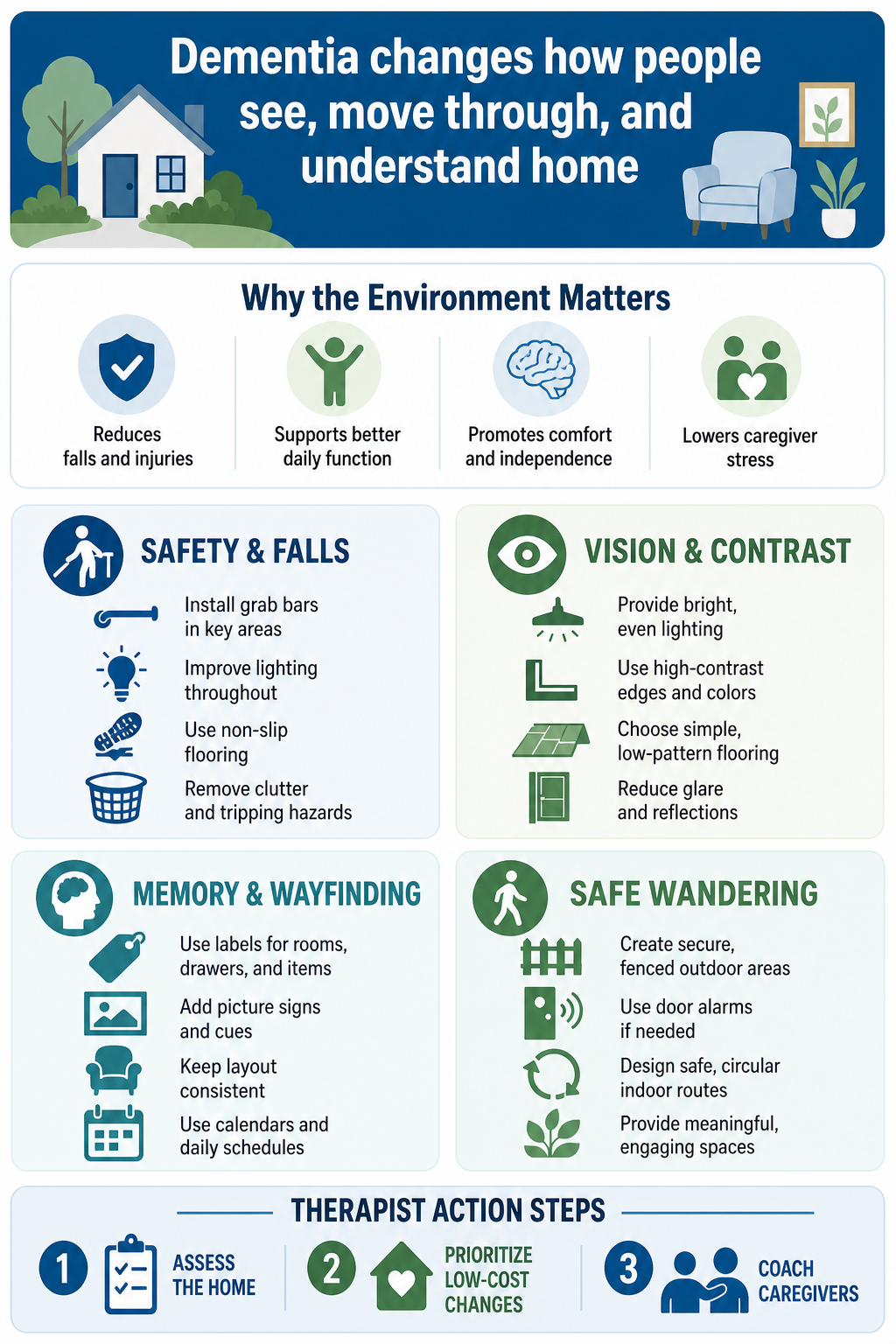
Alzheimer’s and other dementias change how a person moves, sees, and makes sense of their surroundings—but the home often stays exactly the same. Research is showing that this mismatch matters. Thoughtful home modifications can lower fall risk, support independence, and ease caregiver stress for people living with dementia (Struckmeyer & Pickens, 2016; Cha, 2025; Dalvand et al., 2024; Stark et al., 2017).
Why the home environment matters in dementia
Dementia is not just about memory. Changes in attention, visual perception, judgment, and problem solving all affect how a person navigates their home. Hallway clutter that once felt cozy can become an obstacle course. Shiny floors may look “wet,” patterned rugs may read as holes, and a dim bathroom can feel like a trap rather than a safe place to go (Fisher Center, 2010; Bright Focus, 2024; NHS, 2025: Taylor, 2023).
Multiple studies on home modifications for older adults, including those with dementia, show that changing the environment—not just the person—can reduce falls, improve performance of daily activities, and help people remain at home longer. Occupational therapy research specific to Alzheimer’s disease also links home modifications to decreased caregiver stress and better day‑to‑day function. (Cha, 2025; Dalvand et al., 2023; Stark et al., 2017; Allen et al., 2021; Freedman & Agree, 2008: Hutchinson et al., 2026; Struckmeyer & Pickens, 2016)
For therapists, this is encouraging: the home is not a fixed risk; it is a treatment tool.
1. Safety and falls: clearing the path
Falls are common in dementia and can quickly derail plans to age in place. The evidence for home modifications as a fall‑prevention strategy in older adults with cognitive impairment is growing. A recent review and randomized controlled trial concluded that environmental changes significantly reduced fall risk in older adults with dementia when modifications were tailored and implemented with professional support (Dalvand et al., 2023; Cha, 2025).
Key safety‑oriented modifications that show up again and again in research and guidelines include:
- Removing loose rugs and cords, and simplifying walkways to create clear routes through the home (BrightFocus, 2024; NHS, 2025; Yu, 2025; Fisher Center, 2010) .
- Adding non‑slip flooring or non‑skid strips in bathrooms, showers, and on stairs (NHS, 2025; Yu, 2025; Fisher Center, 2010; BrightFocus’ 2024) .
- Installing secure handrails on both sides of stairs, plus grab bars in tubs and near toilets (Struckmeyer & Pickens, 2016; Fisher Center, 2010 BrightFocus, 2024).
- Improving lighting in hallways, on stairs, and in bathrooms, with particular attention to eliminating deep shadows and glare that can distort depth perception (Taylor, 2023; Yu, 2025; Fisher Center, 2010; BrightFocus, 2024; NHS, 2025).
These are classic “fall‑prevention” moves, but in dementia the rationale is more nuanced. A person may misinterpret a darkened doorway as a hole, hesitate, and then lose balance. Or they may rush through a poorly lit hallway because it feels unfamiliar. When we adjust light and visual information, we are not just strengthening safety—we are reducing the cognitive load required to move.
2. Vision, contrast, and perception
Several dementia design resources emphasize that the same home can be either confusing or supportive depending on how it uses color and contrast (Yu, 2025; AFA, 2025; BrightFocus, 2024; NHS, 2010; Taylor, 2023; Grey et al., 2015; Fisher Center, 2010 ). For example:
- Choosing matte, non‑shiny flooring in a color that clearly contrasts with the walls helps people see where the floor begins and ends, and reduces the perception that the floor is wet or uneven.
- Using contrasting colors for key items—like a toilet seat that stands out from the floor and wall, or brightly colored plates against a darker table—makes it easier to find and use those items independently.
- Avoiding bold patterns or stripes on floors and carpets can prevent misperceptions of “holes,” “steps,” or moving objects that increase anxiety and resistance to walking.
Better lighting is a recurring theme. Guidance from dementia organizations and health services recommends maximizing natural light, adding task lighting in high‑risk areas, and using even, consistent lighting to reduce glare and shadows. For therapists, that might mean recommending brighter bulbs, open curtains, motion‑activated nightlights, or additional fixtures on stairways and at entrances.
3. Memory, orientation, and wayfinding
Environmental modifications do more than prevent injury; they can support cognition by externalizing memory and orientation. Dementia‑friendly home guidelines highlight a number of low‑tech, high‑impact strategies (AFA, 2025; NHS, 2010; Tayor, 2023; Yu, 2025; AFA, 2021; BrighFocus, 2024):
- Clear labels and picture signs on doors (bathroom, bedroom, kitchen) and cupboards (dishes, clothes, toiletries) to cue function.
- Large, easy‑to‑read clocks and calendars in key locations to anchor the person in time.
- Consistent placement of frequently used items (keys, wallet, remote, grooming tools) in visible, labeled spots.
- Simple, uncluttered noticeboards or whiteboards listing the day’s schedule, medications, or key reminders.
Research and practice‑based guidelines stress the importance of consistency. Frequent rearranging or “tidying” can be destabilizing for a person who uses familiar objects as landmarks. When we coach families to change the environment, we are also coaching them to then hold that environment steady.
4. Wandering, exits, and “safe freedom”
Wandering or “walking with purpose” is common in dementia. The goal of home modification is not to stop movement, but to make it safer. Dementia care resources recommend pairing environmental controls with safe opportunities to walk (Taylor, 2023; Yu, 2025; AFA, 2021; AFA, 2025; BrightFocus, 2024).
Commonly endorsed strategies include:
- Fencing the yard and adding secure gates to allow safe outdoor wandering.
- Adding door alarms, chimes, or motion detectors at exits to alert caregivers when the person is on the move.
- Placing locks higher or in less obvious locations on exterior doors, while ensuring fire safety and local code compliance.
- Creating clear, circular walking routes inside the home and avoiding “dead ends” that can trigger frustration.
Some resources also discuss ID or GPS bracelets and neighbor/police notification plans as part of a broader environmental safety net. For therapists, this opens the door to interdisciplinary collaboration—linking environmental recommendations with community and technology resources.
5. Impact on caregivers and aging in place
A key finding from the occupational therapy literature is that home modifications for people with Alzheimer’s disease can facilitate safer performance of daily tasks while decreasing caregiver strain. When transfers are easier, bathrooms are safer, and routes are clearer, caregivers expend less physical and emotional energy on “putting out fires” and can focus more on meaningful interaction (Stark et al., 2017; Allen et al., 2021; Struckmeyer & Pickens, 2016).
Broader aging‑in‑place studies report that home modifications are associated with improved physical health, fewer falls, and greater ability to remain at home, as well as better social outcomes through easier access for visitors (Freedman & Agree, 2008; Hutchinson et al., 2025; Struckmeyer, 2019; Cha, 2025; Allen et al., 2021) For couples aging together—like in case studies of spouses caring for partners with dementia—environmental changes often become the deciding factor between institutionalization and continued co‑residence.
From a practice standpoint, this means that a dementia‑focused home assessment followed by targeted modifications and caregiver coaching is not an “extra.” It is central to sustainable care.

Bringing this into your clinical practice
For therapists, Alzheimer’s and Brain Awareness Month is an ideal time to:
- Offer structured “dementia‑friendly home” assessments that look at lighting, contrast, layout, signage, safety, and wandering routes.
- Translate research into a short, prioritized list of recommendations for each family, balancing low‑cost fixes (labels, lighting, decluttering) with larger modifications (grab bars, railings, flooring changes, ramps).
- Provide hands‑on caregiver education so the environment stays consistent and new features (alarms, locks, signage) are used effectively.
The evidence is clear: when we treat the home as part of the care plan, we can reduce risk, support function, and make life more livable for people with dementia and the families who love them.
References
Allen, J., Caiquo, J., Sumner, M., & Tawil, A. (2020). Environmental modifications for dementia care [Master’s thesis, Stanbridge University]. Stanbridge Institutional Repository. https://repository.stanbridge.edu/95/1/MSOT010.10.pdf
Alzheimer’s Foundation of America (AFA). (2025). The apartment: A guide to creating a dementia-friendly home. Alzheimer’s Foundation of America. https://alzfdn.org/theapartment/
Alzheimer’s Foundation of America (AFA). (2021). The apartment: A guide to creating a dementia-friendly home [PDF]. Alzheimer’s Foundation of America. https://alzfdn.org/wp-content/uploads/2021/03/The-Apartment-Guide-web.pdf
Alzheimer’s Resource of America. (2025, November 19). Home safety modifications for seniors. Alzra. https://www.alzra.org/alzheimers-eldercare/home-safety-modifications/
BrightFocus Foundation. (2024, February 8). Making your home dementia friendly. BrightFocus Foundation. https://www.brightfocus.org/resource/making-your-home-dementia-friendly/
Cha S. M. (2025). A Systematic Review of Home Modifications for Aging in Place in Older Adults. Healthcare (Basel, Switzerland), 13(7), 752. https://doi.org/10.3390/healthcare13070752
Dalvand, H., Setoudeh, H., Namazi Shabestari, A., Vahabi, Z., & Almasi-Hashiani, A. (2024). The effectiveness of home modifications on the risk of falling in older adults with dementia: A randomized clinical trial. The British journal of occupational therapy, 87(1), 6–14. https://doi.org/10.1177/03080226231201739
Fisher Center for Alzheimer’s Research Foundation. (2010, August 10). Home modification. Alzheimer’s Disease Research & Education. https://www.alzinfo.org/articles/home-modification/
Freedman, V.A. & Agree, E.M., (2008, October 10). Home modifications: Use, cost, and interactions with functioning among near-elderly and older adults. United States Department of Health and Human Services, Office of the Assistant Secretary for Planning and Evaluation. HHS ASPE. https://aspe.hhs.gov/reports/home-modifications-use-cost-interactions-functioning-among-near-elderly-older-adults-1
Gavin, N. (2019, January 23). Aging in place with dementia: A single case study. Gavin Journal of Aging and Geriatric Research. https://www.gavinpublishers.com/article/view/aging-in-place-with-dementia-a-single-case-study
Health and Social Care Information Centre (NHS). (2025, February 3). How to make your home dementia friendly. National Health Service. https://www.nhs.uk/conditions/dementia/living-with-dementia/home-environment/
Hutchinson, C., Block, H., Dymmott, A., Gough, C., Laver, K., Walker, R., Xiao, L., & George, S. (2026). Home Modification Outcomes for Adults Aged 50 Years and Over and Their Relatives: A Scoping Review. OTJR : occupation, participation and health, 46(3), 539–554. https://doi.org/10.1177/15394492251361086
NCTTRAC Falls Prevention Coalition. (n.d.). Effect of home modification interventions on the performance and safety of people with functional limitations [PDF]. https://ncttrac.org/wp-content/uploads/files/public-files/workgroup-fall-injury-prevention/documents/Falls%20Prevention%20Coalition_Home%20Modifications%20Systematic%20Review.pdf
Sanford, J. A., Nagamine, M., & Butterfield, T. (2012). A descriptive study of home modifications for people living with dementia and barriers to implementation. Journal of Housing for the Elderly, 25(3), 258–273.
Stark, S., Keglovits, M., Arbesman, M., & Lieberman, D. (2017). Effect of Home Modification Interventions on the Participation of Community-Dwelling Adults With Health Conditions: A Systematic Review. The American journal of occupational therapy : official publication of the American Occupational Therapy Association, 71(2), 7102290010p1–7102290010p11. https://doi.org/10.5014/ajot.2017.018887
Struckmeyer LR (2019) Aging in Place with Dementia: A Single Case Study. J Psychiatry Cogn Behav: JPCB-154. DOI: 10.29011/2574-7762. 000054
Struckmeyer, L.R. & Pickens, N.D., (2016). Home Modifications for People With Alzheimer’s Disease: A Scoping Review. Am J Occup Ther Vol. 70(1), 7001270020p1–7001270020p9. doi: https://doi.org/10.5014/ajot.2015.016089
Taylor, A.R. (2023). Aging & In-Home Solutions. Environmental modifications for individuals with dementia [PDF]. https://cicoa.org/wp-content/uploads/2023/04/Environmental-Modifications_Dementia.pdf
Tse, T., & Davie, G. (2024). The effectiveness of home modifications on the risk of falling in older adults with dementia. British Journal of Occupational Therapy, 87(1), 45–55. https://doi.org/10.1177/03080226231201739
Ward, G., & Sykes, C. (2025). A systematic review of home modifications for aging in place: Safety, function, and cost. Journal of Aging and Health, 37(2), 145–168. https://pmc.ncbi.nlm.nih.gov/articles/PMC11988477/
Grey, T., Pierce, M., Cahill,S., & Dyer,M. (2015) Universal design guidelines: Dementia friendly dwellings [PDF]. National Disability Authority. https://www.alzsd.org/wp-content/uploads/2020/10/Universal-Design-PDF.pdf
Wilkins, V., Lang, C. E., & Hays, K. (2015). Home modifications for people with Alzheimer’s disease. American Journal of Occupational Therapy, 70(1), 7001270020p1–7001270020p9. https://doi.org/10.5014/ajot.2016.016816
Yu, V. (2025, April 7). Creating a dementia-friendly home: Five simple ideas. BSHC. https://bshcinfo.org/creating-a-dementia-friendly-home-five-simple-ideas/
Leave a Reply