
Why ADUs are landing on your OT caseload
Across the U.S., more families are asking, “Should we move mom to assisted living, or set up a small home in our backyard?” For occupational therapists specializing in home modifications, accessory dwelling units (ADUs) and manufactured “granny pods” are quickly becoming a new practice frontier.
These units can be designed from the ground up as accessible, sensor‑rich environments that extend aging in place, reduce caregiver burden, and create new service lines for OTs focused on environmental and technological interventions.
What is a smart ADU / granny pod?
A smart ADU (or granny pod) is a small, self‑contained dwelling on a residential lot—often manufactured or modular—intended for an older adult to live independently but near family.
Key environmental features you’ll want to influence as an OT:
- Single‑story, no‑step entry and wide, barrier‑free circulation routes
- Curbless shower, strategically placed grab bars, elevated outlets and lowered switches
- High‑contrast finishes, glare‑controlled lighting, acoustic considerations for hearing loss
Key technology features you can specify and integrate into your plans:
- Ambient safety sensors: motion, contact, pressure, and bed/chair sensors for fall and inactivity detection
- Optional non‑camera, non‑wearable systems (e.g., radar/Wi‑Fi‑based) for clients who won’t use wearables or dislike cameras
- Smart home systems: automated lighting, voice assistants, smart locks, stove shut‑off, medication reminders
- Remote monitoring platforms that route alerts to family, paid caregivers, or even clinical teams in some models
Framed this way, a smart ADU is not just a tiny house—it’s a custom, tech‑enabled therapeutic environment where OT design decisions have outsized impact.
Cost: ADU + tech versus assisted living (from an OT counseling lens)
Your clients will inevitably ask you, “Is this financially reasonable?” While you’re not a financial planner, understanding rough cost ranges helps you contextualize your recommendations and position your services as part of a major capital decision.
Typical assisted living costs (national ballpark)
- Many recent U.S. surveys show median assisted living costs in the mid‑5,000‑dollar/month range nationally, or roughly mid‑60,000s to low‑70,000s per year.
- Over three years, that places families in the ~190,000–210,000‑dollar range; over five years, ~320,000–350,000 dollars, not including higher levels of care or add‑on fees.
Typical ADU + tech costs (big range, but a different pattern)
- Detached ADU projects commonly land somewhere in the ~150,000–300,000‑dollar range in many markets once you include design, permits, utilities, and site work, with a rough “national average” often cited around 180,000 dollars.
- Smart home and monitoring systems can add roughly 2,000–10,000+ dollars, depending on whether the family chooses a simple sensor package or a professionally installed platform with monitoring and integration.
A common scenario your clients might encounter:
- 200,000 dollars: detached ADU build (shell, interior, site work, permits)
- 7,500 dollars: integrated smart tech package and installation
- ≈207,500 dollars: one‑time capital cost
Over five years, that looks more like ~41,500 dollars per year, with a tangible real‑estate asset at the end—often noticeably lower than five years of assisted living fees.
You can use numbers like these to anchor conversations and underline why your up‑front evaluation, design, and follow‑up are worth a small fraction of the overall investment.
Assisted living vs. tech‑enabled ADU for older adults
| Aspect | Assisted Living Community | Tech-enabled ADU/Granny Pod |
| Typical cost | ~5,300–5,900 dollars/month; ~64,000–71,000 dollars/year median. | ~60,000–285,000 dollars build range; ~180,000 dollars “typical,” plus ~2,000–10,000+ for smart tech. |
| 3‑year total | ~192,000–213,000 dollars (excluding care add‑ons). | One‑time ~170,000–220,000 dollars in many markets, plus utilities and maintenance. |
| 5‑year total | ~320,000–355,000 dollars. | Same upfront 170,000–220,000 dollars spread over more years; lower effective annual cost. |
| Ownership value | No real‑estate asset; costs are sunk. | Creates or increases property value; can be repurposed or rented later. |
| Care model | On‑site staff, activities, shared dining; more structured environment. | Family‑anchored support, with remote monitoring and hired help added as needed. |
| Environment | Semi‑institutional/community setting, private unit within larger facility. | Small, private home on family property; strong sense of home, control, and familiarity. |
| Monitoring | Facility call buttons, periodic checks, on‑site staff. | Ambient sensors, smart alerts, optional video/telehealth; data visible to family and sometimes clinicians. |
| OT touchpoints | Episodic consults; environment mostly fixed. | Deep involvement before, during, and after construction; environment is modifiable and data‑rich. |
Clinically and financially, this table positions you as the professional who can help families make sense of the options—not just “install grab bars.”

Zoning and land basics (what an OT needs to know, not to design)
You don’t need to be a land‑use attorney, but basic zoning literacy helps you ask the right questions and time your involvement.
Broad patterns you’re likely to see in many U.S. jurisdictions:
- Minimum lot size and residential zoning: ADUs are typically allowed on standard single‑family lots (often 3,000–5,000+ square feet), but the exact size and zoning code (e.g., R‑1, R‑2) matter.
- Size limits: Detached ADUs are often capped around 800–1,000 square feet of floor area, sometimes a percentage of the main home’s size.
- Setbacks and height: Codes usually require rear and side yard setbacks and limit ADU height; this affects where ramps, paths, and accessible entries can go.
- Parking and owner‑occupancy: Many cities have relaxed off‑street parking and owner‑occupancy requirements to encourage ADUs, but this still varies widely.
Seattle and many other cities have recently relaxed ADU rules—allowing more units per lot, larger ADUs, and fewer restrictions—which is a national trend you can expect to see echoed in numerous states.
Your role: you don’t answer “Can we build here?”; you ask, “Once you know what you’re allowed to build, how do we make it safe, accessible, and clinically effective?”
Clinical role of OTs in smart ADU projects
This is where you can really differentiate your practice from generic “aging in place” consultants or tech installers.
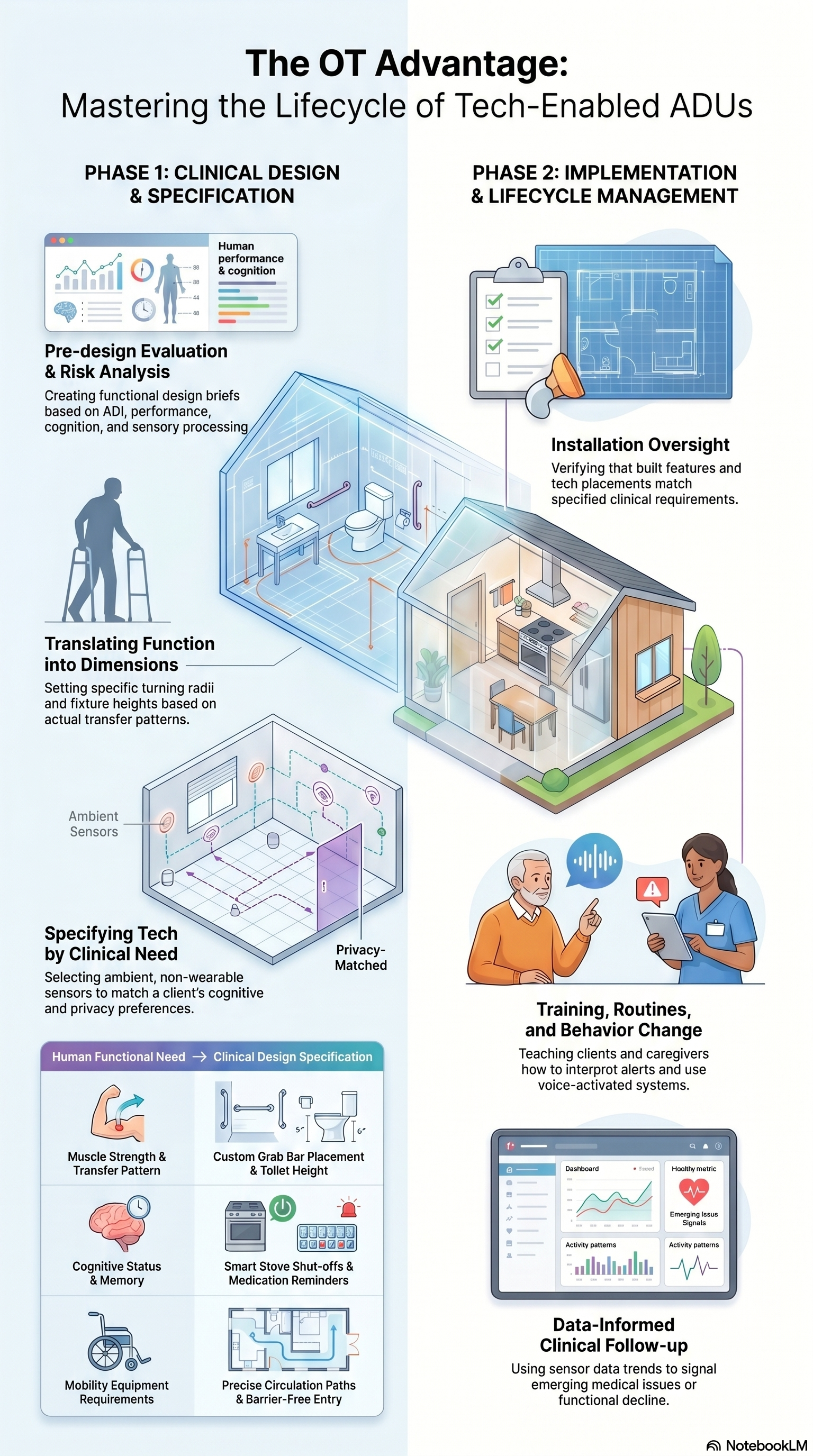
1. Comprehensive pre‑design OT evaluation
Your evaluation informs both architecture and technology:
- Occupational profile with a strong emphasis on current and anticipated ADL/IADL performance, cognition, sensory processing, and caregiver capacity
- Environmental analysis of the existing home and yard: access routes, terrain, lighting, sound, and wayfinding
- Risk analysis focusing on falls, wandering, medication mismanagement, self‑care neglect, and social isolation
Deliverable: a written “functional design brief” you can share with the family, architect/builder, and (if present) care manager.
2. Environmental and layout recommendations
You translate function into dimensions and features:
- Circulation paths, turning radii, and transfer zones for current and possible future mobility equipment
- Bathroom layout (shower entry, seat, grab bar placement, toilet height) tied to actual transfer patterns and muscle strength—not generic ADA diagrams
- Kitchen safety features (appliance types, shut‑offs, storage heights, visibility) aligned with cognition, reach, and fatigue
This lets you bill for high‑value, specialized consultation rather than one‑off home visits.
3. Technology selection and integration
You’re not selling hardware; you’re specifying function:
- Clarify what needs to be monitored (e.g., night‑time bathroom use, exits, cooking, bed exits) based on your evaluation
- Choose tech types that match the person: e.g., non‑wearable ambient sensors for clients who forget or refuse wearables; no cameras in private spaces for clients sensitive to surveillance
- Plan sensor and device placement in collaboration with the builder (wiring, power, data) so tech is integrated, not tacked on
You can standardize this into a “Smart Environmental Monitoring Plan” report that becomes a billable product.
4. Training, routines, and behavior change
Tech only works when it fits into daily life:
- Train the older adult in using smart lights, voice assistants, emergency call methods, and simple routines (e.g., “If you fall and can’t get up, how will you call for help?”)
- Train family and paid caregivers in interpreting alerts, avoiding alarm fatigue, and responding in ways that preserve dignity and autonomy
- Integrate technology into therapeutic routines: prompts for exercise, hydration, medication, or social contact
This is classic OT work—grading demands, supporting habits and routines, and aligning tools with real human behavior.
5. Ongoing data‑informed follow‑up
Smart ADUs can generate continuous, low‑burden data about daily life:
- Decreased activity, more time in bed, or changes in bathroom use may signal emerging medical or functional issues
- Wandering patterns, door‑opening at night, or repeated missed medication prompts may point to cognitive decline and the need to revisit the care plan
You can offer periodic “remote environment and function reviews” where you combine sensor data trends with clinical reassessment, then update environmental and behavioral recommendations.
OT roles and business opportunities in tech‑enabled ADUs
| OT Focus Area | Clinical Role | Business Opportunity |
| Pre‑design evaluation | Comprehensive functional evaluation, occupational profile, risk analysis for aging in place in an ADU. | Flat‑fee “ADU readiness” assessment package for families or builders; could be sold nationally via teleconsult with local walkthrough support. |
| Design collaboration | Translate function into layout, clearances, fixture choices, and environmental features. | Retainer or project‑based consulting with architects, builders, and modular/ADU manufacturers as their “in‑house OT.” |
| Tech specification | Identify monitoring needs, select sensor types and smart home features matched to cognition, mobility, and caregiver capacity. | Branded “Smart Safety & Monitoring Plan” service; potential partnership with vetted tech vendors (you design, they install). |
| Installation oversight | Verify that bathroom features, heights, and tech placements match OT specifications and client abilities. | Construction‑phase site visits or virtual walkthroughs as an add‑on service; quality‑assurance reports for families and builders. |
| Training & caregiver coaching | Teach clients and caregivers to use the environment and tech effectively; develop routines and responses to alerts. | Multi‑session training packages (in‑person or virtual), billed as caregiver education and environmental/self care training. |
| Ongoing monitoring & tune‑ups | Periodic review of sensor trends and functional status; adjust environment, tech settings, and routines over time. | Subscription or annual check‑up model (“ADU Aging‑in‑Place Tune‑Up”) for ongoing revenue and better outcomes. |
| Ethics & privacy consultation | Help families balance safety, autonomy, and dignity with monitoring; guide consent and data‑sharing decisions. | Stand‑alone consults for families, senior law attorneys, or care managers looking for ethically grounded recommendations. |
This table helps you articulate that you’re not just “helping with home mods”—you’re a critical design and outcomes partner in a six‑figure investment.
Positioning your practice: how to talk about this to OTs and partners
Because your primary audience is OTs across the U.S., you can:
- Emphasize clinical rigor: use evaluation language, outcome measures (e.g., falls, ER visits, caregiver burden), and explicit references to ADLs/IADLs and participation.
- Highlight interprofessional collaboration: builders, architects, planners, elder‑law attorneys, and financial planners all benefit from OT input in ADU projects.
- Call out reimbursable vs. private‑pay opportunities: some services may be billed under existing codes, while others become private‑pay consulting/products for families making major housing decisions.
You can also invite OTs to:
- Develop local relationships with ADU builders and modular home companies interested in differentiating themselves via “OT‑designed aging‑in‑place packages.”
- Create standardized, branded deliverables (evaluation templates, design briefs, tech plans) that make their expertise repeatable and scalable.
ADUs as the next big home mod frontier
Tech‑enabled ADUs and manufactured granny pods are not a niche side topic; they sit at the intersection of housing policy, long‑term care costs, family caregiving, and aging in place.
For occupational therapists specializing in home modifications, this is a pivotal opportunity to expand both clinical impact and business models—shifting from retrofitting existing homes to co‑designing the next generation of small, smart homes that keep older adults close to family, safe, and engaged in daily life.
References
A Place for Mom. (2026). Assisted living costs by state: 2026 pricing guide. A Place for Mom. https://www.aplaceformom.com/
Acton ADU. (2025, July 15). Long‑term family care simplified: How ADUs support aging in place. Acton ADU. https://actonadu.com/
Avior Wealth Management. (2025, July 16). 2025 long‑term care cost breakdown. Avior Wealth Management. https://avior.com/
Caring Senior Service. (2025, July 7). How ADUs empower seniors to age in place. Caring Senior Service. https://caringseniorservice.com/
DailyCall by Iamfine. (2024, October 31). How much does assisted living cost in 2025? Aging in place vs assisted living. DailyCall. https://dailycall.iamfine.com/
Earth Advantage. (2024, December 31). Manufactured homes as ADUs. Earth Advantage. https://www.earthadvantage.org/
GrandCare Systems. (2025, June 11). Transforming senior care with GrandCare home monitoring. GrandCare / Hopebridge. https://hopebridge.care/
Mesocore. (2026, March 22). 35 ADU cost statistics: Complete price breakdown for accessory dwelling units. Mesocore. https://www.mesocore.com/
Militia Protection. (2025, September 26). Smart home installation cost: Complete 2025 pricing guide. Militia Protection. https://militiaprotection.com/
Neil Patel Digital. (2025, January 21). Quantity vs quality: Is it better to write one long blog post or 10 shorter ones? Neil Patel. https://neilpatel.com/
Seattle Department of Construction & Inspections. (2025, July 6). ADUs and middle housing. City of Seattle. https://buildingconnections.seattle.gov/
Seattle DADU Guide (New Image Construction). (2025, March 31). Seattle DADU permit: Requirements, costs & 2025 updates. New Image. https://newimage.com/
StoryPoint. (2026, February 16). Cost of assisted living near you: 2025 state averages ranked. StoryPoint Senior Living. https://www.storypoint.com/
Sunflower Communities. (2025, March 16). How much does assisted living cost in 2025? Sunflower Communities. https://sunflowercommunities.org/
U.S. Modular, Inc. (2015, December 7). This granny pod could be the end of assisted living! U.S. Modular, Inc. https://www.usmodularinc.com/
Leave a Reply