
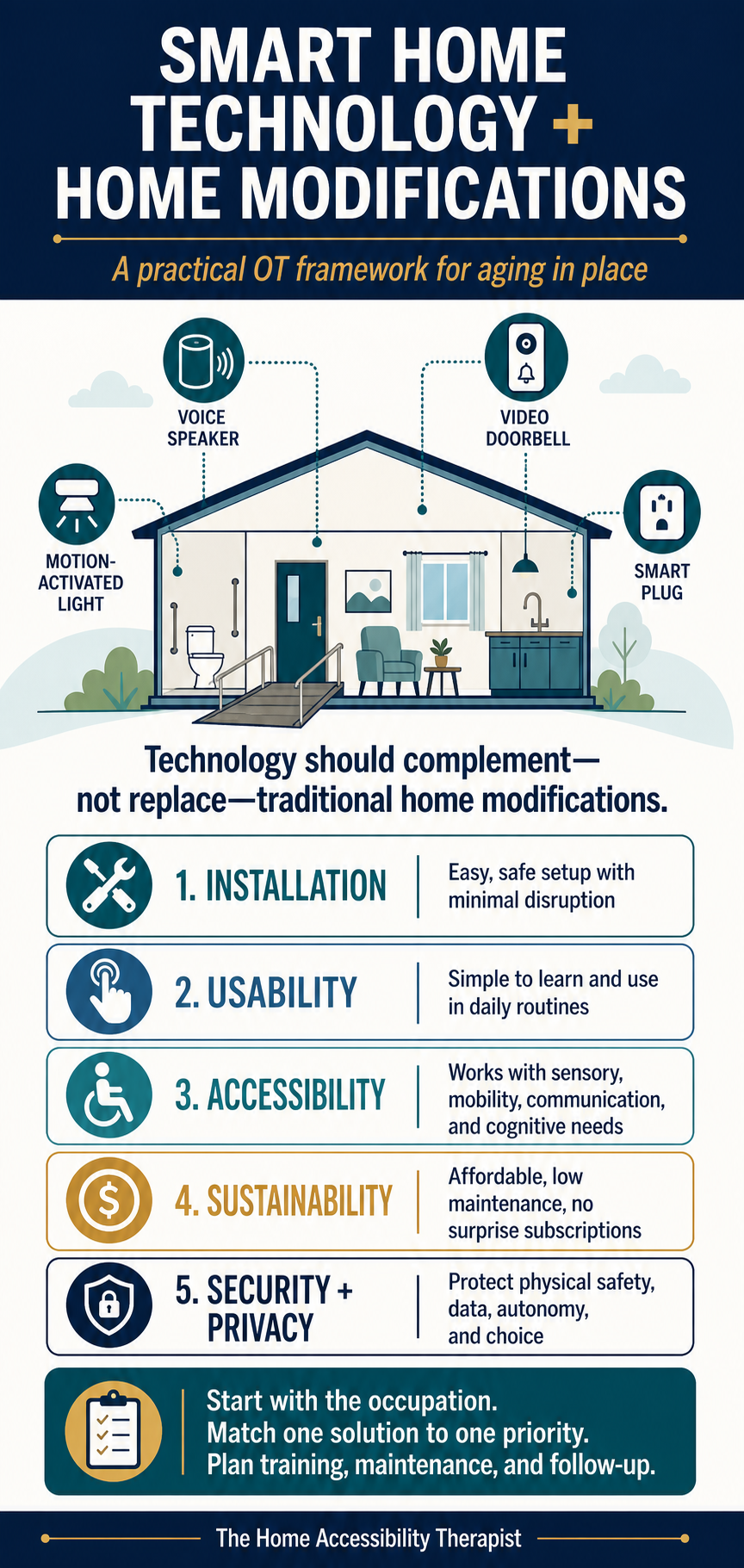

Smart technology can extend safety and independence at home—but only when it fits the person, the home, the support system, and the plan for keeping it working.
Home modification practice has always been about more than products. A grab bar, ramp, lever handle, improved lighting plan, or curbless shower only becomes meaningful when it supports the person’s daily occupations, safety, autonomy, and ability to remain connected to the life they value.
Smart home technology does not change that fundamental principle. It expands the set of possible environmental supports.
A newly published qualitative study by Hu and colleagues (2026) offers particularly useful guidance for occupational therapy practitioners and home modification professionals. The researchers convened a 90-minute focus group with 11 staff members, occupational therapists, Certified Aging-in-Place Specialists (CAPS), home-repair personnel, and program leaders from three organizations funded through the U.S. Department of Housing and Urban Development’s Older Adults Home Modification Program (OAHMP). The purpose was practical: to understand which smart technologies programs are already using, what is getting in the way, and what is needed to integrate technology responsibly into home modification services.
The message is not “put smart devices in every home.” Instead, it is this: smart home technology works best as a thoughtfully selected complement to traditional home modifications—not as a replacement for them.
Traditional Modifications Still Matter
The OAHMP grantees in the study continued to rely primarily on familiar, high-value modifications: grab bars, handrails, bathroom safety features, ramps, raised toilets, lever door hardware, and improved lighting. These interventions are tangible, durable, and often effective without Wi-Fi, apps, subscriptions, passwords, or troubleshooting.
That is an important grounding point. A motion-activated light does not make a poorly designed stairway safe. A video doorbell does not create a step-free entrance. A voice assistant cannot substitute for safe bathroom access, appropriate transfer supports, or an accessible route to the bedroom.
But technology may add value when it addresses a clearly identified activity, participation, or safety need. For example:
- Motion-activated lighting may reduce the need to locate and operate a switch during nighttime toileting.
- A voice-controlled lamp, thermostat, or smart plug may help a person with limited reach, pain, fatigue, or mobility maintain control of their environment.
- A smart speaker may support hands-free communication or calling for help after a fall, depending on the client’s device setup, capacity, and emergency plan.
- A doorbell camera may allow a homeowner to identify a visitor without rushing to the door or opening it unnecessarily.
- A smart plug may support safer routines for selected appliances when it is paired with education, appropriate safeguards, and a realistic understanding of its limitations.
In other words, the clinical question is not, “What smart device should we recommend?” It is, “What is preventing this person from doing what matters safely and independently, and is technology one appropriate part of the solution?”
This person-environment-occupation reasoning is consistent with the home assessment approach discussed in our earlier post, Updating Your Assessment: Integrating Mobility Technology Trends Into Home Assessments (Doyle, 2026). Technology should be assessed in context: alongside physical access, sensory and cognitive demands, routines, caregiver support, power sources, internet reliability, and the client’s own goals.
What Programs Are Actually Using
The study found early, selective adoption rather than widespread smart-home transformation. The devices most commonly mentioned by OAHMP grantees were:
- Amazon Echo devices, including Echo, Echo Show, and Echo Dot
- Ring doorbells and cameras
- Smart plugs
- Motion-activated lights
These are not necessarily the “most advanced” devices. They are relatively familiar, commonly available, and often easier to install than major construction changes. More importantly, the selected devices were seen as directly relevant to safety, emergency response, communication, security, and independent living.
The study also illustrates the creative breadth of a true home assessment. One participant raised potential uses related to detecting pets or wildlife in less-used areas of a rural home and monitoring air quality in hazard-prone settings. Whether or not those applications fit a particular service model, the example reminds us that occupational therapists should begin with the lived reality of the home—not with a preselected technology catalog.
The Three Levels of Barriers
One of the most useful contributions of Hu and colleagues’ study is its clear description of barriers at three levels: individual, contextual, and organizational. If we attend only to whether an older adult “likes technology,” we will miss most of the implementation problem.
Individual barriers: confidence, privacy, and maintenance
Clients may have limited experience with smartphones, apps, passwords, voice assistants, or Wi-Fi-connected equipment. Some may use a landline or flip phone by choice or necessity. Others may have concerns about being watched, recorded, or monitored. These concerns should not be dismissed as resistance; they are legitimate questions about autonomy, privacy, and control.
Maintenance can also turn an initially helpful device into a source of frustration or risk. Who will change batteries? Who will respond when the device disconnects from Wi-Fi? Who will remember a password? What happens when an app update changes the interface? Could a cord, device, or accessory become clutter or a trip hazard if it no longer functions as intended?
An intervention is not complete at installation. The client must be able to use it, understand it, maintain it, and opt out of it.
Contextual barriers: the home and community infrastructure
Smart home products are often marketed as though every household has dependable, affordable broadband service. The OAHMP participants emphasized that this is not the case, especially in rural communities where internet bandwidth may be unreliable.
During a home assessment, therefore, ask questions that go beyond the device itself:
- Is there reliable internet where the device will be used?
- Does the client have a compatible phone, tablet, or computer if one is necessary?
- Are electrical outlets accessible and safely located?
- Is cellular service reliable enough for emergency features?
- Is the acoustic environment appropriate for voice commands?
- Is there a backup plan for power outages, internet outages, or device failure?
A device that depends on infrastructure the household does not have is not an accessible solution.
Organizational barriers: capacity is part of the intervention
For home modification programs, smart technology requires more than a purchase order. Participants identified staff and contractor training, troubleshooting capacity, funding, leadership support, and partnerships as essential. Programs may need to train staff, CAPS professionals, contractors, volunteers, students, clients, and caregivers.
This has implications for private-practice OTs as well. Before recommending a connected device, consider your own referral and support pathway. Can you provide basic education? Is there a family member, caregiver, vendor, assistive technology professional, aging-services organization, or technology coach who can assist with setup and follow-up? Do you know who the client can call when something stops working?
The answer does not have to be “the OT does everything.” In fact, it should not be. It does need to be clear.
A Five-Part Screen for Smart-Home Recommendations
Hu and colleagues proposed five domains for selecting smart-home devices within home modification programs: installation, usability, accessibility, sustainability, and security and privacy. This is a strong starting framework for OT clinical reasoning.
Use the following screen before recommending or incorporating a smart device into a home modification plan.
| Domain | Questions for the OT home assessment |
|---|---|
| Installation | Can the device be installed safely with minimal disruption to the home? Does it require electrical work, permanent mounting, a hub, extensive wiring, or technical expertise beyond the available support? |
| Usability | Can the client learn the basic steps, use the device during ordinary routines, and recover from common problems? Does it reduce task demands rather than create a new memory, sequencing, or troubleshooting burden? |
| Accessibility | Are the controls, text, contrast, auditory prompts, app interface, and feedback accessible for the client’s vision, hearing, dexterity, speech, language, and cognitive needs? Is responsive technical support available? |
| Sustainability | Is the upfront cost reasonable? Are there subscriptions, replacement batteries, cloud-storage fees, data costs, or recurring purchases? Who will maintain the device over time? |
| Security and privacy | Does the device introduce physical hazards, unwanted surveillance, confusing data-sharing practices, or avoidable cybersecurity concerns? Has the client made an informed decision about who can access information and controls? |
This framework should not become a checklist that overrides clinical judgment. Rather, it helps ensure that the excitement of a new product does not eclipse person-centered assessment.
A Practical OT Workflow
For therapists who want to integrate smart-home thinking without turning every assessment into a technology consultation, consider this workflow.
1. Start with occupation, not the device
Identify the occupational concern in concrete terms. Is the client unable to reach a light switch when using a walker? Are nighttime bathroom trips unsafe? Does pain or limited endurance make it difficult to answer the door? Is the caregiver worried about missed routines? Is the client trying to manage the home independently after a change in health or function?
2. Address the physical environment first
Determine whether a conventional modification is required. Improve lighting, remove tripping hazards, add railings, change hardware, alter the bathroom, address entrances, or modify storage and work surfaces as indicated. Technology may enhance a sound environmental plan; it should not conceal a missing one.
3. Evaluate readiness and infrastructure
Ask what technology the client already uses and enjoys. Observe phone use, charging habits, hearing, vision, dexterity, communication, cognition, internet access, and available support. Ask directly about privacy preferences and concerns.
4. Match one solution to one priority
Begin with the smallest useful intervention. A single motion-activated light may be more successful than a whole-house system. One clearly taught feature of a smart speaker may be more meaningful than a long list of unused commands.
5. Plan setup, training, and maintenance
Clarify who will install, connect, teach, document passwords or settings appropriately, replace batteries, pay subscriptions, and troubleshoot. Give the client a simple written guide with large print and visual steps when appropriate. Include caregivers only with the client’s consent and in a way that preserves the client’s control.
6. Follow up and revise
Technology acceptance can change over time. The OAHMP participants described a progressive approach: clients may decline a device initially and later become interested when their needs or circumstances change. Revisit the option after a fall, a functional decline, a caregiver transition, a move, or a change in daily routines—but avoid using a crisis to pressure someone into unwanted monitoring.
This approach also complements the client-centered and co-design principles discussed in our previous post, Improving Adherence to Occupational Therapy Home Modifications: Key Insights for Better Outcomes (Doyle, 2024). The best recommendation is one the person understands, chooses, and can realistically incorporate into everyday life.
A Brief Case Illustration
Consider an older adult who uses a rollator and gets up several times overnight to use the bathroom. She has adequate bathroom grab bars and a clear path, but she avoids turning on the overhead bedroom light because glare makes it difficult to fall back asleep. In dim light, she has trouble locating the wall switch.
A thoughtful plan might include a low-glare, motion-activated pathway light positioned to illuminate the route from bed to bathroom without creating shadows or glare. The OT would assess placement, contrast, cord safety, batteries or power source, visual needs, pet-related activation, and the client’s ability to adjust or maintain the device. If the device connects to Wi-Fi, the therapist would ask whether that feature is necessary. It may not be.
The intervention is not “smart lighting.” The intervention is safer nighttime toileting and greater confidence moving through the home.
Equity Must Be Part of Innovation
Smart technology can be useful, but it can also widen disparities if programs assume that every client has reliable internet, a smartphone, an email address, funds for subscriptions, a tech-savvy caregiver, or someone available to solve problems. The OAHMP study is especially valuable because it centers the realities of low-income and underserved older adults within home modification service delivery.
Equitable technology integration means:
- Offering non-digital alternatives that achieve the same goal whenever possible
- Avoiding unnecessary subscriptions and hidden long-term costs
- Selecting low-maintenance devices
- Supporting clients with hands-on, respectful instruction
- Designing for unreliable connectivity and power interruptions
- Protecting privacy and honoring a client’s choice not to use monitoring technology
- Building community partnerships for setup, training, and follow-up
The study highlighted university partnerships in which students helped older adults set up devices, learn the basics, and access follow-up support. These collaborations can benefit everyone: older adults receive individualized assistance, while students gain practical experience in aging in place, assistive technology, communication, and real-world environmental assessment.
The Bottom Line
The next phase of home modification practice is not about choosing between grab bars and smart homes. It is about using the full range of environmental supports—low-tech, high-tech, and everything in between—to support meaningful daily life.
For occupational therapists, our value lies in the assessment process. We can help clients, families, builders, programs, and funders distinguish between a device that is merely novel and a solution that is genuinely useful, usable, accessible, sustainable, and aligned with the client’s goals.
Before adding a smart device to a home modification plan, ask:
Does this technology make an important occupation safer, easier, or more possible for this person in this home—and is there a realistic plan for the person to use and sustain it?
If the answer is yes, smart technology may be a powerful addition to the home modification toolkit. If the answer is unclear, return to the assessment.
What smart-home technologies are you seeing work well in home modification practice? What barriers are clients and families encountering? Share your experiences in the comments.
References
Campani, D., Caristia, S., Amariglio, A., et al. (2021). Home and environmental hazards modification for fall prevention among the elderly. Public Health Nursing, 38(3), 493–501. https://doi.org/10.1111/phn.12852
Dermody, G., Wadsworth, D., Dunham, M., Glass, C., & Fritz, R. (2024). Factors affecting clinician readiness to adopt smart home technology for remote health monitoring: Systematic review. JMIR Aging, 7, e64367. https://doi.org/10.2196/64367
Doyle, S. D. (2024, November 24). Improving adherence to occupational therapy home modifications: Key insights for better outcomes. The Home Accessibility Therapist LLC. https://thehomeaccessibilitytherapist.blog/2024/11/24/improving-adherence-to-occupational-therapy-home-modifications-key-insights-for-better-outcomes/
Doyle, S. D. (2026, February 17). Integrating mobility technology trends into home assessments. The Home Accessibility Therapist LLC. https://thehomeaccessibilitytherapist.blog/2026/02/17/integrating-mobility-technology-trends-into-home-assessments/
Hu, H., Clarke, M., Hughes, M., Sharma, P., Fried, J., Singh, P., & Toto, P. (2026). Smart home technology integration in home modification programs serving older adults: Focus group study with program grantees. JMIR Aging, 9, e89729. https://doi.org/10.2196/89729
Ma, C., Guerra-Santin, O., & Mohammadi, M. (2022). Smart home modification design strategies for ageing in place: A systematic review. Journal of Housing and the Built Environment, 37, 625–651. https://doi.org/10.1007/s10901-021-09888-z
Miller, L. M., Callegari, R. A., Abah, T., & Fann, H. (2024). Digital literacy training for low-income older adults through undergraduate community-engaged learning: Single-group pretest-posttest study. JMIR Aging, 7, e51675. https://doi.org/10.2196/51675
Tian, Y. J., Felber, N. A., Pageau, F., Schwab, D. R., & Wangmo, T. (2024). Benefits and barriers associated with the use of smart home health technologies in the care of older persons: A systematic review. BMC Geriatrics, 24, Article 152. https://doi.org/10.1186/s12877-024-04702-1
Tural, E., Lu, D., & Austin Cole, D. (2021). Safely and actively aging in place: Older adults’ attitudes and intentions toward smart home technologies. Gerontology and Geriatric Medicine, 7, 23337214211017340. https://doi.org/10.1177/23337214211017340
Author disclosure: This article was prepared with the assistance of generative artificial intelligence for research support, organization, and editorial drafting. Sue Doyle, OTR/L, was responsible for the article’s conception, professional interpretation, fact-checking, source selection, revision, and final approval. The author accepts full responsibility for the accuracy, integrity, and originality of the published content.
Leave a Reply