

When therapists think about home modifications, attention often goes to entrances, showers, toilets, and stairs. Those are critical areas, but the sink deserves just as much clinical scrutiny. A recent feasibility study of the Access-H2O smart faucet in people living with cervical spinal cord injury (SCI) reinforces an important point for home modification practice: independent water access is not a minor convenience issue. It is a meaningful functional goal that can influence hydration, hygiene, safety, privacy, caregiver burden, and overall autonomy (Jeng, Koperna, & Waddell, 2025).
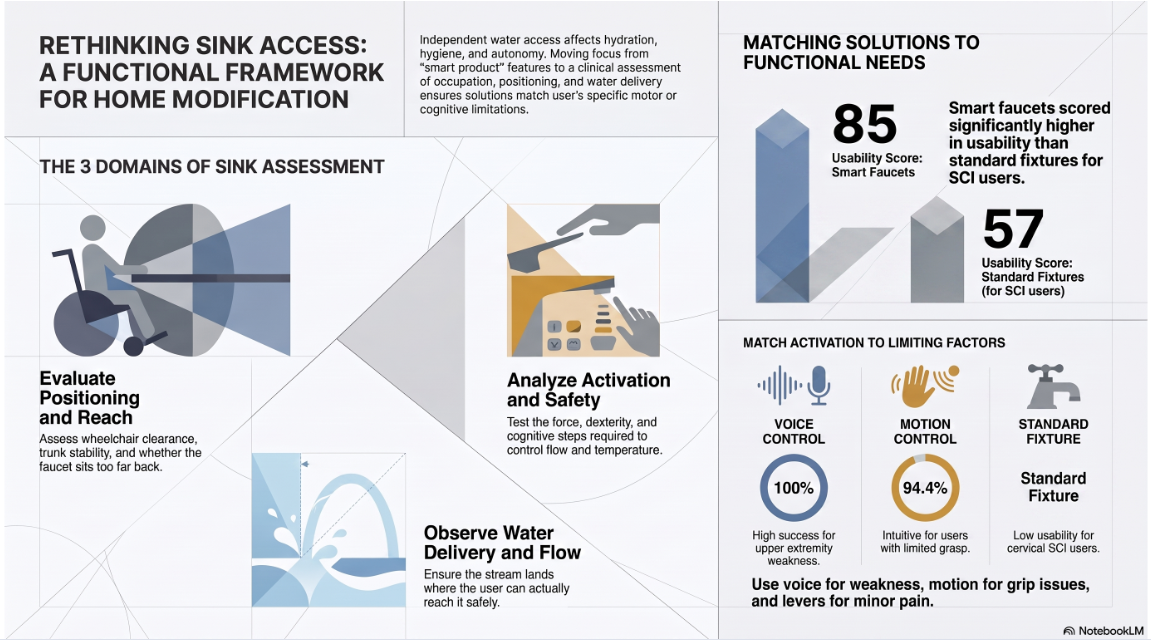
In that study, 18 participants living with SCI at levels C2 to C6 tested a faucet with three modes—fountain, washing, and grooming—and three activation methods—voice, motion, and eye-gaze. Participants showed high success rates across drinking, rinsing, and grooming tasks, and they rated the device much more usable than traditional faucets, with an average System Usability Scale score of 85 compared with 57 for standard fixtures (Jeng, Koperna, & Waddell, 2025). The study was performed in a clinic with a prototype rather than in a home with a commercial product, so it should not be overgeneralized. Still, it gives therapists a practical evidence base for thinking differently about sink access and for making better decisions about faucets, positioning, control type, and other accessibility features that affect daily function (Jeng, Koperna, & Waddell, 2025).
This second post builds on that research but shifts the focus toward clinical application. The key question is not whether a faucet is “smart.” The key question is whether the person can independently, safely, and consistently access water for the tasks that matter in their daily life.
Start with occupation, not product
A common mistake in home modification planning is to begin with the fixture. The better starting point is the activity. Before choosing a faucet, handle, sensor, or sink configuration, the therapist needs to understand which water-based tasks the client is trying to complete and what happens when those tasks break down.
At minimum, sink access may support handwashing, face washing, oral care, rinsing the mouth, taking medication with water, filling a cup or bottle, basic kitchen cleanup, and grooming. For some clients, water at the sink is also tied to temperature comfort, symptom management, stoma care, or safe cleanup after bowel and bladder routines. The Access-H2O study focused on drinking, rinsing, and grooming, which is a useful reminder that even very small sink-based tasks may represent major points of dependence for people with upper extremity limitations (Jeng, Koperna, & Waddell, 2025).
That means assessment should begin with a functional interview and direct observation. Ask which tasks the client wants to do at the sink, which ones require assistance, which ones they avoid, and which workarounds they currently use. A person who says, “I can use the sink,” may mean only that they can briefly wash one hand under cold water. Another may report independence but only by using inefficient or unsafe compensatory strategies such as leaning far forward without trunk support, turning on scalding water because temperature adjustment is too difficult, or skipping oral rinsing altogether.
Build a sink-access assessment framework
The faucet study provides a helpful model because it did not assess water access as a single yes-or-no ability. Instead, it examined distinct tasks, distinct activation methods, and levels of assistance (Jeng, Koperna, & Waddell, 2025). That same logic can strengthen a therapist’s home evaluation.
A useful clinical framework is to assess sink use across five domains:
- Positioning and approach.
- Reach and activation.
- Water delivery.
- Safety and feedback.
- Endurance and repeatability.
Positioning and approach
Start by looking at how the client gets to the sink and how they orient to it. Can a wheelchair user approach the sink closely enough, with enough knee clearance and toe clearance, to access the basin and controls? Can the client get their legs underneath without hitting supply lines, cabinet faces, or decorative sink panels? Is the sink depth forcing excessive forward flexion? Does the faucet sit too far back on the counter, increasing reach demands beyond what the client can safely manage?
For standing users, look at balance, endurance, and foot placement. A client with Parkinson’s disease, stroke, peripheral neuropathy, or deconditioning may technically be able to reach the sink but may not be stable enough to lean forward, manipulate controls, and step back safely with wet hands. For clients with poor trunk control, the faucet’s position relative to the body can matter as much as the type of control. The Access-H2O study included users seated in their own manual or power wheelchairs with space provided under the sink, highlighting how essential positioning is before any faucet technology can be meaningfully evaluated (Jeng, Koperna, & Waddell, 2025).
Other positioning details also deserve attention. Mirror height may affect grooming. Sidewalls or adjacent counters may provide stabilizing contact—or create obstruction. The location of soap, toothbrushes, cups, and towels can either support a smooth sequence or force repeated reaching beyond the client’s capacity. A strong sink recommendation is rarely about the faucet alone.
Reach and activation
Once positioned, can the client actually turn water on? This is where therapists often think first about automation, but reach and activation include much more than that.
Observe whether the client can:
- Reach the control without shoulder pain or unsafe trunk movement.
- Generate enough force to move the handle.
- Sustain grip long enough to rotate or push it.
- Isolate movement well enough to set temperature and flow.
- Repeat the action consistently when fatigued.
- Turn the water off without panic, overreaching, or help.
Traditional round knobs are often among the least forgiving choices because they demand grasp strength, forearm rotation, and fine motor control. Lever handles are often easier, but even they can fail a client if they require too much force, sit too far back, or move in a direction that triggers pain or spasticity. Extended lever options, cross handles with added grip surfaces, and paddle-style adaptations may help some users, especially when the limitation is mechanical rather than cognitive.
Single-lever faucets often work better than dual-handle fixtures because they reduce the number of actions needed and simplify temperature control. But even a single lever may not be usable if the client cannot maintain contact or if the handle position requires awkward wrist extension. Therapists should therefore avoid the trap of recommending a handle style by category alone. The actual force, direction, location, and travel range all matter.
Automation broadens the choices. In the Access-H2O study, voice control produced a 100 percent success rate across drinking, rinsing, and grooming, motion control produced a 94.4 percent success rate, and eye-gaze also performed strongly, especially for drinking and rinsing.(Jeng, Koperna, & Waddell, 2025) Those findings support the idea that alternative activation methods can meaningfully reduce the demands of faucet use. At the same time, they also remind us that each access method comes with trade-offs. Motion control depends on the client being able to present a body part in the sensor field. Voice control depends on speech clarity, cognitive sequencing, device setup, and environmental noise. Eye-gaze may work for a narrow group of users with very limited motor control, but the study raised important concerns about privacy, HIPAA implications, and cost in a bathroom setting.
Match the control method to the person
A helpful way to think clinically is to identify the client’s limiting factor and then match the faucet strategy to that problem.
If the main barrier is pain or limited grip, a lower-tech option may be enough: low-force single-lever hardware, extended handles, or a repositioned faucet. If the main barrier is inability to grasp at all, touchless or motion-activated fixtures may be more appropriate. If the main barrier is severe upper extremity weakness with intact speech, voice control may be the better fit. If the client has very limited limb movement but reliable eye control, a gaze-based solution may be worth exploring in a highly customized setting, although the study makes clear that this is not yet the most practical mainstream approach.(Jeng, Koperna, & Waddell, 2025)
The same reasoning applies across diagnoses. A person with rheumatoid arthritis may do well with a long lever and anti-scald protection. A person with hemiparesis after stroke may need one-handed reach, stable positioning, and visual clarity more than high-tech automation. A person with high tetraplegia may benefit from voice activation, a carefully directed water stream, and enough under-sink access to position the wheelchair precisely. A client with ALS or muscular dystrophy may initially manage with handle changes but later require sensor-based activation as fatigue and weakness progress.
Therapists who specialize in home modifications are in a good position to stage recommendations over time. The “best” faucet is not always the most advanced. It is the one that matches current function, foreseeable progression, caregiver support, maintenance realities, and budget.
Assess the water, not just the switch
One of the most useful contributions of the Access-H2O study is that it focused on water delivery, not merely faucet activation. The prototype included a fountain mode for drinking, a washing mode with downward flow, and a grooming mode with a facial spray pattern (Jeng, Koperna, & Waddell, 2025). That distinction matters because turning water on is only half the task.
Many clients can activate a faucet but still cannot use the water effectively. The stream may fall too far back in the basin, requiring forward neck flexion, shoulder protraction, or unsupported leaning. The spray angle may make face washing messy or ineffective. A client may be able to reach the sink but not position the mouth under a standard downward stream for rinsing after brushing teeth. A shallow or poorly placed bowl may cause splashing into the lap. These are design failures from a functional standpoint, even if the faucet itself works perfectly.
During assessment, watch where the water lands and what body movements are required to use it. Ask:
- Can the client bring their hands, mouth, or face to the water stream safely?
- Does the stream need to come to the client rather than the client going to the stream?
- Would an extended spout, pull-out feature, fountain-like upward flow, or aerated spray pattern improve access?
- Is the basin shape supporting or interfering with the task?
This is also where sink depth, faucet height, spout reach, and basin geometry become part of clinical reasoning. A change in faucet position or spout length may do more for function than adding sensors. Similarly, reducing counter depth or improving wheelchair knee clearance may matter more than replacing the faucet itself.
Prioritize temperature safety and feedback
A sink setup is not accessible if it creates fear or risk around water temperature. This issue is especially relevant for clients with impaired sensation, delayed reaction time, limited dexterity, cognitive change, or a history of burns. In the smart faucet study, temperature was actively controlled through an electromechanical mixing valve and users could adjust it through the control system, with setup allowing hot, warm, and cold zones for motion input (Jeng, Koperna, & Waddell, 2025). While most homes will not use that exact platform, the underlying lesson is clinically important: temperature control must be simplified and made safer.
Therapists should consider anti-scald protection, thermostatic mixing, clear hot/cold indicators, reduced force requirements for temperature change, and controls that do not drift unexpectedly. Visual feedback on temperature can be helpful for some users, but auditory or tactile feedback may be equally important when vision is limited or when the user cannot easily see the display from their position. The study authors specifically noted the need for stronger auditory feedback to confirm mode activation and for a larger screen to improve visibility and legibility (Jeng, Koperna, & Waddell, 2025). That observation has direct practice implications. If users cannot tell what the system is doing, they cannot trust it.
Automatic shutoff is another underused accessibility feature. It can reduce anxiety for clients who struggle to turn water off quickly, support users with cognitive or attentional limitations, and reduce flooding risk. For some clients, time-limited flow may increase independence more than any change in handle style.
Consider sensory, cognitive, and communication demands
Home modification specialists often focus appropriately on biomechanics, but faucet use also has cognitive and sensory components. A client may have adequate reach and strength yet still struggle if the system requires too many steps, poor memory for sequences, unclear cues, or dependence on speech production that is inconsistent.
This means automation is not universally better. Voice activation may seem ideal until the client has aphasia, dysarthria, low volume, accent recognition issues, or simply does not want to speak commands every time they wash their hands. Motion sensors may appear intuitive until the client has tremor, involuntary movement, or trouble maintaining their hand in the detection zone. Touchless systems can also be frustrating if they trigger unpredictably or stop too early.
The best clinical assessment therefore includes usability in context. Can the client learn the method? Remember it? Correct errors? Recover if the system fails? The Access-H2O study found high overall usability but also identified the need to improve voice integration and user feedback, which is a reminder that even promising technology can be undermined by interface issues (Jeng, Koperna, & Waddell, 2025).
Include features beyond the faucet itself
Therapists sometimes address sink access by focusing so tightly on the control hardware that other decisive environmental features get overlooked. In many cases, the most effective intervention is a combination of changes rather than a single faucet swap.
Additional features to assess include:
- Sink height relative to wheelchair or standing elbow level.
- Knee and toe clearance under the sink.
- Counter depth and reach to the basin and controls.
- Insulation or protection of hot pipes for seated users.
- Mirror placement for grooming tasks.
- Lighting quality and glare.
- Contrast between the faucet, sink, backsplash, and controls.
- Placement of soap, cups, towels, toothbrushes, and grooming supplies.
- Adjacent support surfaces for setting down objects.
- Floor slip resistance in front of the sink.
- Clearances for turning, side approach, or caregiver assistance.
Pipe protection is especially important when under-sink access is opened up for wheelchair users. Likewise, a touchless faucet may still fail the client if the soap dispenser is impossible to reach or if there is nowhere to place a cup without crossing over the wet basin. Accessibility emerges from the sequence, not from one product.
Use a practical decision-making sequence
For therapists who want a repeatable process, the following sequence can help structure recommendations.
First, define the priority occupations. Is the main goal independent handwashing, oral care, medication management with water, face washing, or filling a bottle? Second, observe the entire task, not just activation. Third, identify the specific limiting factors: reach, strength, dexterity, posture, sensation, cognition, fatigue, or environmental obstruction. Fourth, trial the least complex solution likely to solve the problem. Fifth, add automation or more specialized controls only when they clearly improve function over simpler options.
That sequence matters because it helps avoid overprescribing technology. A client with mild hand pain may not need voice activation; a long lever and anti-scald valve may solve the problem. Another client may need a repositioned sink and shallower basin more than a new faucet. Still another may need both environmental change and automation because no single intervention will close the gap.
Therapists can also document recommendations more effectively when they describe the clinical reasoning in functional terms. Instead of recommending a “smart faucet,” describe the goal and the required features: for example, “Client requires hands-free water activation, limited-force temperature selection, forward-reach spout position, and automatic shutoff to support independent oral care and handwashing from wheelchair level.” That kind of language is more useful to contractors, suppliers, funders, and caregivers.
Collaborate across disciplines
The smart faucet article sits at the intersection of rehabilitation, engineering, plumbing, and product design, and real-world sink access requires the same kind of interdisciplinary thinking (Jeng, Koperna, & Waddell, 2025). Home modification therapists are often the professionals best positioned to translate functional goals into design criteria.
That may mean working with contractors on counter height and knee clearance, plumbers on faucet type and valve settings, smart-home installers on automation platforms, and family members on routines and maintenance. It may also mean helping clients understand the trade-offs between cost, complexity, privacy, repair needs, and ease of use. The study itself noted that eye-gaze integration increased cost and introduced privacy concerns, while motion and voice controls offered more practical directions for broader use (Jeng, Koperna, & Waddell, 2025). Those are exactly the kinds of trade-offs therapists help clients navigate.
Keep the long view in mind
Finally, sink recommendations should reflect not only present performance but also likely change over time. Progressive conditions, aging, fluctuating endurance, caregiver turnover, and changes in housing all affect whether a faucet solution remains useful. A setup that works for a client today may become too effortful in a year, while an overengineered system may be abandoned if it is too cumbersome for daily use.
The Access-H2O study is valuable because it demonstrates that changing water access can produce meaningful gains in independence for people with significant physical limitations. For therapists specializing in home modifications, the larger lesson is this: sink access deserves the same depth of clinical reasoning that is already applied to showers, toilets, and entrances. When therapists assess occupation, positioning, control demands, water delivery, safety, and the surrounding environment together, faucet selection becomes far more than a hardware choice. It becomes a targeted intervention that can restore privacy, reduce caregiver dependence, and improve everyday life at home.
Reference:
Jeng, H.A., Koperna, L.J., & Waddell, S. (2025). Increasing water access for individuals living with spinal cord injury using an innovative smart faucet. Assistive Technology Outcomes and Benefits 19(Spring), 33-46
Leave a Reply