
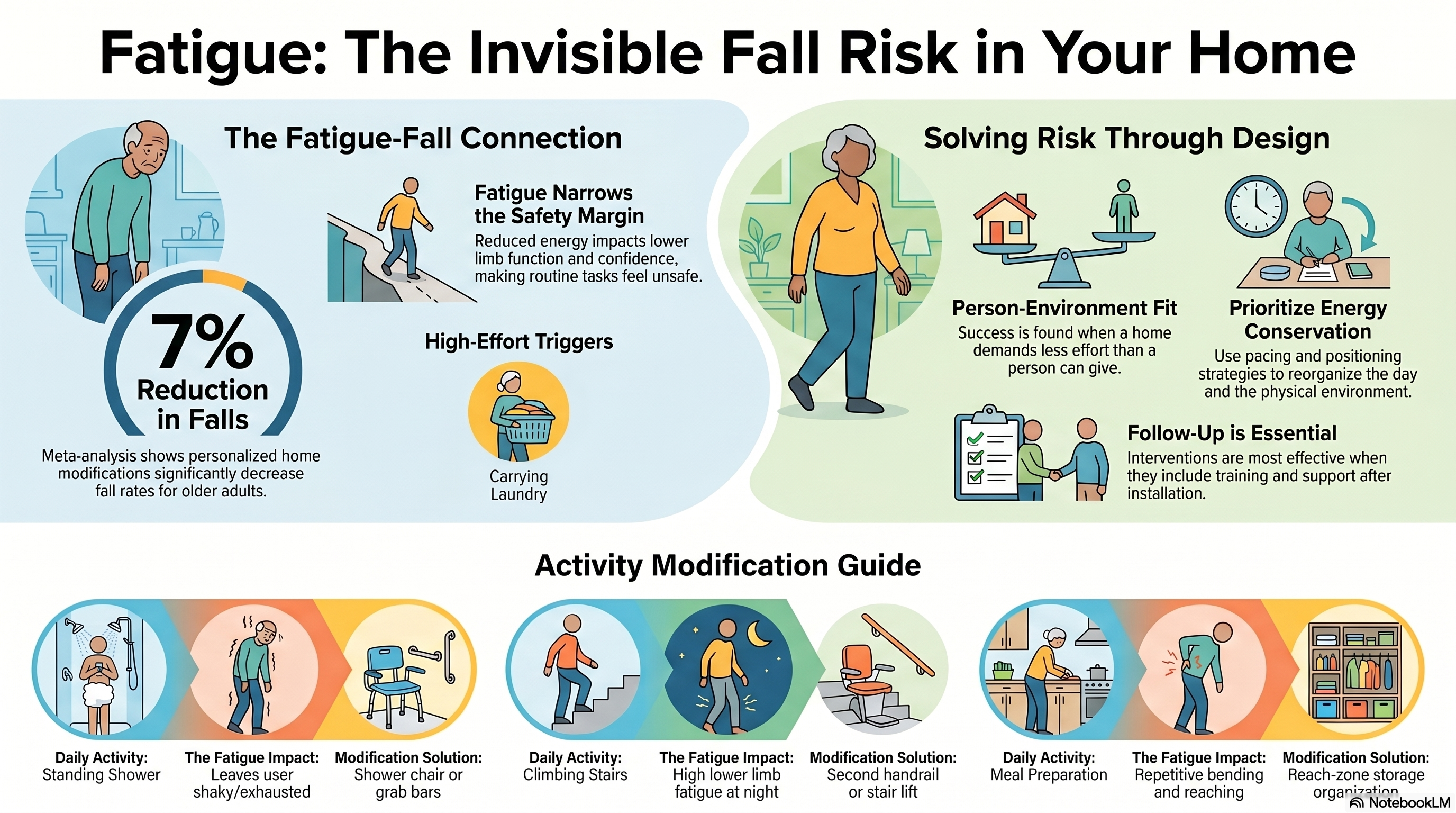

When people think about fall prevention at home, they often picture loose rugs, poor lighting, missing grab bars, or cluttered walkways. Those hazards matter, but they are only part of the picture. One of the most overlooked contributors to falls and near-falls is fatigue: the very real drop in physical endurance, balance, attention, and confidence that can make an otherwise manageable activity feel unsafe later in the day or after too much exertion (He et al., 2022; Adam et al., 2024; Cha, 2025).
For occupational therapists, caregivers, and older adults, this matters because many of the daily tasks most likely to trigger fatigue are the same tasks most likely to cause a fall or near-fall: showering, climbing stairs, dressing, carrying laundry, preparing meals, and hurrying to the bathroom. In other words, the issue is not just whether the home has hazards. It is whether the person is being asked to meet the demands of that environment at a time when their energy, steadiness, and problem-solving are already reduced.
That is why fatigue management should be part of every home modification discussion. A well-designed home does not just remove hazards. It reduces effort, supports timing, improves safety during daily routines, and helps people conserve energy for the activities that matter most.
Fatigue changes fall risk in real life
Research increasingly supports what many clinicians see every day: fatigue is associated with greater falls risk in older adults. In one study of adults over age 75, fatigue was associated with falls risk both directly and indirectly through lower limb function and falls efficacy, meaning confidence and concern about falling during activity. That is clinically important because it suggests fatigue is not only about feeling tired. It can also influence how well someone moves, how steady they feel, and how cautiously or efficiently they approach a task (Renner et al., 2020; He et al., 2022).
This helps explain why a person may report, “I can do the stairs in the morning, but not after dinner,” or “I’m usually okay in the shower, but if I’ve already been on my feet all day, I feel unsteady.” These are not minor complaints. They are functional clues. Fatigue can narrow the margin of safety during everyday occupations, especially when the environment still demands standing tolerance, quick reactions, reaching, carrying, turning, or multitasking.
Falls research also shows that the consequences of falls extend far beyond injury. Falls can contribute to fear of falling, activity restriction, decreased daily participation, and loss of independence. Once someone begins avoiding bathing independently, skipping meal prep, or limiting trips within the home because of fatigue and unsteadiness, the problem is no longer just “fall risk.” It becomes a participation problem, a quality-of-life problem, and often an aging-in-place problem (Adam et al., 2024; Cha, 2025).
Why home modifications matter
Home modifications are often discussed as if they are only about structural safety, but good home modification practice is really about person-environment fit. The question is not simply, “Is there a hazard?” The better question is, “Does this home demand more effort, balance, reach, strength, or attention than this person can safely give, especially when fatigued?”
That framing is strongly supported by the home modification literature. A 2023 systematic review and meta-analysis of randomized studies found a clinically meaningful 7% reduction in falls across trials of home modification interventions for older adults (Lektip et al., 2023). The authors concluded that falls can be significantly reduced when home modifications are thorough, well-focused, based on environmental fit, and paired with adequate follow-up.
That last point matters. The most effective interventions are not generic checklists. They are targeted, individualized, and connected to how the person actually moves through daily life. Many of the successful studies in the review involved occupational therapist-led home hazard assessment, recommendations, training, and follow-up rather than simply handing someone a list of suggestions (Georlee et al., 2020).
The newer aging-in-place literature reinforces this broader view. A 2025 systematic review found that home modifications support not only fall prevention, but also functional independence, quality of life, and, in some studies, cost savings (Cha, 2025). The review also emphasized that the field needs more personalized and adaptable interventions, which aligns closely with occupational therapy’s focus on matching environmental supports to changing abilities over time.
The link between fatigue and home setup
Fatigue and home design intersect in powerful ways. A poorly set up environment forces people to use more energy than necessary. That extra effort may not look dramatic from the outside, but it accumulates quickly.
Consider a few common examples:
- A person showers standing because there is no shower chair, even though standing for 10 minutes leaves them shaky afterward.
- Laundry requires carrying a basket up or down stairs at the end of the day, when lower limb fatigue is already high.
- Meal prep happens in a kitchen where frequently used items are stored too low or too high, requiring repeated bending, reaching, and carrying.
- Nighttime bathroom trips involve dim lighting, furniture obstacles, and urgency, all of which become more dangerous when someone is tired or rushing.
In each of these cases, the home is not merely “inconvenient.” It is increasing physical demand at exactly the moment when the person’s capacity may be lowest.
This is where energy conservation and home modification naturally overlap. Occupational therapy fatigue management emphasizes strategies like pacing, planning, prioritizing, positioning, and simplifying tasks. Home modifications operationalize those principles. A shower chair turns bathing into a seated task. Better storage reduces bending and reaching. Improved lighting reduces visual strain and nighttime disorientation. Grab bars reduce the balance demand of transfers. A second rail or stair lift can reduce exertion and risk on stairs.
What the research says about effective home modification programs
Several patterns emerge from the research. First, interventions tend to work best when they are directed at people with meaningful fall risk, previous falls, functional limitations, or specific environmental barriers rather than applied broadly without targeting. For example, in the classic Cumming trial, the intervention was effective among people who had reported one or more falls in the prior year.
Second, follow-up matters. Studies that included follow-up calls, repeat visits, training, or support for implementation often reported stronger results than interventions that relied on one-time education alone. This is clinically intuitive: a recommendation only helps if it is understood, feasible, and actually put into place.
Third, bathroom and transfer-related modifications appear repeatedly in successful programs. Across multiple studies, common helpful modifications included grab bars, shower seats, anti-slip flooring, improved lighting, safer toilet setups, and removal of clutter. These are especially relevant for fatigued clients because bathroom routines often combine wet surfaces, urgency, standing tolerance, transfers, and limited space.
Fourth, home modifications may also reduce fear of falling, increase comfort, and improve daily function, even when changes in formal ADL measures are less dramatic. That is important because many clients do not define success only as “fewer falls.” They define success as feeling steadier, needing less help, avoiding less, or getting through the day with less exhaustion.
What this means for occupational therapy practice
For OTs, the takeaway is clear: when a client reports fatigue, variable function across the day, or task avoidance, that should trigger not only symptom education but also closer attention to the home environment. A client who says, “I’m wiped out by evening,” may not just need pacing advice. They may need a safer shower setup, task relocation, better lighting, a seated work area, or a different way to organize the day.
This is why a fatigue-informed home assessment can be so valuable. It goes beyond asking what the person can technically do. It asks when they can do it most safely, what parts of the task drain them most, and how the environment could better support performance.
A few useful clinical questions include:
- When in the day do you feel strongest or most steady?
- Which task leaves you most tired?
- Which task becomes less safe if you do it late in the day?
- Are you avoiding any daily task because it feels like too much effort or too much risk?
- Would a change in setup help more than trying harder?
These questions help reveal when a home modification is not just about hazard removal, but about reducing energy demand and improving daily participation.
A practical takeaway
One of the simplest ways to start this conversation is with a planning tool that helps people connect timing, fatigue, task demands, and home setup. That is the purpose of the Daily Energy & Fall-Risk Planner: a worksheet that helps clients identify when they feel strongest, which tasks are highest effort, and what environmental or equipment changes may help.
This kind of tool can support better clinical reasoning, more meaningful goal-setting, and more targeted home modification recommendations. It also helps clients and caregivers see that safety is not only about avoiding obvious hazards. It is about building routines and environments that fit the person’s energy, mobility, and real life.
Download the free Daily Energy & Fall-Risk Planner to use with clients, caregivers, or your own home safety education materials.
References
Adam, C. E., Fitzpatrick, A. L., Leary, C. S., Ilango, S. D., Phelan, E. A., & Semmens, E. O. (2024). The impact of falls on activities of daily living in older adults: A retrospective cohort analysis. PloS one, 19(1), e0294017. https://doi.org/10.1371/journal.pone.0294017
Cha, S.-M. (2025). A systematic review of home modifications for aging in place in older adults. Healthcare, 13(7), 752. https://doi.org/10.3390/healthcare13070752
Georlee, G. M., U, A., Dat, P. N., Tuan, N. K., & Mehrotra, S. (2020). Home-modification interventions addressing falls and participation in activities of daily living among older adults: a scoping review protocol. BMJ open, 10(9), e039742. https://doi.org/10.1136/bmjopen-2020-039742
He, Y., Zhang, H., Song, M., Wu, H., & Pi, H. (2022). Association between fatigue and falls risk among the elderly aged over 75 years in China: The chain mediating role of falls efficacy and lower limb function. Frontiers in Public Health, 10, 850533. https://doi.org/10.3389/fpubh.2022.850533
Lektip, C., Chaovalit, S., Wattanapisit, A., Lapmanee, S., Nawarat, J., & Yaemrattanakul, W. (2023). Home hazard modification programs for reducing falls in older adults: A systematic review and meta-analysis. PeerJ, 11, e15699. https://doi.org/10.7717/peerj.15699
Physiopedia. (n.d.). Energy Conservation. https://www.physio-pedia.com/Energy_Conservation_Techniques
Renner, S. W., Cauley, J. A., Brown, P. J., Boudreau, R. M., Bear, T. M., Blackwell, T., Lane, N. E., & Glynn, N. W. (2020). Higher Fatigue Prospectively Increases the Risk of Falls in Older Men. Innovation in aging, 5(1), igaa061. https://doi.org/10.1093/geroni/igaa061
Royal College of Occupational Therapists. (n.d.). Occupational therapy advice for Managing energy. https://www.rcot.co.uk/learn-about-occupational-therapy/ot-advice/lift-up/energy
Thomas, S., Thomas, P. W., Kersten, P., Jones, R., Green, C., Nock, A., Slingsby, V., & Hillier, C. (2017). Effects of a one-to-one fatigue management course for people with chronic conditions and fatigue: A pilot study. American Journal of Occupational Therapy, 71(4). https://research.aota.org/ajot/article/71/4/7104100020p1/6281/Effects-of-a-One-to-One-Fatigue-Management-Course
Leave a Reply