
Occupational therapy has always been rooted in one fundamental belief: that people deserve to live, work , and participate in meaningful activities or occupations within environments that support- not hinder- their independence. Nowhere is this more evident than in the practice of home modifications and home safety assessments. As we celebrate OT Month this April it is fitting to look back at how our profession arrived at the forefront of accessible living, and how that journey has culminated in the development of the Certified Home Accessibility Therapist (CHAT) certification.
Early Roots: Occupation, Environment, and the Home (1910s–1940s)
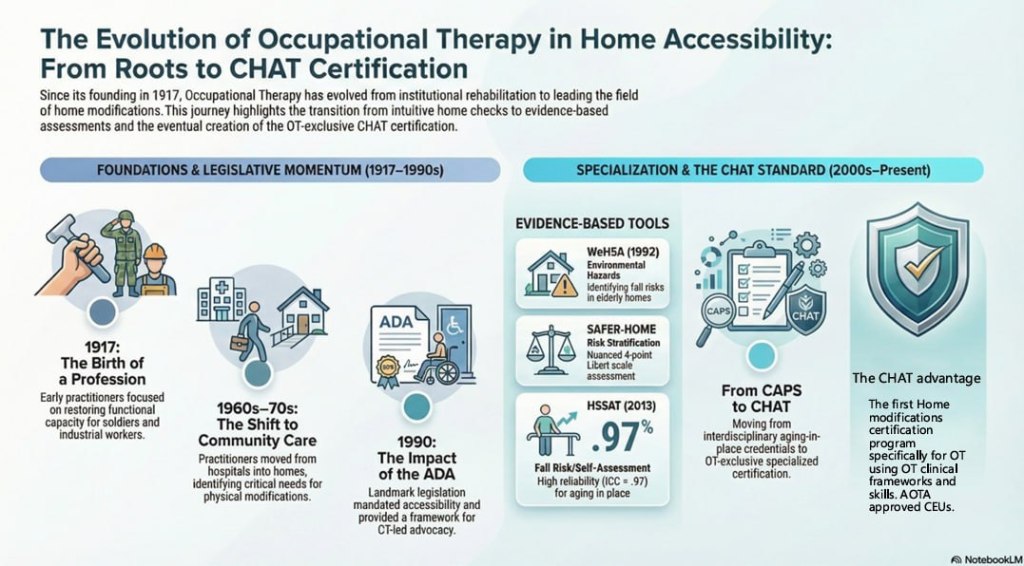
Occupational therapy was formally established in 1917 with the founding of the National Society for the Promotion of Occupational Therapy, which later became the American Occupational Therapy Association (AOTA). The profession emerged during a period of social change, with early practitioners working alongside soldiers injured in World War 1 and individuals disabled by illness and industrial accidents. The focus was on restoring functional capacity – helping people return to the meaningful occupations of daily life.
While early OT practice was largely institution-based, the seeds of home-centered care were already being planted. Practitioners recognized that recovery did not end at the hospital door. A person’s ability to perform daily tasks – bathing, cooking, dressing, navigating their living space – was inextricably tied to the physical environment they returned to. The home was not just a backdrop to occupational; it was a critical factor in enabling or limiting it (Char, 2025).
The Community Care Shift: 1950s–1970s
The post-World War II era brought an expanded understanding of disability and rehabilitation. The Independent Living Movement began to gather momentum in the 1960s, championing the rights of people with disabilities to live self-directed lives in community settings rather than institutions. Occupational therapists were natural allies in this movement, given the profession’s holistic focus on function, environment, and client-centered care.
The landmark Community Mental Health Act of 1963 accelerated the deinstitutionalization of care, and by the 1970s, OT practitioners were increasingly providing services in home health settings. This shift brought therapists directly into the living spaces of clients, exposing a critical need: the home environment itself often needed to change. Ramps were needed. Grab bars were needed. Door widths needed to accommodate wheelchairs. OT’s role as an environmental problem-solver was beginning to take shape.
Legislative Momentum: The ADA and Universal Design (1980s–1990s)
The 1980s and 1990s marked a turning point driven by landmark legislation. The Americans with Disabilities Act (ADA), signed into law on July 26, 1990 by President George H.W. Bush, prohibited discrimination based on disability and mandated accessibility in public spaces and new construction. While the ADA primarily addressed public accommodations and employment, it dramatically elevated national awareness about accessibility and gave OT practitioners a legislative framework to reference when advocating for clients.
Simultaneously, the principles of Universal Design – designing environments usable by all people, regardless of age or ability – began gaining traction in architecture and rehabilitation fields. Occupational therapists were uniquely positioned to translate Universal design principles into practical, client-specific home recommendations. This era also saw growing attention to aging in place, as researchers and policymakers recognized that the rapidly expanding older adult population overwhelmingly preferred to remain in their own homes rather than move to institutional care.
The Rise of Standardized Home Safety Assessment Tools (1990s–2000s)
A critical development in the maturation of OT’s home modification role was the creation and validation of standardized home safety assessment tools. Prior to this, home evaluations were largely informal and inconsistent. The development of structured, evidence-based instruments gave the profession rigor, reproducibility, and credibility.
Key tools developed during this era include:
- Westmead Home Safety Assessment (WeHSA): Developed by Clemson et al. in 1992, the WeHSA was specifically designed to identify environmental hazards in the homes of elderly persons — one of the first such tools developed explicitly for and by occupational therapists (Gudavalli & Vagvala, 2020).
- SAFER-HOME (Safety Assessment of Function and the Environment for Rehabilitation): Developed in Canada, this tool assessed environmental risks on a 4-point Likert scale, providing nuanced risk stratification for OT home assessments (Gudavalli & Vagvala, 2020).
- Home Safety Self-Assessment Tool (HSSAT): Created by the Occupational Therapy Geriatric Group at the University at Buffalo in partnership with the Health Foundation for Western and Central New York, the HSSAT was designed to empower older adults to identify their own fall risks and access solutions. Published research in 2013 confirmed it as a reliable and valid instrument, with a content validity index of .98 and strong test-retest reliability (ICC = .97) (University of Buffalo Occupational Therapy Geriatric Group, 2017).
These tools moved OT home safety practice from intuition-based to evidence-based, and laid the groundwork for OT’s recognition as the lead discipline in home modification assessment.
Formalizing the Field: AOTA, CAPS, and Community Partnerships (2000s–2010s)
The early 2000s brought formal recognition of OT’s central role in home modifications through organized professional partnerships. In 2001, AOTA and Rebuilding Together — a national nonprofit providing free home repairs and modifications to low-income homeowners — launched a landmark collaboration, placing OT practitioners as clinical leads within community-based home modification programs (American Occupational Therapy Association, n.d.).
In 2003, the Certified Aging-in-Place Specialist (CAPS) credential was created by the National Association of Home Builders (NAHB) in partnership with AARP and the NAHB Research Center. The CAPS program provided training in technical, business management, and customer service skills for professionals working on home modifications for aging adults, and was accredited through the National Commission for Certifying Agencies in 2008. While CAPS welcomed OT practitioners and helped bridge the gap between therapy and construction, it was designed as a broadly interdisciplinary credential — serving remodelers, builders, contractors, and therapists alike (Engel, 2023).
Throughout the 2010s, OT’s evidence base for home modifications continued to grow robustly. The American Journal of Occupational Therapy published a series of Evidence Connection articles demonstrating the effectiveness of occupation-focused, client-centered home modification assessment and intervention. AOTA strengthened its position statements on aging in place, and OT home modification practice was increasingly recognized in Medicare policy discussions as a reimbursable, outcomes-driven service.
A Credential Built for OT: The Birth of CHAT (2020s)
Despite the growth of the field, occupational therapists for years navigated a gap: available home modification training was largely not designed with OT scope, professional licensure, or Medicare compliance in mind. Credentials like CAPS provided valuable construction and aging-in-place knowledge, but did not address the clinical assessment frameworks, billing structures, or professional context unique to OT practice.
This gap was recognized by Susan Doyle, PhD, OTR/L, a nationally recognized expert in home modifications with more than four decades of clinical, academic, and leadership experience in occupational therapy and accessibility solutions. As CEO of The Home Accessibility Therapist LLC, Dr. Doyle developed the Certified Home Accessibility Therapist (CHAT) program — the only certification built exclusively for occupational therapists and occupational therapy assistants.
The CHAT program is AOTA-approved CEU course and equips OTs to:
- Conduct thorough, evidence-based home safety assessments addressing client factors and environmental barriers
- Develop comprehensive, client-centered home modification plans for areas including bathroom safety, ramp design, and grab bar placement
- Interpret construction floor plans and select appropriate products aligned with therapy goals
- Navigate Medicare billing, documentation, and compliance requirements specific to OT practice
- Collaborate effectively with clients, families, and contractors
- Apply telehealth strategies to home modification practice
- Launch and grow a private home modification practice
Unlike broader credentials, CHAT integrates OT’s occupational performance framework with the practical realities of home modification business — providing ongoing mentorship, bi-weekly case reviews, and a private graduate network to support therapists after certification.
Conclusion: From Founding Principles to a Specialized Future
The arc of OT’s involvement in home modifications and home safety assessment is, in many ways, the arc of the profession itself — moving from institution to community, from informal practice to evidence-based rigor, and from general rehabilitation to specialized, client-centered expertise. What began as helping veterans return to daily life after World War I has evolved into a sophisticated, data-driven practice area with its own validated assessment tools, policy frameworks, and now, a certification designed exclusively for the OT profession.
As we celebrate OT Month this April, the development of the CHAT certification stands as a powerful symbol of how far our profession has come — and a clear declaration of where OT’s leadership in accessible, safe, and inclusive living is headed.
References
American Occupational Therapy Association. (n.d.). Home modifications and key community-based partnerships. https://www.aota.org/practice/practice-settings/home-modifications-key-community-partnerships
Americans with Disabilities Act of 1990, Pub. L. No. 101-336, 104 Stat. 327 (1990). https://en.wikipedia.org/wiki/Americans_with_Disabilities_Act_of_1990
Cha S. M. (2025). A Systematic Review of Home Modifications for Aging in Place in Older Adults. Healthcare (Basel, Switzerland), 13(7), 752. https://doi.org/10.3390/healthcare13070752
Clemson, L., Fitzgerald, M. H., & Heard, R. (1999). Content validity of an assessment tool to identify home fall hazards: The Westmead Home Safety Assessment. British Journal of Occupational Therapy, 62(4), 171–179.
Doyle, S. D. (n.d.). About us: The Home Accessibility Therapist LLC. https://thehomeaccessibilitytherapist.blog/about/
Engel, J. 2023. What Is Caps Certification – Certified Aging In Place Specialist? Retrieved from: https://janetengel.com/what-is-caps-certification-certified-aging-in-place-specialist/
Gitlin, L. N. (1998). Testing home modification interventions: Issues of theory, measurement, design, and implementation. Annual Review of Gerontology and Geriatrics, 18, 190–246.
Gudavalli, N., Vagvala, P. (2020). A Comparative Study of Standardised Tools for Assessment of Environmental Fall-Hazards. International Journal of creative Research Thoughts, 8(12). Retrieved from: https://ijcrt.org/papers/IJCRT2012247.pdf
Horowitz, B. P., Nochajski, S. M., & Schweitzer, J. A. (2013). Occupational therapy community practice and home assessments: Use of the Home Safety Self-Assessment Tool (HSSAT) to support aging in place. Occupational Therapy in Health Care, 27(3), 216–227. https://doi.org/10.3109/07380577.2013.807450
National Association of Home Builders. (2003). Certified Aging-in-Place Specialist (CAPS). https://www.nahb.org/education-and-events/credentials/certified-aging-in-place-specialist-caps
OT Centennial. (2017). A historical look at 100 years of occupational therapy [Video]. https://www.otcentennial.org/video/history-of-occupational-therapy
Palit, M., & Morrow, M. (2020). A comparative study of standardised tools for assessment of home hazards. International Journal of Creative Research Thoughts, 8(12). https://ijcrt.org/papers/IJCRT2012247.pdf
Stark, S., Somerville, E., & Morris, J. C. (2010). In-home occupational performance evaluation (I-HOPE). American Journal of Occupational Therapy, 64(4), 580–589. https://research.aota.org/ajot/article/70/5/7005395010p1/59
The Home Accessibility Therapist LLC. (2025, June 10). The Certified Home Accessibility Therapist program — Setting the standard in home modification practice. https://thehomeaccessibilitytherapist.blog/2025/06/10/the-certified-home-accessibility-therapist-program-setting-the-standard-in-home-modification-practice/
The Home Accessibility Therapist LLC. (n.d.). Certified Home Accessibility Therapist (CHAT) information. https://www.thehomeaccessibilitytherapist.com/CHAT
University at Buffalo Occupational Therapy Geriatric Group. (2017). Home Safety Self Assessment Tool (HSSAT) v.5. Health Foundation for Western and Central New York. https://housingtech.wihd.org/wp-content/uploads/2022/02/HSSAT-v.5-1-12-17.pdf
Vance, J. (2025, March 26). A systematic review of home modifications for aging in place in occupational therapy. PubMed Central. https://pmc.ncbi.nlm.nih.gov/articles/PMC11988477/
 The Home Accessibility Therapist LLC
Leave a comment