
April is Occupational Therapy Month, and there has never been a more compelling moment to spotlight how dramatically the landscape of home safety practice is expanding. From new Medicare policy, to federal grant programs, to bipartisan falls prevention legislation, to a workforce increasingly choosing community-based and private practice settings — the stars are aligning for occupational therapists who work in home modification and home safety assessment. Our profession is being called to step into a larger role. The question is: are we ready to answer?
Medicare’s Expanding Recognition of Home Safety
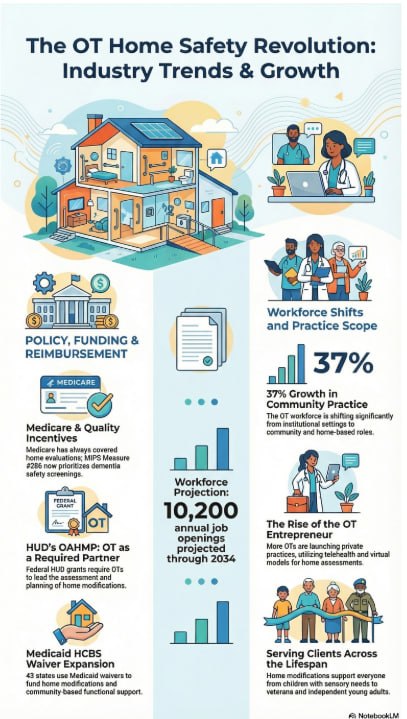
Perhaps the most significant recent policy development for home modification OTs is the formal incorporation of home safety evaluations into Medicare coverage. Medicare now supports physician-initiated home environment assessments as a documented component of a patient’s medical profile — recognizing that health does not stop at the clinic door. When a patient has seven steps to enter their home, that structural reality is now part of the medical record. When discharge planning begins after a hip replacement or a fall, that documented home environment becomes a critical clinical tool.
For OTs, this creates a direct pathway into preventive and proactive care conversations. Home safety evaluations ordered through a physician and conducted by an occupational therapist are billable under Medicare Part B using the appropriate OT evaluation CPT codes as part of a skilled plan of care. And with bipartisan legislation — the SAFE Act — currently moving through Congress to formally integrate OT-led falls prevention screening into routine Medicare wellness visits, the policy recognition of OT’s unique skill set is only growing.
MIPS: Home Safety and Fall Prevention as Quality Metrics
The Merit-based Incentive Payment System (MIPS) represents one of the most strategically important — and underutilized — opportunities for OTs practicing in home safety. There are currently three active 2026 MIPS quality measures directly relevant to falls assessment and home safety, all of which create a compelling case for physician-OT collaboration:
Measure #318 – Falls: Screening for Future Fall Risk
This measure tracks the percentage of patients age 65 and older who were screened for future fall risk during the measurement period. It is designated as a High Priority measure and is listed explicitly under the 2026 MIPS measures relevant to Physical Therapy/Occupational Therapy. This is OT’s direct lane — fall risk screening using validated tools is squarely within our scope of practice and our daily workflow.
Measure #155 – Falls: Plan of Care
This High Priority measure tracks the percentage of patients age 65 and older with a documented history of falls who had a plan of care for falls documented within 12 months. Here is the win-win that every OT should know about: Measure #155 applies to any MIPS-eligible clinician — including the referring physician. When a physician refers a patient to OT for a home safety assessment and that OT documents a falls plan of care, the physician can report that documented plan toward their own MIPS #155 performance score. This means that referring to OT is not just good clinical practice — it is a direct quality metric benefit for the physician. Educating your referring providers about this dynamic transforms OT home safety assessment from a service they can order into one they are actively incentivized to order.
Measure #513 – Patient Reported Falls and Plan of Care
This measure tracks reported falls and plan of care for patients with movement disorders, MS, dementia, neuromuscular conditions, or stroke — populations that OTs frequently serve. For therapists working in neurological, home health, or aging populations, this measure is highly relevant and reportable.
Together, these three measures embed occupational therapy’s fall prevention and home safety assessment skills directly into Medicare’s value-based care framework — and make OT an asset to the referring providers navigating that framework alongside us.
CDC STEADI: Active, Validated, and Being Updated
The CDC STEADI (Stopping Elderly Accidents, Deaths & Injuries) initiative remains fully active in 2026 and is one of the most widely used falls prevention frameworks in clinical practice. Originally launched in 2012, STEADI provides clinicians with evidence-based tools for screening, assessment, and intervention for fall risk in adults 65 and older.
Critically, STEADI explicitly names referral to occupational therapy for a home safety assessment as a core recommended intervention for patients identified as high-risk — making it one of the few federal public health frameworks that directly prescribes OT involvement as part of the fall prevention care pathway.
In January 2025, the American Geriatrics Society (AGS) published formal recommendations to update STEADI — the first major revision guidance since its launch. Key recommendations include:
- Universal annual screening for all adults 65 and older, regardless of fall history
- Reframing fall prevention as routine preventive care, not a reactive response
- Strengthening multifactorial risk assessment, including home environment evaluation
A February 2026 study published in Frontiers in Health Services examined STEADI implementation in outpatient therapy settings, confirming the toolkit to be acceptable, appropriate, and feasible for therapists — with home safety recommendations and ADL training identified as the interventions most aligned with STEADI’s framework. The study noted that limited therapist familiarity with STEADI remains a barrier — an opportunity for targeted professional development and a compelling argument for the kind of specialized training the CHAT curriculum provides.
Federal Grant Programs: OT as a Required Partner
On the funding side, the federal government is actively channeling dollars toward home modification programs — and explicitly naming OTs as essential to program delivery.
HUD’s Older Adult Home Modification Program (OAHMP) has distributed millions in grant funding to nonprofits, public housing authorities, and state governments to deliver low-cost, high-impact home modifications for low-income seniors. Grant applicants are required to integrate occupational therapists or Certified Aging-in-Place Specialists into the assessment and modification planning process. This is federal recognition, written into grant requirements, that OT expertise is not optional — it is the clinical standard for responsible home modification delivery.
Key features of the OAHMP:
- Individual grant awards range from $1 million to $2 million per organization
- Designed for nonprofits and governmental entities with at least 3 years of experience serving older adults
- No cost-sharing requirement — making it accessible to a wide range of community organizations
- Focus on modifications that reduce fall risk, improve safety, increase accessibility, and improve functional ability at home
For OT practitioners, this is not just a funding stream — it is a direct pipeline into community-based practice partnerships with grant-funded organizations eager to partner with qualified therapists.
Home and Community-Based Services (HCBS) Waivers
Medicaid HCBS 1915(c) Waivers are another powerful and underutilized pathway for OT home modification practice. These waivers allow states to fund services that help individuals avoid institutionalization and remain in community settings. Covered services can include adaptive equipment, environmental and home accessibility modifications, assistive technology, vehicle modifications, and caregiver training.
Analysis of Medicaid HCBS waivers nationally reveals that 43 states have included occupational therapy services within their waiver structures, using OT to provide long-term, community-based functional support that extends well beyond what traditional Medicaid state plans cover. Some states have specifically integrated OT-centered programs like CAPABLE (Community Aging in Place — Advancing Better Living for Elders) into their HCBS offerings — a model pairing an OT, a nurse, and a handyperson to support aging in place with impressive functional and cost outcomes.
For occupational therapists in private practice, HCBS waivers represent an opportunity to work with clients across the full lifespan — older adults, individuals with intellectual and developmental disabilities, physical disabilities, chronic health conditions, and neurological conditions — all of whom may need their home environment modified to live safely and independently.
A Profession Moving Into the Community
These policy and funding trends are reflecting — and accelerating — a broader shift in where OTs are choosing to work and build their careers. The data tells a clear story:
- Community-based OT practice has grown 37% over the past decade, with community settings now one of the fastest-growing areas of the profession
- Primary care integration has grown 158% since OT models were first introduced — a sign that OT’s preventive, function-based approach is being recognized far beyond traditional rehabilitation settings
- The profession is projected to grow 14% from 2024 to 2034 — approximately 10,200 openings per year — much faster than the national average for all occupations
- The U.S. OT services market, valued at over $59 billion in 2024, is projected to exceed $128 billion by 2032, driven significantly by the aging population and the shift toward community-based care
- More OTs are choosing entrepreneurship and private practice, with telehealth enabling 62% of practitioners to incorporate virtual services — a model that home modification assessment lends itself to naturally
OT’s Unique Position: Clients of All Ages, Living Their Best Lives at Home
It would be a mistake to see home modification and home safety assessment as exclusively a geriatric issue. The same expertise that helps an 80-year-old safely age in place also serves a veteran returning home after amputation, a young adult with cerebral palsy transitioning to independent living, a child with autism in a home needing sensory modifications, a person managing progressive MS, or a family setting up a home for a child with complex developmental needs.
The AOTA’s Occupational Therapy Practice Guidelines for Home Modifications confirms that home modification intervention is an occupation-based, client-centered practice applicable across the lifespan — not a specialty niche, but a core OT competency. Every client deserves to live in a home that supports their best life. That is, at its heart, what occupational therapy has always been about.
The Takeaway: The Table Is Set — Now It’s Time to Show up Prepared.
Whether through Medicare’s home safety evaluation coverage, MIPS quality measures that incentivize physician referrals to OT, CDC STEADI guidelines that prescribe OT involvement in fall prevention, HUD grant programs requiring OT assessment, HCBS waiver-funded community services, or the groundswell of OTs building community-based and private practices — the infrastructure for OT-led home modification practice has never been more robust.
The opportunity is real. The funding exists. The policy recognition is growing. The evidence is solid.
But opportunity without preparation is just potential. And right now, the gap between the demand for skilled home modification OTs and the supply of practitioners trained to meet it at the highest clinical level is wide — and widening. The 2025 systematic review by Cha confirmed that personalized, clinician-led home modification interventions produce the strongest outcomes. The STEADI framework names OT as a required partner in fall prevention care. Federal grant programs are writing OT into their requirements. Medicare is opening new reimbursement doors. And the aging population is not waiting.
This is the moment to train a generation of occupational therapy practitioners with advanced home modification skills. Not generalists who occasionally recommend a grab bar — but clinicians who can conduct comprehensive, evidence-based home safety assessments; develop clinical, occupation-focused modification plans; navigate Medicare billing with confidence; collaborate with contractors and community organizations; and build sustainable practices that serve clients of every age and ability.
That training exists. The Certified Home Accessibility Therapist (CHAT) certification — the only advanced home modification credential built exclusively for occupational therapists and OTAs — is precisely the preparation this moment calls for. CHAT-certified practitioners are not just responding to trends. They are leading them.
As we celebrate OT Month this April, the call to our profession is clear: the table is set. Show up prepared.
References
American Occupational Therapy Association. (n.d.). HCBS waiver decision guide. https://www.aota.org/practice/practice-settings/community-based-services/hcbs-waiver-decision-guide
American Occupational Therapy Association. (n.d.). Home modifications and key community-based partnerships. https://www.aota.org/practice/practice-settings/home-modifications-key-community-partnerships
American Occupational Therapy Association. (n.d.). Navigating home modifications billing for Medicare-covered clients. https://www.aota.org/practice/practice-essentials/payment-policy/medicare1/navigating-home-modifications-medicare
American Occupational Therapy Association. (2024, December 31). New bills highlight OT’s role in preventing falls. https://www.aota.org/advocacy/advocacy-news/2025/new-bills-highlight-ots-role-in-preventing-falls
American Occupational Therapy Association. (2025). Occupational therapy practice guidelines for home modifications. AOTA Press. https://library.aota.org/OT_Practice_Guidelines_Home_Modification/
Beaming Health. (2025). Occupational therapy statistics 2025: Workforce, salaries, and outcomes. https://beaminghealth.com/article/occupational-therapy-statistics
Centers for Disease Control and Prevention. (2025). STEADI — Older adult fall prevention. https://www.cdc.gov/steadi/index.html
Centers for Medicare & Medicaid Services. (2026). 2026 MIPS quality measure #155: Falls: Plan of care. https://mdinteractive.com/mips_quality_measure/2025-mips-quality-measure-155
Centers for Medicare & Medicaid Services. (2026). 2026 MIPS quality measure #318: Falls: Screening for future fall risk. https://mdinteractive.com/mips_quality_measure/2026-mips-quality-measure-318
Centers for Medicare & Medicaid Services. (2026). 2026 MIPS quality measure #513: Patient reported falls and plan of care. https://mdinteractive.com/mips_quality_measure/2026-mips-quality-measure-513
Fortune Business Insights. (2025). U.S. occupational & physical therapy services market. https://www.fortunebusinessinsights.com/u-s-occupational-physical-therapy-services-market-106420
Kaplan, S., & Subramanian, S. (2026, February 17). Implementing STEADI for routine falls prevention of all older adults in outpatient therapy settings. Frontiers in Health Services. https://pmc.ncbi.nlm.nih.gov/articles/PMC12977011/
Kratzer, J., & Reed, M. (2025). Updating STEADI for primary care: Recommendations from the American Geriatrics Society. Journal of the American Geriatrics Society. https://agsjournals.onlinelibrary.wiley.com/doi/abs/10.1111/jgs.19378
Navigate Housing. (2024, September 23). Older adult home modification program: $30M HUD grant. https://www.navigatehousing.com/older-adult-home-modification-program-supporting-low-income-seniors-to-age-in-place/
Spassiani, N. A., Parker Harris, S., & Hammel, J. (2018). Occupational therapy in Medicaid home and community-based services waivers. American Journal of Occupational Therapy, 72(1). https://pmc.ncbi.nlm.nih.gov/articles/PMC5807402/
U.S. Bureau of Labor Statistics. (2025). Occupational therapists: Occupational outlook handbook. https://www.bls.gov/ooh/healthcare/occupational-therapists.htm
U.S. Department of Housing and Urban Development. (2024). Older adults home modification grant program. https://www.advancingstates.org/index.php/older-adults-home-modification-grant-program
WebPT. (2025, November 4). What the 2026 final rule means for rehab therapists. https://www.webpt.com/blog/the-2026-final-rule-rehab-therapists
 The Home Accessibility Therapist LLC
Leave a comment