
Celebrating OT Month with a Look at the Latest Evidence — and What It Means for Your Practice
Every April, Occupational Therapy Month invites us to pause, reflect, and celebrate the unique value our profession brings to individuals, families, and communities. This year, as we honor over a century of OT practice, a timely 2025 systematic review published in Healthcare gives us powerful, peer-reviewed evidence to stand behind — evidence that not only validates our role in home modifications and aging in place, but points directly toward where our profession must go next.
That study is: Cha, S.-M. (2025). A Systematic Review of Home Modifications for Aging in Place in Older Adults. Healthcare, 13(7), 752.
Why This Study Matters Right Now
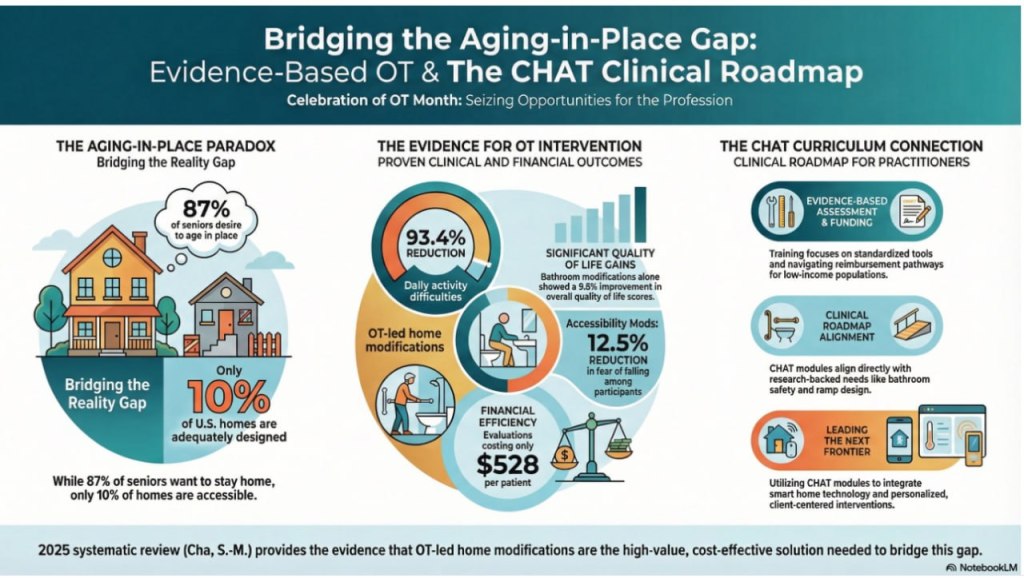
The numbers are staggering. According to the United Nations, the proportion of individuals aged 65 and older worldwide is projected to reach 16% by 2050, with some regions surpassing 25%. Meanwhile, a recent AARP study found that over 87% of adults 65 and older prefer to remain in their own homes as they age — yet U.S. Census Bureau data reveals that only 10% of American homes are adequately designed for aging populations.
That gap — between where people want to live and the environments they actually have — is precisely where occupational therapy lives. And this systematic review, conducted following rigorous PRISMA 2020 guidelines and analyzing 20 peer-reviewed studies published between 2010 and 2024, confirms what OTs in the field have observed for decades: home modifications work.
What the Evidence Actually Shows
Of the 20 studies included in the review, 13 (65%) directly confirmed the effectiveness of home modifications in fall prevention, functional independence, and cost savings. The results across these studies were compelling:
- Fall reduction: Studies consistently demonstrated significant reductions in fall rates following home modifications. One large-scale longitudinal study of 657,536 older adults in Wales tracked data across seven years and found that home adaptations reduced fall-related emergency admissions by 3% per quarter
- Fear of falling: Participants in home modification programs reported significant decreases in fear of falling — a crucial finding, because fear of falling is itself a risk factor for falls, reduced activity, and social withdrawal
- Independence in daily activities: Multiple studies showed measurable improvements in ADL performance after modifications, including one Spanish study where autonomy scores improved significantly (p = 0.003), mobility improved (p = 0.001), and home adaptation rates climbed from 45.2% to 79% following OT-led intervention
- Quality of life: Bathroom modifications and accessibility adaptations in particular showed a 9.8% improvement in quality of life scores, alongside a 12.5% reduction in fear of falling
- Caregiver impact: Studies noted reductions in caregiving burden following home modifications — a finding with profound implications for family systems and healthcare costs
- Cost-effectiveness: One program embedded within a home-based primary care practice reported a cost of just USD $528 per patient for a full home modification evaluation and implementation — a remarkably low-cost intervention given the downstream savings from prevented falls and delayed institutionalization
The Gaps — and Why They Are an OT Opportunity
Perhaps the most exciting aspect of this review for occupational therapists is not what the evidence confirms, but what it reveals is still missing. The author identified three critical, underexplored areas in current home modification research:
- Personalized, client-centered interventions — Most studies focused on population-level or standardized modifications. Few examined how tailored, occupation-focused interventions (the hallmark of OT practice) compare to generic approaches
- Smart home technologies — Emerging assistive technologies, from motion sensors to voice-activated systems to smart lighting, represent a frontier that few studies have rigorously examined in the context of aging in place
- Long-term adaptability — Most studies measured outcomes over months, not years. As the needs of aging adults evolve, how do home modifications need to adapt? This is exactly the kind of longitudinal, client-centered thinking that OT is uniquely positioned to lead
For OT professionals, these gaps are not shortcomings — they are an open invitation. Our profession’s framework — person-centered, occupation-based, environment-focused — is precisely what is needed to fill them. The Person-Environment-Occupation (PEO) model, cited directly in this study as the theoretical anchor for understanding home modification effectiveness, is the language we already speak.
Connecting the Evidence to CHAT Core Modules
For those pursuing or holding the Certified Home Accessibility Therapist (CHAT) certification, this systematic review reads almost like a clinical roadmap through the CHAT curriculum. Here is how the study’s findings align with CHAT’s core modules:
| Study Finding | CHAT Module Connection |
|---|---|
| Bathroom modifications showed the highest frequency and largest impact on QOL, reducing difficulties by 93.4% | Bathroom Safety Module — grab bar placement, shower conversions, toilet adaptations |
| Ramp installation and door widening consistently identified as critical structural modifications | Ramp Design & Structural Modifications Module — technical specifications and therapy-informed planning |
| Standardized assessment tools (SAFER-HOME, Housing Enabler, Katz ADL) used across studies to quantify outcomes | Home Safety Assessment Module — conducting thorough, evidence-based evaluations |
| 77% of modifications in the U.S. were self-funded; rural and low-income older adults modified less | Medicare Billing, Documentation & Funding Module — navigating reimbursement and funding pathways |
| Smart home technologies and personalized interventions identified as a critical research gap | Assistive Technology & Product Selection Module — matching technology to client goals |
| Interdisciplinary approaches (OT + nurses, contractors, primary care) linked to better outcomes | Collaboration & Practice-Building Module — working with contractors, families, and healthcare teams |
| Long-term, evolving needs of clients with Parkinson’s disease and cognitive decline highlighted | Serving Special Populations Module — dementia, neurological conditions, progressive disability |
The CHAT certification was built with this exact evidence base in mind — preparing occupational therapists to deliver not just modifications, but outcomes-driven, occupation-focused, clinically defensible home modification practice.
A Call to Action for OT Month
This April, as you celebrate OT Month, consider what this evidence is asking of us as a profession:
- Advocate for OT’s essential role in home modification assessment — not as a complementary service, but as the clinical standard of care
- Document outcomes rigorously; the research gaps identified in this review can only be filled by practicing OTs who collect data on their clients’ functional gains
- Expand your toolkit — whether through CHAT certification, continuing education, or community partnerships — to meet the growing demand for accessible home environments
- Educate your referral sources — physicians, discharge planners, and care coordinators — that OT home modification assessment is a high-value, cost-effective intervention backed by a growing international evidence base
The science is clear. The need is enormous. And occupational therapy — with its unique focus on person, environment, and occupation — is uniquely equipped to answer the call.
Reference
Cha, S.-M. (2025). A systematic review of home modifications for aging in place in older adults. Healthcare, 13(7), 752. https://doi.org/10.3390/healthcare13070752
 The Home Accessibility Therapist LLC
Leave a comment