When occupational therapists recommend home modifications, we often focus on the functional outcomes—improved safety, enhanced independence, reduced fall risk. But what happens after we make our recommendations? A groundbreaking qualitative study published in the March 2026 issue of the American Journal of Occupational Therapy provides crucial insights into what clients actually experience when navigating the home modification process.
The research team, led by Siobhan Galeazzi and colleagues from the University of Toronto, interviewed 31 community-dwelling adults with musculoskeletal and sensory disabilities, plus 2 caregivers, about their lived experiences implementing accessible home modifications. What they uncovered should fundamentally influence how we approach home modification practice.
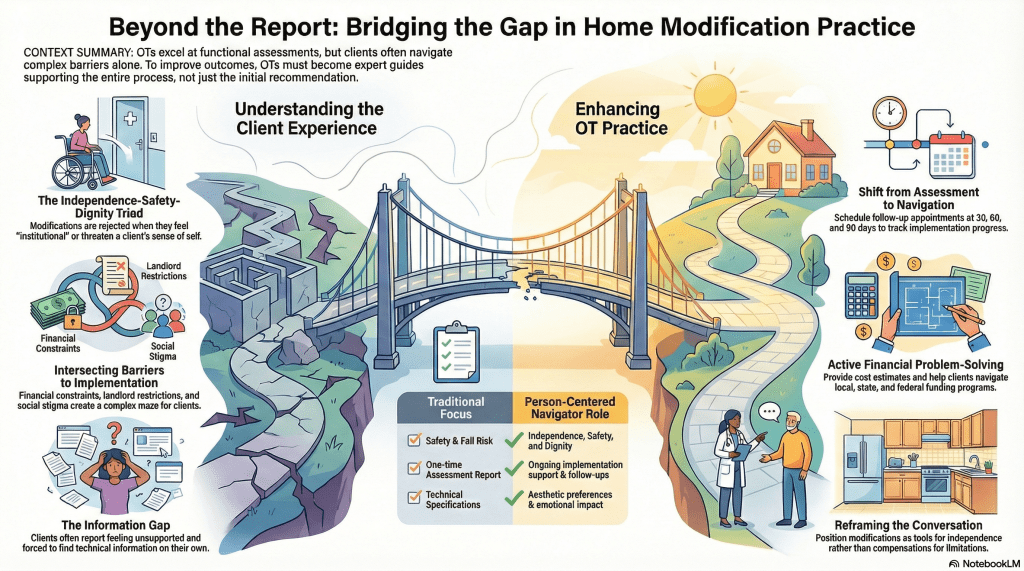
What the Research Reveals
The study employed a qualitative descriptive design with semi-structured interviews and thematic analysis, identifying four critical themes that occupational therapists need to understand:
- Impacts of unmet needs for home modifications
- Barriers to effective home modifications
- Facilitators of effective home modifications
- Outcomes and benefits of having home modifications
Central to all four themes were three interconnected concerns: independence, safety, and dignity. Participants described how structural barriers, financial constraints, and attitudinal obstacles intersect in complex ways during decision-making processes.
Perhaps most striking: participants consistently reported a lack of guidance on how to approach the home modification process. They described having to find information on their own and advocate for themselves without adequate support.
Critical Implications for Home Modification Practice
The Gap Between Recommendation and Implementation
This study highlights a troubling reality: while occupational therapists may recommend home modifications, implementation often falls entirely to clients. This creates a significant gap in service delivery. Our role cannot end with a report listing recommended modifications. Clients need ongoing support navigating what the researchers describe as a complex, multifaceted process.
What this means for your practice:
- Schedule follow-up appointments to check on implementation progress, not just functional outcomes
- Provide written resources with step-by-step guidance on finding contractors, securing funding, and managing timelines
- Consider developing partnerships with trusted contractors and vendors who understand accessibility needs
- Document barriers clients face during implementation to advocate for systemic changes
The Independence-Safety-Dignity Triad
The study found that decisions about home modifications aren’t purely functional—they’re deeply tied to how clients perceive their independence, safety, and dignity. When we frame modifications only through a safety lens (“you need this to prevent falls”), we may inadvertently threaten clients’ sense of independence and dignity.
What this means for your practice:
- Frame recommendations as tools for enhancing independence rather than compensating for limitations
- Discuss aesthetic preferences openly—modifications that clients perceive as “institutional” may be rejected
- Acknowledge the emotional weight of making permanent changes to one’s home
- Use person-centered language that emphasizes choice, control, and continued participation in valued activities
- Consider how modifications align with clients’ identity and self-concept
Financial Barriers Require Active Problem-Solving
Participants emphasized that finances played a central role in their decision-making. However, financial barriers aren’t always about total cost—they involve complex considerations including timing, prioritization, and uncertainty about what funding sources are available.
What this means for your practice:
- Develop expertise in local, state/provincial, and federal funding programs for home modifications
- Help clients prioritize modifications based on both need and financial feasibility
- Provide cost estimates for recommended modifications (work with contractors to develop typical pricing)
- Present multiple options at different price points when possible
- Connect clients with financial counselors or social workers who specialize in accessibility funding
- Advocate for expanded funding programs and policy changes that reduce financial barriers
Structural and Attitudinal Barriers Intersect
The study found that structural barriers (physical environment, building codes, landlord restrictions) and attitudinal barriers (stigma, resistance from family members, ageism) don’t exist in isolation—they interact in complex ways. A client may be physically able to install a ramp but face resistance from a homeowners’ association that views it as aesthetically undesirable.
What this means for your practice:
- Conduct thorough assessments that include social and environmental contexts, not just physical function
- Anticipate resistance from landlords, family members, or housing authorities and prepare advocacy strategies
- Educate families about the benefits of modifications using both functional and quality-of-life outcomes
- Collaborate with social workers and case managers to address systemic barriers
- Document how barriers impact occupational participation to strengthen justification letters and appeals
Expertise Matters—Including Lived Experience
Notably, 14 of the 31 participants had professional expertise related to accessible housing. These individuals likely navigated the modification process more successfully due to their knowledge. This highlights the critical importance of OT expertise in guiding clients who lack this specialized knowledge.
What this means for your practice:
- Position yourself as an expert guide throughout the entire modification process, not just during assessment
- Develop deep knowledge of accessibility standards, building codes, and universal design principles
- Pursue continuing education specifically focused on home modification practice
- Consider certification programs like the Certified Environmental Access Consultant (CEAC) or specialized home modification credentials
- Build a network of professionals (contractors, designers, occupational therapy colleagues) for consultation on complex cases
The Broader Advocacy Role
The researchers conclude that occupational therapists are “well positioned to support individuals in navigating this process and to contribute to broader advocacy efforts”. This study provides evidence that our role extends beyond individual client care into systems-level change.
Advocacy opportunities include:
- Engaging with policymakers to improve funding programs and reduce bureaucratic barriers
- Contributing to building code development and universal design standards
- Educating real estate professionals, contractors, and architects about accessibility needs
- Participating in community planning initiatives that promote aging-in-place infrastructure
- Publishing case studies and outcomes data that demonstrate the value of OT-guided home modifications
- Collaborating with disability rights organizations to address attitudinal barriers
Applying This Research to Your Practice
Here are concrete steps you can take immediately:
- Develop a “Home Modification Navigation Guide” for your clients that includes local resources, funding sources, contractor recommendations, and step-by-step processes
- Create follow-up protocols that check on implementation progress at 30, 60, and 90 days post-assessment
- Expand your assessment to explicitly ask about financial constraints, family attitudes, landlord relationships, and aesthetic preferences
- Build a resource network of contractors, funding specialists, and other professionals who can support the implementation process
- Document implementation barriers systematically to identify patterns and advocate for systemic solutions
- Reframe your recommendations using language that emphasizes independence, choice, and dignity alongside safety
Why This Study Matters
This research fills a critical gap in North American literature by centering the voices of people with disabilities who have actually navigated the home modification process. Their experiences reveal that effective home modification practice requires far more than technical knowledge of grab bar placement and doorway widths.
As occupational therapists, we must embrace a more comprehensive role that includes ongoing support, financial navigation assistance, advocacy against systemic barriers, and person-centered communication that honors clients’ needs for independence, safety, and dignity.
The study’s conclusion is clear: achieving true person-environment fit through home modifications is complex, and occupational therapists are uniquely positioned to guide clients through this complexity. The question is: are we stepping fully into this role?
Reference:
Galeazzi, S., Bacchus-Misir, F., Cohen, E., Sheppard, C., Tomasella, F., Athanasopoulos, P., Yuzwa, K. E., & Hitzig, S. L. (2026). Accessible home modification and impacts: A qualitative study. American Journal of Occupational Therapy, 80(2), 8002205110. https://doi.org/10.5014/ajot.2026.051139
What strategies have you found effective in supporting clients beyond the initial assessment? Share your experiences in the comments below.
 The Home Accessibility Therapist LLC
Leave a comment