

The call came at 8:30 on a Monday morning. Sarah’s voice was tight with frustration and worry. “Mom came home from her mastectomy two weeks ago. She’s doing okay, I think. But this morning she called me crying because she couldn’t lift her arm high enough to get her coffee mug from the cabinet. She says she can’t even make her own breakfast anymore.”
I could hear the unspoken questions behind Sarah’s words: How long will this last? What else should we expect? Why didn’t anyone prepare us for this?
Medical treatment saves lives—thank goodness for the advances in breast cancer care that have dramatically improved survival rates. But here’s what often gets lost: functional recovery doesn’t happen in the hospital or the oncology clinic. It happens at home, in the kitchen at 7 AM when you want coffee, in the bathroom when you’re trying to wash your hair, in the bedroom when you can’t fasten your own bra. And that’s where we come in.
October is Breast Cancer Awareness Month, and while pink ribbons remind us of the disease itself, I want to expand our awareness to include what happens after treatment—when breast cancer survivors come home and face the reality of daily life with changed bodies and abilities.

Understanding the Scope of Post-Treatment Challenges
The American Occupational Therapy Association released updated practice guidelines in September 2024 that firmly establish OT’s role in cancer care. And the evidence backs this up: a comprehensive meta-analysis of eight studies involving 543 breast cancer patients found that occupational therapy significantly improves quality of life across multiple domains—global health, physical health, social health, cognitive function, and fatigue.
But what does that actually mean in someone’s kitchen on a Tuesday morning?
Post-mastectomy surgery creates immediate functional limitations. Shoulder range of motion decreases. Upper extremity strength diminishes. Simple reaching movements become difficult or impossible. For women who’ve had lymph node dissection, there’s the constant concern about lymphedema and what activities might trigger it. Add chemotherapy to the picture, and you’re dealing with “chemo brain”—cognitive impacts that affect memory, task completion, and planning abilities. Then there’s fatigue, consistently cited as the most common and debilitating symptom survivors face.
But we often overlook the psychological dimensions. Body image concerns affect willingness to participate in activities. Worries about intimacy and sexuality go unaddressed. The grief of losing previous roles—the marathoner who can no longer run, the artist who can’t lift her arm to paint, the grandmother who’s afraid to pick up her grandchild—these losses are real and profound.
This is precisely where occupational therapy’s focus on meaningful activity and participation becomes invaluable. We don’t just help people move better; we help them live better.
The Home Environment Through a Survivor’s Eyes
Let me walk you through how we can assess every breast cancer survivor’s home, starting where Sarah’s mom encountered trouble that Monday morning.
In the Kitchen
The coffee mug incident is common, but it’s preventable. We can reorganize kitchens so frequently used items live at counter height or in lower cabinets—no reaching above shoulder level during early recovery. Where possible, make the switch to lightweight dishes and cookware. A standard ceramic dinner plate weighs more than you’d think when your upper body strength is compromised.
Introduce adaptive equipment: jar openers, electric can openers, and lightweight utensils. But more importantly, I teach energy conservation principles through kitchen organization. Can we arrange the workspace so that all the necessary items for breakfast are in one area, minimizing the need for movement? Can we add a stool so meal prep happens sitting down?
And here’s what many therapists miss: teach one-handed techniques not because the arm is paralyzed, but because using it may be inadvisable during certain recovery phases. Show someone how to open a jar, crack an egg, or dice vegetables one-handed, and you’ve given them independence during a time when they desperately need it.
In the Bathroom
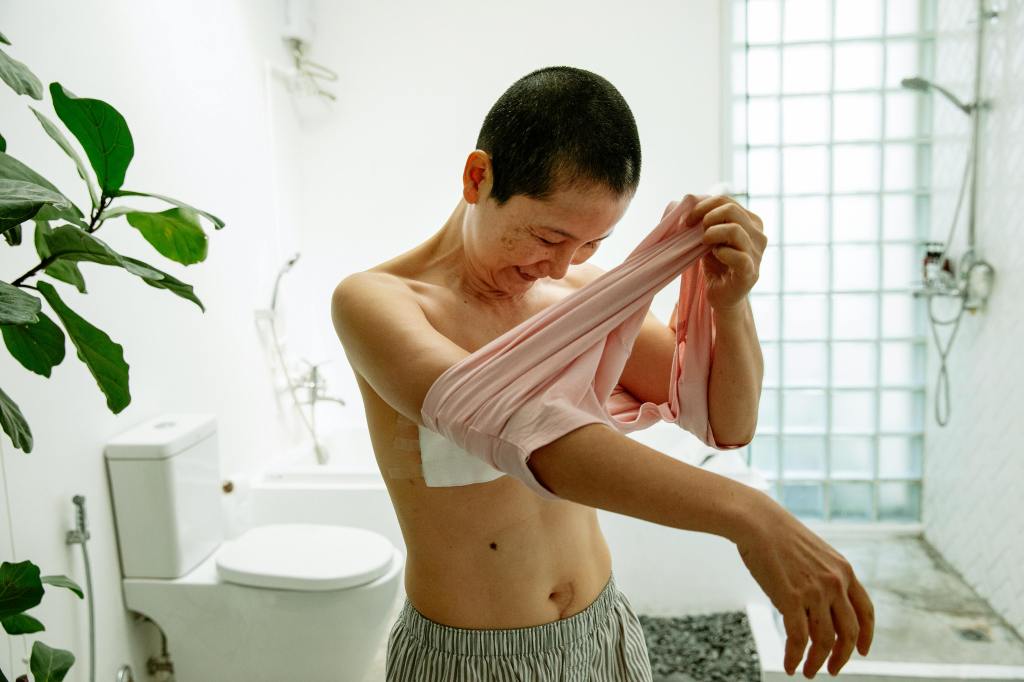
Post-surgical dressing is its own challenge. I recommend front-closure bras exclusively during recovery—no reaching behind the back. Button hooks and sock aids aren’t just for stroke patients; they’re essential for anyone with limited shoulder mobility. A long-handled shoe horn prevents the forward flexion that pulls on surgical sites.
Shower modifications go beyond the standard grab bars. A handheld showerhead allows washing without raising arms overhead. A shower chair addresses the fatigue that hits midway through what used to be a simple task. Long-handled sponges and brushes extend reach without strain.
Hair care deserves special attention. Women undergoing chemotherapy often struggle with hair loss, and those who aren’t may still find it difficult to wash, dry, and style hair when they can’t lift their arms. Lightweight hair dryers, hair dryer stands, adaptive brushes with extended handles, and simpler hairstyles become important adaptations.
In the Bedroom
Bed height matters enormously when core and upper body strength are compromised. Too low, and transfers become difficult. Too high, and getting into bed requires more arm strength than many survivors have. Positioning pillows properly for lymphedema management during sleep requires education—most people don’t intuitively understand elevation principles.
Clothing modifications extend beyond bras. Elastic waistbands replace buttons and zippers. Front-closure garments become standard. Magnetic closures offer a middle ground for people who want to maintain their previous style while accommodating new physical limitations.
And we reorganize closets and dressers to minimize reaching, bending, and stretching. If your client’s favorite sweater requires standing on tiptoe and reaching to the top shelf, she’s not going to wear it—even if she physically could manage it. Make it accessible, and you restore both function and dignity.
Addressing “Chemo Brain” in Daily Routines
When I talk about cognitive function with breast cancer survivors, I see relief wash over their faces. “I thought I was going crazy,” they often say. “I couldn’t remember simple things. I’d start tasks and forget what I was doing.”
The research shows that occupational therapy significantly improves cognitive function in breast cancer patients. But here’s what that looks like practically:
External memory aids become essential. I set up medication organizers—not just for medications, but for supplements and vitamins that are often part of cancer recovery protocols. We program phone alarms for appointments, medication times, and even reminders to eat and drink water (appetite and thirst cues often diminish during treatment).
Visual checklists transform overwhelming tasks into manageable steps. Morning routine feeling impossible? We break it into six steps, write them on a laminated card, and post it in the bathroom. Suddenly the fog of “I don’t know what to do” lifts.
Environmental cues support memory without adding cognitive burden. We label drawers and cabinets. We use color-coding systems for different types of items. We place objects where they’ll be needed—the water bottle next to the pill organizer, the phone charger by the bed.
Task simplification is an art. Can we reduce a complex recipe to three steps? Can we batch-prepare simple meals on high-energy days for low-energy days later? Can we establish predictable routines that reduce the number of decisions required each day?
And critically, we help survivors understand that these cognitive changes often improve after treatment ends, but they’re real in the moment. Validating the experience while providing concrete strategies makes an enormous difference.
Energy Conservation: The Foundation of Everything
Sarah’s mom couldn’t make breakfast not just because of the cabinet height—she was exhausted from the effort of getting dressed. This is where energy conservation becomes foundational to every other intervention we make.
The meta-analysis found that occupational therapy significantly reduces fatigue in breast cancer patients. Here’s how we do it.
I teach the Four P’s of Energy Conservation:
Planning: We identify high-priority activities (what matters most?) and schedule them during peak energy times, usually mid-morning for most people. Rest periods aren’t optional; they’re prescription.
Pacing: Breaking tasks into manageable segments prevents the boom-and-bust cycle where someone does too much on a good day and pays for it with three bad days. Can we do laundry in stages throughout the week instead of one exhausting Saturday marathon?
Positioning: Proper body mechanics and choosing sitting over standing whenever possible conserves significant energy. I assess every regular task: Can it be done sitting? Can the work surface be brought to the person instead of the person going to the work surface?
Permission: This might be the most important P. I explicitly give clients permission to ask for help, to say no, to modify expectations—their own and others’. The perfectionist who’s always hosted elaborate dinner parties needs permission to order takeout or accept help from others.
We develop “good day” and “bad day” routines. On good days, certain activities are feasible. On bad days, we have a simplified routine that maintains essentials without depleting limited energy reserves. This prevents the guilt and disappointment that comes from feeling like every day should be a good day.
The Psychological Dimensions We Can’t Ignore
The research shows that occupational therapy improves global health, social health, and role function in breast cancer survivors. Interestingly, improvements in emotional health approached but didn’t quite reach statistical significance—which tells me we need to do more in this area.
Body image changes profoundly affect participation. A woman who’s had a mastectomy may avoid activities that require changing clothes around others, even in private gym locker rooms. She may refuse to swim, though swimming would be excellent exercise. She may skip physical therapy appointments because the clinic gown makes her self-conscious.
I address this by normalizing the feelings while problem-solving the barriers. Adaptive clothing that provides coverage and comfort. Private exercise options. Prostheses and post-surgical garments fitted properly. These aren’t vanity concerns; they’re participation barriers that occupational therapists can help remove.
Fear of lymphedema sometimes creates more disability than lymphedema itself. Women become afraid to use their affected arm at all. I provide education about actual risk factors, teach appropriate precautions, and encourage normal use within guidelines. The goal is informed caution, not paralysis.
Loss of role identity cuts deep. “I used to be the one who took care of everyone” is something I hear repeatedly. Redefining roles and finding new ways to contribute becomes part of the therapeutic process. Maybe she can’t cook the entire Thanksgiving dinner, but she can guide others in making her signature dish. Maybe she can’t garden on her knees for hours, but raised beds allow continued connection to this meaningful activity.
Social isolation happens gradually. First, she cancels one coffee date because she’s tired. Then she stops accepting invitations because explaining her limitations feels exhausting. Before long, the phone stops ringing. Our interventions need to specifically support social connection—ensuring homes can accommodate visitors comfortably, setting up technology for video calls with distant family, adapting shared activities so participation remains possible.
Practical Tools: Room-by-Room Modification Checklist
Here’s what I now assess in every breast cancer survivor’s home:
Kitchen:
- ✓ Frequently used items at shoulder height or below
- ✓ Lightweight dishes and cookware readily available
- ✓ Adaptive equipment provided (jar openers, electric appliances, easy-grip utensils)
- ✓ Seating available at appropriate work surfaces
- ✓ One-handed techniques taught as needed
Bathroom:
- ✓ Front-closure adaptive clothing accessible
- ✓ Dressing aids provided (button hooks, sock aids, long-handled shoe horn)
- ✓ Shower modifications (handheld showerhead, long-handled sponge, shower chair)
- ✓ Hair care tools adapted for limited ROM/strength
- ✓ Task lighting for grooming and medication management
Bedroom:
- ✓ Bed height appropriate for transfers given upper body limitations
- ✓ Positioning pillows for lymphedema management
- ✓ Front-closure sleepwear and clothing at easy access
- ✓ Adequate lighting for nighttime safety without requiring reaching
Living/Work Spaces:
- ✓ Computer/workspace ergonomically arranged for energy conservation
- ✓ Cognitive aids in place (calendars, checklists, reminder systems)
- ✓ Seating supports proper positioning and energy conservation
- ✓ Temperature control easily accessible (treatment affects thermoregulation)
General Throughout Home:
- ✓ Energy conservation principles taught and activity modifications implemented
- ✓ Client demonstrates understanding of lymphedema precautions
- ✓ Family/support system educated on role in recovery
- ✓ Mental health referral offered or completed if indicated
This checklist isn’t comprehensive—every client’s needs differ based on their specific treatment, complications, and valued activities. But it provides a starting framework that goes beyond standard home safety assessments.
Moving Forward
Let’s revisit Sarah’s mom three weeks after that Monday morning phone call. The transformation was remarkable—and modest. The kitchen was reorganized. Lightweight dishes had replaced heavy ceramic. A small bistro table near the counter provided a work surface at the right height. She’d learned to use a reacher not just for dropped items but for accessing higher cabinets on good days.
But more than the equipment, her outlook had changed. “I’m not trying to be who I was before,” she told me. “I’m figuring out who I am now, and what I can do now.” She was making breakfast again—not the elaborate spreads she used to prepare, but simple, nourishing meals she could manage independently.

The research is clear: occupational therapy improves quality of life for breast cancer survivors across multiple domains. But the real story isn’t in the statistics—it’s in the coffee mug retrieved from an accessible cabinet, the shower taken independently, the hobby resumed with modifications, the family dinner participated in with adapted contributions.
This October, as pink ribbons remind us of breast cancer awareness, let’s expand our awareness to include functional recovery. Let’s recognize that occupational therapy’s role in cancer care isn’t auxiliary—it’s essential. Let’s ensure that when survivors come home, they have the support they need not just to survive, but to participate meaningfully in the lives they’re fighting to preserve.
And let’s start those conversations earlier. Not after someone’s crying over a coffee mug, but during treatment planning. Not as an afterthought to medical care, but as an integral part of comprehensive cancer support.
Because survival is about more than living. It’s about living well.
(Sarah’s mom is a composite of patients treated by this therapist and clinical roles for occupational therapy.)
References
- Robin M. Newman, Katie M. Polo, Yasaman Amanat, Claudine Campbell, Anne Fleischer, Stacey Morikawa; Occupational Therapy Practice Guidelines for Adults Living With and Beyond Cancer. Am J Occup Ther September/October 2024, Vol. 78(5), 7805397010. doi: https://doi.org/10.5014/ajot.2024.078501
- Pergolotti, M., Williams, G. R., Campbell, C., Munoz, L. A., & Muss, H. B. (2016). Occupational Therapy for Adults With Cancer: Why It Matters. The oncologist, 21(3), 314–319. https://doi.org/10.1634/theoncologist.2015-0335
- He, K., Jiang, J., Chen, M., Wang, T., Huang, X., Zhu, R., Zhang, Z., Chen, J., & Zhao, L. (2023). Effects of occupational therapy on quality of life in breast cancer patients: A systematic review and meta-analysis. Medicine, 102(31), e34484. https://doi.org/10.1097/MD.0000000000034484
- DiSipio, T., Rye, S., Newman, B., & Hayes, S. (2013). Incidence of unilateral arm lymphoedema after breast cancer: a systematic review and meta-analysis. The Lancet. Oncology, 14(6), 500–515. https://doi.org/10.1016/S1470-2045(13)70076-7
- Loh, S. Y., & Musa, A. N. (2015). Methods to improve rehabilitation of patients following breast cancer surgery: a review of systematic reviews. Breast cancer (Dove Medical Press), 7, 81–98. https://doi.org/10.2147/BCTT.S47012
- American Cancer Society. (2024). Breast Cancer Facts & Figures 2023-2024. Atlanta: American Cancer Society, Inc.
 The Home Accessibility Therapist LLC
Leave a comment