The holiday season should be a time of joy and connection for all family members, including older adults and individuals with disabilities. Yet traditional holiday environments—with their decorative obstacles, temporary furniture arrangements, and activity-filled spaces—can create significant accessibility challenges that limit participation for those with mobility impairments, sensory needs, or functional limitations. As occupational therapists specializing in home modifications, we have a unique opportunity to guide families in creating inclusive holiday spaces that enable full participation while maintaining safety and dignity.
The Occupational Impact of Inaccessible Holiday Environments
Research demonstrates that home modifications significantly improve occupational participation and quality of life for individuals with disabilities. One study exploring occupational changes after moving into a newly modified accessible home identified three major themes: accessibility (physical access to spaces), opportunity (social and emotional engagement enabled by access), and relief (reduced stress for both the individual and family members) (Healio, 2019).
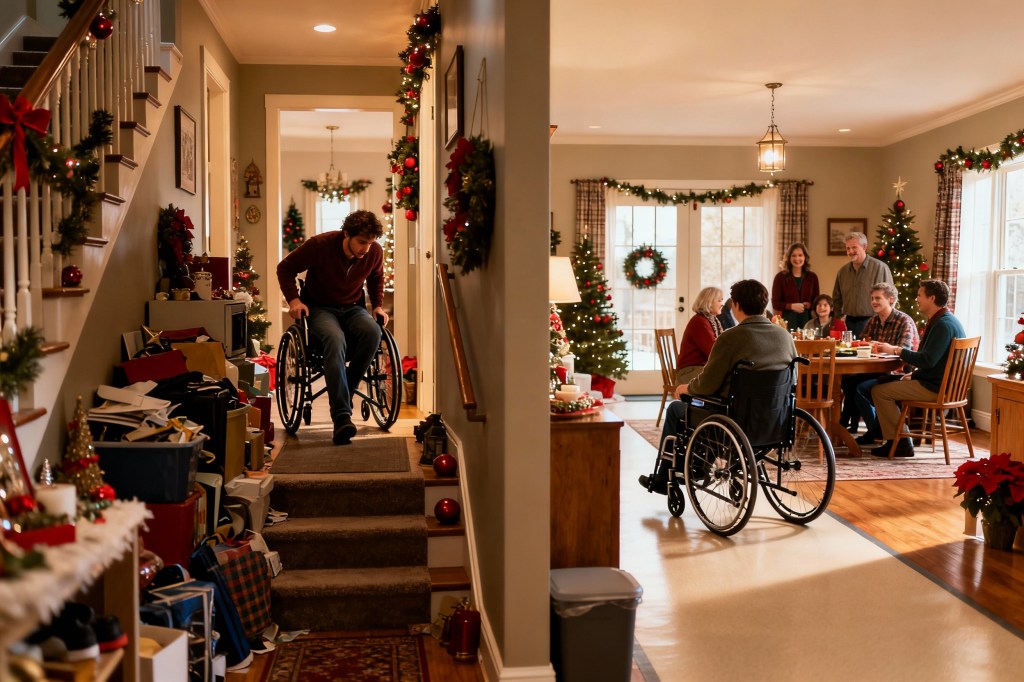
These findings have direct implications for holiday gatherings. When family members with mobility challenges cannot physically access holiday spaces—whether due to narrow doorways, steps without ramps, inaccessible bathrooms, or cluttered pathways—they experience more than physical barriers. They face social exclusion, emotional distress, and loss of valued occupational roles like cooking, hosting, and engaging with family members.
The holidays intensify these challenges. Homes that may be marginally accessible during routine daily life become significantly less accessible when filled with extra furniture, decorations, serving tables, and guests. Individuals who can usually compensate for environmental barriers may find their strategies overwhelmed during the complex sensory and physical demands of holiday gatherings.
Evidence-Based Entrance Modifications
The entrance sets the tone for accessibility throughout the home. Research on home modifications emphasizes that entrance accessibility is fundamental to enabling participation in all other home activities (Custodia, 2025; HUD, 2014).
Width and Clearance: Ensure entrances are at least 32 inches wide to accommodate wheelchairs and walkers. This may require removing seasonal decorations, planters, or furniture temporarily placed near doorways. Measure clearance with mobility devices present—what appears adequate empty may be too narrow when a person approaches in a wheelchair.
Threshold and Step Solutions: Even small thresholds can prevent wheelchair access or create tripping hazards. Temporary threshold ramps (available in various heights and materials) provide cost-effective solutions for holiday visits. For outdoor steps, portable ramps with slip-resistant surfaces enable access while protecting against falls in rain or ice. Ensure ramps have appropriate slope (1:12 ratio for wheelchair access) and secure placement.
Lighting and Visibility: Install motion-detecting lights at entrances to provide automatic illumination during dark winter evenings. This modification benefits all guests but is particularly important for those with vision impairments or balance challenges. Consider the dramatic reduction in daylight hours during winter when planning entrance lighting (Custodia, 2025).
Handrails and Support: If stairs are unavoidable, ensure sturdy handrails are present on both sides, extending beyond the top and bottom steps. Handrails should be easy to grip and securely mounted to support full body weight.
Kitchen Accessibility for Holiday Meal Participation
The kitchen becomes the heart of holiday activity, and exclusion from this space can be particularly isolating for individuals who value cooking and food preparation roles. Evidence-based kitchen modifications enable continued participation in these meaningful occupations.
Counter and Work Surface Access: Lower a section of countertop to 28-34 inches to accommodate wheelchair users, or provide a sturdy, accessible table at appropriate height for food preparation. Ensure adequate knee clearance (27 inches high, 30 inches wide, 19 inches deep) beneath work surfaces. Even for standing users with balance challenges, providing a tall stool at counter height enables participation while conserving energy and reducing fall risk.
Storage and Reach Considerations: Place frequently needed items—dishes, serving platters, cooking utensils—within easy reach (no higher than 48 inches from floor for wheelchair users). Install pull-out shelves in lower cabinets to eliminate bending and reaching into deep spaces. Lazy Susans in corner cabinets improve access to stored items.
Flooring Safety: Use non-slip mats in high-traffic areas and in front of the sink and stove where water or grease may create slipping hazards. Ensure mats have beveled edges to prevent tripping. During busy holiday cooking, promptly clean up spills and remove obstacles from walking paths (Custodia, 2025).
Adaptive Equipment Integration: Ensure adequate electrical outlets at accessible heights for adaptive equipment like electric can openers, food processors, or other assistive devices. Plan counter space for equipment setup so users don’t need to repeatedly move heavy items.
Bathroom Safety and Accessibility
Bathroom accessibility is essential for guest comfort and safety, yet often overlooked in holiday preparation. Evidence shows that bathroom modifications—particularly grab bars—are among the most effective fall prevention interventions for older adults.
Grab Bar Placement: Install grab bars near the toilet (side and/or behind) and in the shower or bathtub. Horizontal bars should be mounted 33-36 inches from the floor; vertical bars provide additional support for various transfer techniques. Ensure grab bars are properly installed into wall studs or backing boards—decorative towel bars are not adequate substitutes and can fail under weight, causing falls.
Transfer Space and Maneuvering: Provide adequate clear floor space (30×48 inches minimum) for wheelchair transfers at the toilet and sink. Remove or relocate bathroom furniture, decorative items, or storage that impedes maneuvering. Consider temporarily removing bathroom rugs that create tripping hazards or interfere with wheelchair/walker movement.
Shower Access: For guests who require shower accessibility, consider temporary solutions like transfer benches (for tub showers) or shower chairs (for roll-in or low-threshold showers). Handheld showerheads mounted on sliding bars provide flexibility for various users. Non-slip mats or adhesive strips inside tubs and showers are essential fall prevention tools (Custodia, 2025).
Hardware Modifications: Replace standard door knobs with lever handles, which are easier to operate for individuals with arthritis, reduced hand strength, or limited dexterity. This modification also benefits users carrying items or using mobility aids.
Living and Gathering Space Adaptations
Living rooms and dining areas become social hubs during holidays. Thoughtful modifications ensure these spaces accommodate all family members.
Furniture Arrangement for Circulation: Create wide, clear pathways (minimum 36 inches, preferably 42-48 inches for wheelchair turning radius) through living and dining areas. Remove occasional tables, plant stands, or decorative items that narrow paths. Arrange furniture to allow wheelchair users to join conversational groupings rather than being isolated at the periphery.
Seating Considerations: Provide chairs with appropriate seat heights (17-19 inches for most adults), firm cushions, and armrests to assist with sitting and standing transfers. Avoid low, soft sofas that make transfers difficult. Ensure adequate space around seating for maneuvering mobility devices. Consider renting or borrowing appropriate seating if your current furniture is not accessible (Custodia, 2025).
Table Access: Ensure dining tables have adequate knee clearance (27 inches high minimum) for wheelchair users. Pedestal tables or tables with legs at the corners provide better wheelchair access than tables with center supports or aprons. Set the table to leave clear wheelchair access spaces rather than placing chairs at every position.
Lighting Optimization: Layer lighting to provide adequate illumination without glare. Add task lighting for specific activities (reading, games, crafts) and ambient lighting for general visibility. Smart lighting systems with voice control or remote operation enable users with mobility limitations to adjust lighting without physically accessing switches (Custodia, 2025).
Accessible Holiday Decorating Principles
Holiday decorations can create both atmosphere and obstacles. Applying accessibility principles to decorating ensures safety without sacrificing festivity.
Height and Placement: Place decorations where they can be appreciated without creating barriers—on walls, mantels, or high shelves rather than floor level where they obstruct pathways or create tripping hazards. Ensure decorations don’t hang at face level for wheelchair users or create visual obstacles at transfer points.
Electrical Safety: Secure extension cords along baseboards or under rugs (with appropriate cord covers) rather than across walking paths. Use outlet extenders and power strips to reduce the number of cords crossing floors. Consider battery-operated decorations in areas where cords would create hazards (Custodia, 2025).
Sensory Considerations: For individuals with sensory processing challenges, provide quieter spaces with reduced stimulation where they can retreat when overwhelmed. Consider the impact of flashing lights, strong scents from candles or air fresheners, and background music volume on guests with sensory sensitivities.
Fire Safety: Ensure decorations don’t block exits, smoke detectors, or fire extinguishers. Battery-operated candles provide ambiance without fire risk—particularly important when individuals with mobility limitations might not be able to evacuate quickly.
Temporary vs. Permanent Modifications
Many families face the question: should we make temporary accommodations for holiday visits or invest in permanent modifications?
Temporary Solutions: Threshold ramps, portable grab bars with suction mounts, removable raised toilet seats, temporary lighting, and furniture rearrangement provide cost-effective solutions for occasional visits. These options work well when the visiting individual has different needs than the primary resident, or when trying modifications before making permanent changes.
Permanent Modifications: For families who regularly host the same individuals, or when residents themselves have accessibility needs, permanent modifications provide better long-term solutions. Properly installed grab bars, lever door handles, wide doorways, and accessible bathrooms add home value and benefit all users through principles of universal design (HUD, 2014).
Progressive Approach: Consider implementing high-impact, permanent modifications first (grab bars, lever handles, improved lighting) while using temporary solutions for less critical needs. This approach spreads costs while immediately addressing safety priorities.
Building Your Accessible Home Modification Practice
The holiday season presents a natural opportunity to engage families in conversations about accessibility and home modifications. Adult children visiting aging parents often notice accessibility challenges that have developed gradually. Holiday gatherings that highlight participation barriers can motivate families to seek professional assessment and intervention.
As occupational therapists with expertise in home modifications and accessibility, we can provide comprehensive services including pre-holiday home assessments, modification recommendations tailored to specific family needs and budgets, vendor referrals for installation services, and education on universal design principles that benefit all users.
Consider developing holiday-specific service packages, educational workshops on creating accessible celebrations, and partnerships with contractors who can implement recommended modifications. By positioning yourself as the expert resource for accessible holiday planning, you expand your practice while ensuring that all individuals can fully participate in this meaningful season.
References
Custodia. (2025). Accessible holiday home modifications for seniors. https://custodia.com/accessible-holiday-home-modifications-for-seniors/
Healio. (2019). Effect of home modifications on the occupational participation of a family. OT Practice, 24(19), CE1-CE7. https://doi.org/10.3928/24761222-20191018-03
U.S. Department of Housing and Urban Development. (2014). Retrofits & adaptations: Improving mobility in the home. HUD User. https://www.huduser.gov/portal/portal/sites/default/files/pdf/Retrofits-Adaptations-Improving-Mobility-in-the-Home.pdf
 The Home Accessibility Therapist LLC
Leave a comment